A zero-cost bus shelter programme works when the city grants a media operator the exclusive right to sell advertising on shelters for a fixed term — typically 8–15 years — in exchange for the operator funding, installing and maintaining the shelters. The city's cost becomes contract management, not capital expenditure. Success depends on tendering the advertising revenue correctly, not the shelter hardware.
For a city transport officer or estates manager, an advertising concession is not a marketing idea — it is a procurement structure with its own tender documents, revenue assumptions, risk allocations and exit conditions. Get the structure right and the city receives new shelters, real-time information screens and a revenue share without touching its capital budget. Get it wrong and the city ends up with ageing assets, an operator who has stopped maintaining them, and a contract that is expensive to exit. This guide sets out what a city authority must decide, document and verify before signing a shelter concession.
What must the city fix before tendering a concession?
Three numbers decide whether a concession is viable, and all three must be fixed in the pre-tender data pack — not left for bidders to assume: annual passenger boardings per site, the estimated gross advertising revenue per site, and the city's minimum acceptance standard for the asset. If the city cannot state these, bidders will price conservatively and the city will receive fewer shelters than the footfall justifies.
Pre-tender data item | What the city must document | Why it decides the deal | Consequence if left open |
Site inventory | Number of eligible stops, footfall estimates, utility access, planning constraints | Revenue is a function of traffic, not shelter count | Bidders cherry-pick profitable sites; marginal areas get nothing |
Gross revenue estimate | Indicative monthly gross ad revenue per site class (A/B/C sites) | Basis for the revenue-share bid | Without it, the floor price in the tender is guesswork |
Asset acceptance standard | Dimensions, glazing type, LED screen class, accessibility compliance | Defines what "free" actually means | Operators deliver minimum-spec shelters in year 3 |
Maintenance obligation | Response times, cleaning frequency, spares availability | 60–70% of operator cost sits here | Shelters deteriorate; city has no contractual remedy |
Term and exit | Concession length, hand-back condition, buy-out formula | Determines whether the city can recover control | End-of-term assets stranded with no hand-back clause |
Planning consent | Whether the city or operator secures heritage/highway approvals | Consent risk is priced into every bid | Bid prices inflated by 15–30% to cover unknown consent risk |
YEROO supplies the asset-side half of this pack — dimensional drawings, LED screen specifications, coating and glazing specs, and production capacity documentation — so the city can issue a technically anchored tender rather than a hardware wish list. Request the specification pack via YEROO's bus shelter range.
Which revenue-share model should the tender use?
There is no single "concession model" — there are four, and they shift risk between the city and the operator very differently. The city should choose the model before it chooses the operator, because the model determines what bidders will offer.
Model | Who pays capital | Revenue to city | City risk | Best when |
Pure capital purchase | City (budget) | None | Low — city owns everything | Budget exists and speed matters |
Revenue share, operator-funded | Operator | 20–50% of gross (indicative global range) | Operator revenue shortfall | Footfall is proven and ad demand exists |
Guaranteed minimum + share | Operator guarantees a floor payment to city | Floor fee + % above threshold | Low — city gets paid even in downturn | City wants predictable income |
Hybrid: city funds structure, operator funds screens/maintenance | Shared | Higher % share, smaller base | Split | City wants ownership but not full cost |
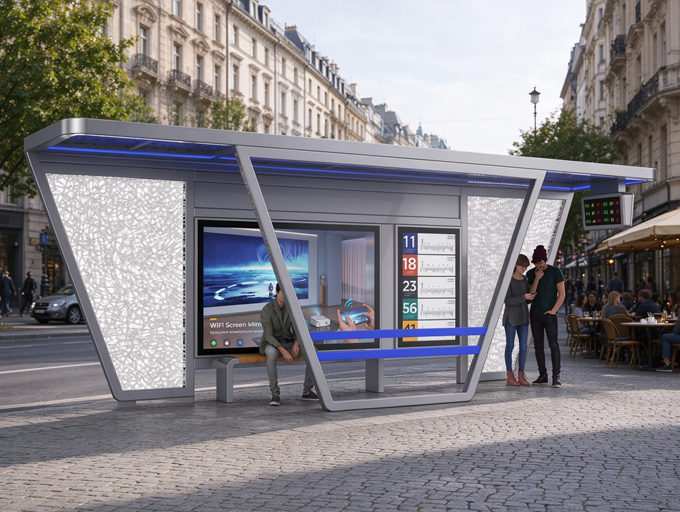
The definitive judgement: if annual boardings exceed roughly 1,500 per site on a main corridor and the city has no in-house media sales capability, tender a revenue-share model with a guaranteed minimum payment. The guaranteed minimum is the single most important clause in the contract — it converts the city's advertising risk into the operator's problem, which is where it belongs, because the operator controls the sales effort. Cities in Spain, Mauritius and Guam have used precisely this structure with YEROO shelter assets carrying digital advertising screens, as in the Mauritius high-impact advertising hub project and the Guam storm-resilient shelter with revenue-generating advertising.
What must the tender require from shelter manufacturers?
In a concession, the operator buys the hardware, so the city's only lever is the technical annex of the tender. If the annex is silent on a component, the operator will buy the cheapest version that satisfies no one in year 4. Every line in the annex should name a standard or a measurable parameter — "high quality stainless steel" is not a tender clause.
Component | Minimum clause the city should write | Evidence to demand |
Structure | Hot-dip galvanised steel to ISO 1461, or 304/316L stainless where ISO 9223 corrosivity category is C4+ | Mill certificates, coating thickness test reports |
Glazing | Tempered glass to EN 12150-1 (or equivalent national standard) | Glass test certificates per batch |
LED screen | IP65 minimum, ≥1,500 nits brightness for daylight legibility, remote brightness control | IEC test reports, sample unit demonstration |
Power | Grid connection design, or solar array sized to published irradiance data | Electrical drawings, solar sizing calculation |
Coating finish | Polyester powder coat ≥80μm over galvanising, Qualicoat-class | Powder brand declaration, thickness measurement |
Accessibility | Compliant with the city's national standard (e.g. UK DfT Inclusive Mobility, US PROWAG/ADA) | Dimensioned drawings showing clearances |
Wind rating | Designed to the site's code wind load (e.g. EN 1991-1-4 in Europe) | Structural calculation signed by a chartered engineer |
Require pre-approval of shop drawings before fabrication. A drawing pre-approval stage costs the programme two to three weeks; omitting it costs the city a shelter that does not fit its highway clearance rules, discovered after delivery. YEROO issues dimensioned GA drawings, structural calculations and material certificates with every project package, and city reviewers can verify manufacturing capability before award through the factory verification checklist for shelter buyers.
How should the city score bidders?
Concession tenders fail in evaluation more often than in delivery, because cities weight the revenue bid too heavily. An operator who bids the highest revenue share and the lowest maintenance commitment will underperform on every metric except the one the city measured. Score on a weighted matrix that forces bidders to prove delivery capability, not just promise revenue.
Criterion | Suggested weight | What a strong bidder shows |
Revenue bid (share + guaranteed minimum) | 30% | Modelled assumptions per site class, not a flat percentage |
Asset specification compliance | 20% | Line-by-line technical annex response with certificates |
Maintenance and response plan | 20% | Named spares stock, response times, penalty acceptance |
Manufacturing and delivery track record | 15% | Reference projects with photos, factory audit or verified inspection report |
Financial capacity | 10% | Audited accounts, funding letter, no single-project balance sheet |
Exit and hand-back plan | 5% | Written hand-back condition schedule and asset register format |
Insist on a factory verification right as a condition of award: the city, or its engineer, may audit the nominated shelter manufacturer before the first unit ships. For the operator, that means the manufacturer's capacity, certifications and quality system must survive inspection — the reason the bus shelter specifications checklist for procurement officers should be attached to the concession annex and applied to the operator's nominated supplier. YEROO, as an ISO 9001-certified OEM/ODM manufacturer with a 31,000 m² facility and delivery experience in 109 countries including Hungary, Romania and Iceland, provides the audit package: certificates, production-line access and reference project contacts.
How does the shelter integrate with the city's data platform?
In a concession, the smart-city layer is a contract term, not a product feature. The city must specify, in the tender, what data the assets must expose and who owns it — otherwise the operator owns the data feeds and the city pays to access its own infrastructure.
Write these four clauses into every smart shelter concession:
Open data interfaces. Real-time bus arrival feeds (GTFS-RT or the city's national standard) must display on screens and be readable by the city's platform without per-query licence fees.
Asset data obligations. Each shelter reports operational status (screen health, power, temperature, door/vandalism alarms) to the city's asset management system in a documented format.
City ownership of asset data. Advertising performance data belongs to the operator; infrastructure condition data belongs to the city. State the split explicitly.
Interoperability at hand-back. At term end, screens, sensors and controllers must be replaceable without proprietary lock-in, and the city receives the full as-built drawing set and controller credentials.
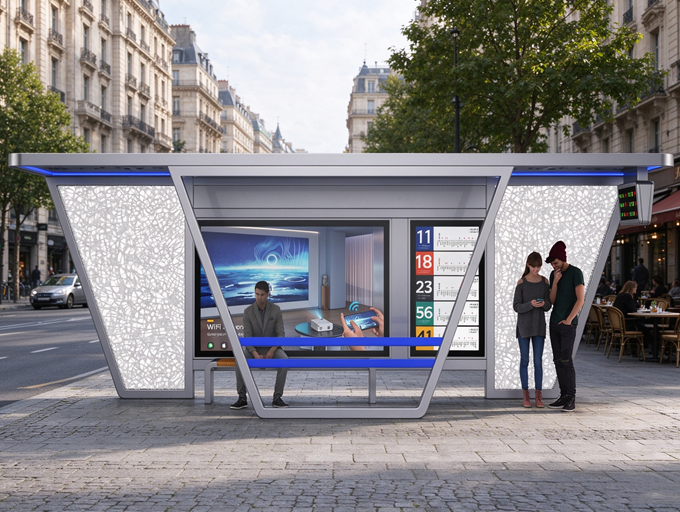
If the city already runs a smart transit platform, require the operator's nominated manufacturer to demonstrate an integration — not a datasheet. The smart bus shelter solution used on YEROO's Hungary and Spain projects exposes real-time information and screen status to the city's platform, and the Hungary smart shelter with LED display is a referenceable integration case.
What does getting the concession wrong cost?
The failure modes of shelter concessions are well documented across the industry, and each has a corrective cost that the city — not the operator — usually ends up paying in political capital or unplanned budget.
Mistake | Typical trigger | Corrective cost (indicative) |
No guaranteed minimum in revenue-share model | Ad market downturn; operator stops paying | Lost revenue for remaining term; renegotiation legal fees |
Technical annex silent on spec | Operator procures minimum-grade hardware in years 3–8 | Refurbishment at city's cost: tens of thousands per site class |
No maintenance response times | Dirty, broken shelters visible to voters | Emergency city-funded cleaning contracts; reputational damage |
No hand-back condition schedule | Assets returned degraded at term end | City funds full replacement programme |
Consent risk left with bidder pricing | Inflated bids or abandoned marginal sites | programme shrinks 20–40% below plan |
No data ownership clause | City pays to access its own asset data | Annual licence fees; platform integration rework |
The single highest-value control is the asset register and spares clause: require the operator to maintain a live asset register (location, model, serial numbers, installed components) and to hold critical spares — glazing panels, LED modules, control boards — locally, with replacement times written into the contract. 【YEROO DATA NEEDED: standard spares-holding policy and typical replacement lead times for concession projects】. Without this, a broken screen on a flagship site stays broken for the length of an international shipping cycle, and the city's "free" shelter becomes a visible liability.
Frequently asked questions
How long should a bus shelter advertising concession last?Eight to fifteen years is the workable range. Below eight years the operator cannot recover the capital cost of digital screens; above fifteen years the hardware will be obsolete while the contract still runs. Write a mid-term technology refresh obligation (e.g. screens reviewed at year 6–7) into the contract rather than extending the term.
Does the city really pay nothing in a zero-cost shelter programme?The city pays no capital cost, but it pays in three currencies: exclusive use of its advertising space for the term, contract management staff time, and planning/consent administration. A realistic budget line for programme management is required even in a fully operator-funded model.
What percentage of advertising revenue should a city receive?Indicative global ranges run from roughly 20% of gross in fully operator-funded models to over 50% in hybrid models where the city funds part of the asset. The correct number is set by competitive tender — the city's job is to publish accurate footfall and site data so bidders compete on real assumptions, not to fix the percentage in advance.
Who owns the shelters at the end of the concession?Whatever the contract says — so the contract must say it explicitly. The default the city should write: all assets transfer to the city at hand-back in the defined hand-back condition (structural soundness, working screens, cosmetically maintained), with a defect rectification period before final acceptance.
Can a concession include solar and real-time information displays?Yes, and it should. Specify the solar array sizing method, battery autonomy days (typically 3–5 for information-only loads) and the data interface standard in the technical annex, so the operator's supplier designs to the city's requirements rather than the operator's margin.
What if no operator bids for the smaller sites?Bundle sites into a single concession with cross-subsidy required: the operator must deliver the full network, including low-revenue sites, priced against the profitable corridors. Splitting the tender into "attractive" and "unattractive" packages guarantees the unattractive sites are never built.
Conclusion: ask for the tender-ready package, not a brochure
A zero-cost shelter programme is won or lost in the tender documents. The city that arrives at market with a fixed site inventory, a technically anchored annex, a chosen revenue model and a supplier verification right will receive competitive bids and a contract it can enforce. YEROO supports city authorities and their concession operators directly with the documents the tender needs: dimensioned specification packs per shelter model, material and glazing certificates, structural calculation packages, LED screen technical files and itemised quotations against the city's own bill of quantities. Send YEROO your site schedule and technical annex draft, and receive a tender-ready quotation and compliance document set within 【YEROO DATA NEEDED: standard quotation turnaround for concession tenders】 — start at https://www.yeroo.com/contact.
Related reading: how bus shelters are made inside YEROO's 31,000 m² manufacturing facility · bus shelter cost breakdown: what drives pricing in 2026 · YEROO bus station project cases










 Address:North Tower 904,New World Times Center,Guangyuan Dong Road ,Guangzhou,China
 Phone: +86 13826225776
 Email:yeroo10@3dyeroo.com


