An advertising-funded bus shelter network is procured through a concession or build-operate-transfer contract in which the operator funds, installs and maintains shelters in exchange for advertising revenue rights. The buyer — whether a media operator bidding for a concession or a city authority awarding one — must set minimum footfall, advertising asset and handback terms in the tender before any unit is ordered, because the wrong contract structure turns free infrastructure into a 10–15-year liability.
What contract model should the tender use?
Use a full advertising concession for high-footfall urban corridors, a build-operate-transfer (BOT) contract for new network rollouts, and a revenue-share lease only when the authority wants to retain asset ownership. The model decides who carries capex, who maintains the shelters and who owns the assets at the end of the term. A media operator should not accept a model that leaves it with maintenance obligations but no exclusive advertising rights, because that removes the revenue stream that pays for the shelters.
The four models used in public-space advertising procurements are:
Contract model | Who funds capex | Who maintains | Revenue rights | Asset ownership at term end | Best for |
Advertising concession (operator owns assets) | Media operator | Media operator | Exclusive to operator | Operator or transfer to authority | Dense urban networks with proven daily effective impressions (DEIs) > 50,000 per site |
Build-operate-transfer (BOT) | Operator or SPV | Operator during concession | Operator | Transfers to authority after 10–15 years | New city networks where the authority wants zero upfront cost but future ownership |
Revenue-share lease | Authority or mixed | Authority or operator | Shared % split | Authority | Single sites or small networks where the authority keeps control of public realm |
Management contract | Authority | Operator (fee-based) | Authority collects; operator gets fee | Authority | Trials, temporary events or public-information-first deployments |
Tender clause to write: Specify the contract model in Section 1 of the tender and make the bidder state asset ownership, handback condition and revenue-sharing percentage (if any) in the financial envelope. If the authority selects BOT, require a 10-year structural warranty and a handback condition survey using the same acceptance criteria as initial commissioning.
What revenue evidence must exist before the first shelter is ordered?
Demand proof that each location delivers at least 35,000–50,000 daily effective impressions (DEIs) for static faces or 60,000+ DEIs for digital screens before the operator commits capex. Without this evidence, the advertising yield will not cover the shelter cost, maintenance and the concession fee. The authority should not award a concession until the bidder submits a location-by-location revenue model audited against independent footfall data. DEI methodology follows industry audience-measurement conventions published by bodies such as Outsmart and the IAB; public-transport demand context is available from UITP.
Site type | Minimum daily boardings | Indicative DEI potential | Recommended primary asset | Break-even horizon |
City-centre high street | > 3,000 | 80,000–150,000 | 55″–75″ digital screen or double-sided LED | 3–5 years |
Suburban arterial | 1,000–2,500 | 25,000–45,000 | Backlit static 6-sheet or scrolling poster | 5–7 years |
Hospital / university campus | 1,500–3,000 | 30,000–60,000 | Digital screen + static backup face | 4–6 years |
Retail park / interchange | 2,500–5,000 | 50,000–90,000 | Double-sided digital or LED | 3–5 years |
Low-density residential | < 800 | < 15,000 | Not recommended under advertising-funded model | N/A — fund through capital programme instead |
Evidence to demand: The bidder must provide (a) 12 months of boarding or pedestrian count data, (b) comparable rate-card evidence from the same city or a demographically matched market, (c) a 10-year revenue forecast with sensitivity analysis at ±20% occupancy, and (d) advertiser demand letters or LOIs for at least 30% of the first-year inventory. If the authority cannot supply footfall data, require the bidder to install temporary counting sensors for 90 days before final site acceptance.
Which advertising assets should the tender specify, and when?
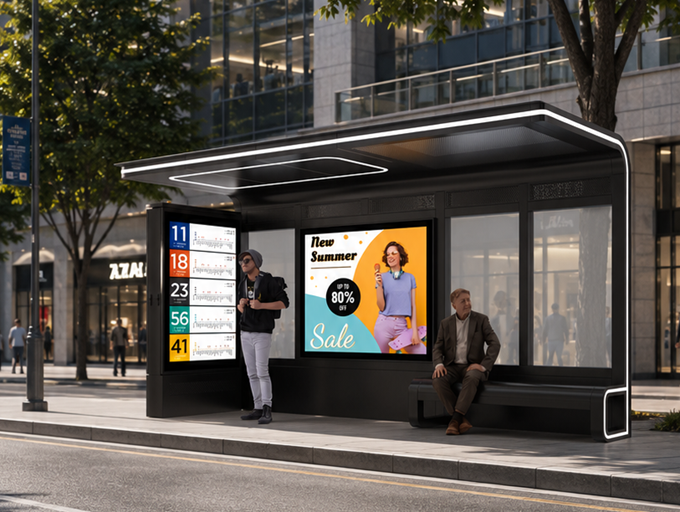
Specify digital screens only where footfall and advertiser demand justify the 3×–5× higher capex; use backlit static faces for the majority of suburban and campus sites. The asset choice drives power supply, maintenance cost, content management and revenue potential. The tender must state minimum brightness, operating temperature range, ingress protection and content-playback evidence requirements, because these become the basis for acceptance testing and warranty claims.
Project condition | Recommended asset | Minimum spec to write into tender | Why it matters |
Footfall > 3,000/day AND grid power within 50 m | 55″–75″ outdoor LCD or LED screen | 1,500 nits brightness, −20 °C to +50 °C, IP65, remote CMS, 99.5% uptime SLA | Programmatic and time-slot revenue need daylight visibility and reliability |
Footfall 1,000–3,000/day OR no grid power | Backlit static 6-sheet / 4-sheet + solar LED topper | 80 μm powder coat, LED illumination 500 lux face, solar+battery autonomy ≥ 3 days | Lower capex, lower maintenance, still generates recurring poster revenue |
Mixed-income network with upgrade path | Smart-ready shelter with pre-wired face mounts | Pre-installed conduits, 230 V/110 V supply stub, network port | Allows later upgrade from static to digital without replacing the structure |
Premium city gateway / airport link | P4–P5 LED full-colour screen | ≥ 4,500 nits, EN 50155/EN 45545-2 compliant if rail-adjacent, remote monitoring | Highest CPM; requires 24/7 support contract |
Procurement consequence: Include an asset-class approval gate in the tender. The supplier must submit shop drawings showing face dimensions, mounting details and cable routes before manufacture. YEROO's outdoor media solution and LED screen product line can be evaluated against these tender clauses to confirm they meet the specified brightness and ingress ratings.
How should buyers score suppliers in an advertising-funded tender?
Weight financial viability and operational track record at least as heavily as unit price, because the cheapest shelter from an undercapitalised operator is the fastest route to network failure. The scoring matrix must reward bidders who can prove they have delivered, financed and maintained comparable networks for the full concession term.
Scoring criterion | Weight | Evidence to require | Pass/fail or scored |
Concession financial model | 25% | 10-year cash-flow model, sensitivity at 70%/85%/100% occupancy, proof of funding or bond | Scored 0–25 |
Comparable network references | 20% | 3+ installed networks of ≥ 50 shelters, each operated for ≥ 3 years, with client contact | Scored 0–20 |
Manufacturing & delivery capacity | 15% | Factory audit, ISO 9001 certificate, production plan for the full rollout, QA test reports | Pass/fail then scored |
Maintenance & uptime SLA | 15% | Response-time commitment, spare-parts policy, uptime guarantee with penalty clause | Scored 0–15 |
Advertising asset specification | 15% | Screen/cms datasheets, brightness and temperature certificates, content-playback evidence | Scored 0–15 |
Design & planning compliance | 10% | Planning precedents, heritage/conservation response, accessibility compliance (PROWAG/DfT) | Scored 0–10 |
Tender clause to write: Make the financial model and references pass/fail gates at a minimum threshold, then score the remaining criteria. Require a parent-company guarantee or performance bond equal to 10% of the contract value for the first two years. When evaluating a manufacturer such as YEROO, cross-check the bus shelter factory verification checklist and require the supplier to show delivery records for advertising-heavy projects such as the YEROO Mauritius advertising-hub shelter or the Guam wind-resistant revenue shelter.
What maintenance and handback terms belong in the contract?
The contract must assign structural maintenance to the asset owner, advertising-asset maintenance to the revenue beneficiary, and graffiti/vandalism repair to whichever party controls the concession. If these responsibilities are blurred, neither party fixes defects until they become safety hazards. The authority should also reserve the right to remove non-compliant advertising and charge the operator for removal costs.
Maintenance item | Recommended responsibility | Minimum contract term | Evidence required |
Structural integrity (steel, roof, glass, foundations) | Operator during concession; authority after handback | Annual inspection by chartered/PE engineer | Written report with photos and remedial schedule |
Advertising face / screen repair and replacement | Operator | 24-hour response for safety faults; 72-hour for display faults | Service logs and uptime reports |
Cleaning and graffiti removal | Operator | Weekly in city centre; fortnightly elsewhere | Cleaning log with date-stamped photos |
Electrical safety and earthing | Operator | Annual PAT/earth-resistance test | Test certificates |
Content management system (CMS) hosting | Operator | 99.5% uptime SLA | Monthly uptime report |
Asset handback condition | Operator must return in "good repair" minus fair wear and tear | At end of concession | Independent condition survey using original acceptance criteria |
Handback clause: At the end of the concession, require the operator to commission an independent condition survey. If the authority takes ownership, the operator must remove all advertising hardware and restore the shelter to a neutral state, or transfer ownership of compliant digital assets at an agreed depreciated value. Specify that non-structural advertising fixings must not damage the shelter finish during removal — a common source of disputes.
What are the costliest mistakes in advertising-funded networks?
The most expensive error is awarding a concession based on the highest revenue share without verifying that the bidder can actually build and maintain the network. A high revenue-share percentage is worthless if the operator abandons the contract in year three. The second-most expensive error is under-specifying the advertising assets, which leads to early replacement before the concession term ends.
Mistake | Typical cause | Corrective cost (indicative) | Tender prevention clause |
Operator insolvency or exit | Weak financial due diligence | 20–40% of original contract value to re-tender and remediate | Parent guarantee + 10% performance bond + audited accounts |
Screen failure in year 2–4 | Consumer-grade display used outdoors | €3,000–€12,000 per screen replacement | Require industrial outdoor rating (−20 °C to +50 °C, IP65, 1,500 nits) |
Advertising revenue 40% below forecast | Overstated footfall or rate card | Concession becomes loss-making; authority loses service | Independent footfall audit + sensitivity test + LOIs |
Handback dispute over asset condition | No baseline condition survey | Legal fees + refurbishment €2,000–€8,000 per shelter | Independent baseline and handback surveys with photo schedule |
Planning refusal after installation | Heritage/streetscape conflict | Removal + redesign + reinstallation €5,000–€15,000 per site | Pre-approval planning response and material sample board |
Poor access for maintenance | Shelter design blocks lift/cable routes | 30–50% higher lifetime maintenance | Maintenance access clause in shop-drawing approval |
FAQ
What is an advertising-funded bus shelter network?It is a public transport shelter programme paid for by advertising revenue rather than direct public capital. A media operator funds, installs and maintains the shelters in exchange for the right to sell advertising space on them for a fixed concession period, typically 10–15 years.
Who should issue the tender — the media operator or the city?The city or transport authority issues the tender when it wants a private operator to fund and manage the network. The media operator issues sub-contracts to manufacturers and maintenance providers after winning the concession. Both parties must align the tender and subcontract on asset specs and handback terms.
What footfall makes a site viable for advertising funding?A site needs roughly 35,000–50,000 daily effective impressions for static advertising or 60,000+ for digital screens to attract recurring advertiser spend. Sites below this threshold should remain in a capital-funded or revenue-share programme rather than a pure advertising concession.
Should the tender require digital screens or static posters?Digital screens suit high-footfall, grid-powered city sites with strong advertiser demand. Static backlit faces are more appropriate for suburban, campus and lower-footfall locations. The tender should let bidders propose the asset class per site, subject to minimum footfall and brightness criteria.
How long should the concession term be?Most successful concessions run 10–15 years. Shorter terms do not give the operator enough time to recover capex; longer terms expose the authority to technology-obsolescence risk and reduce competitive pressure.
What happens to the shelters when the concession ends?The contract must state whether assets transfer to the authority, are removed by the operator or are purchased at depreciated value. The handback condition should be measured against an independent baseline survey taken at commissioning.
Conclusion
An advertising-funded bus shelter network is a finance and operations contract first, a product purchase second. The buyer — whether awarding the concession or bidding for it — must lock the contract model, revenue evidence, asset specification, supplier scoring and handback terms before any shelter is manufactured. Get the model wrong and the network becomes either a public-realm eyesore or an unprofitable asset stranded for a decade.
YEROO supplies advertising-ready shelters and outdoor LED/LCD assets from a 31,000 sqm Foshan facility, with project references including Mauritius, Guam, Spain and Hong Kong, China. If you are preparing an advertising-funded shelter tender, request our Tender Specification Pack for Advertising-Funded Networks, which includes a model contract schedule, asset specification template and supplier scoring matrix ready for your procurement team. Contact YEROO for a concession-ready proposal and itemised quotation.










 Address:North Tower 904,New World Times Center,Guangyuan Dong Road ,Guangzhou,China
 Phone: +86 13826225776
 Email:yeroo10@3dyeroo.com


