Every bus shelter that withstands a decade of monsoons, salt spray, and daily commuter traffic begins its life as raw steel on a factory floor. For procurement officers evaluating a bus shelter manufacturer, understanding how these structures are fabricated reveals far more than production trivia — it exposes the quality controls, material choices, and engineering rigour that separate a 15-year asset from a five-year liability.
YEROO has manufactured outdoor advertising and transit infrastructure from its 31,000-square-metre facility in Foshan, China, for 26 years. With ISO 9001 certification and deployments across 111 countries, the company produces everything from classic stainless steel shelters to smart IoT-enabled units with integrated digital displays. This article walks through the complete production pipeline — from material receipt to final commissioning — so buyers know exactly what to audit during a factory visit or supplier qualification.
Raw Material Selection: The Foundation of Durability
The lifespan of a bus shelter is determined long before the first weld. YEROO's procurement team sources cold-rolled carbon steel, 304 and 316-grade stainless steel, aluminium extrusions, and tempered glass from certified mills. Each incoming batch carries mill test certificates verifying tensile strength, chemical composition, and corrosion resistance.
Carbon steel remains the workhorse for structural frames due to its high strength-to-cost ratio. For coastal municipalities or regions with heavy road-salt application, 316 stainless steel is specified for its molybdenum content, which resists chloride pitting. Aluminium is selected for lightweight roof panels and decorative trims where weight reduction matters — particularly for rooftop installations or heritage-sensitive locations where crane access is restricted.
Tempered glass for shelter panels is sourced to EN 12150 or AS/NZS 2208 standards, depending on the destination market. YEROO's incoming inspection includes random-sample impact testing and edge-quality checks. Rejected batches are returned to the supplier; the company maintains a supplier scorecard that has eliminated three sub-par mills in the past four years.
Material traceability is maintained through barcode tracking from receipt to finished goods. This allows YEROO to identify the exact steel coil used in any shelter shipped to projects from Hungary to Australia — a critical capability when warranty claims or structural audits arise years after installation.
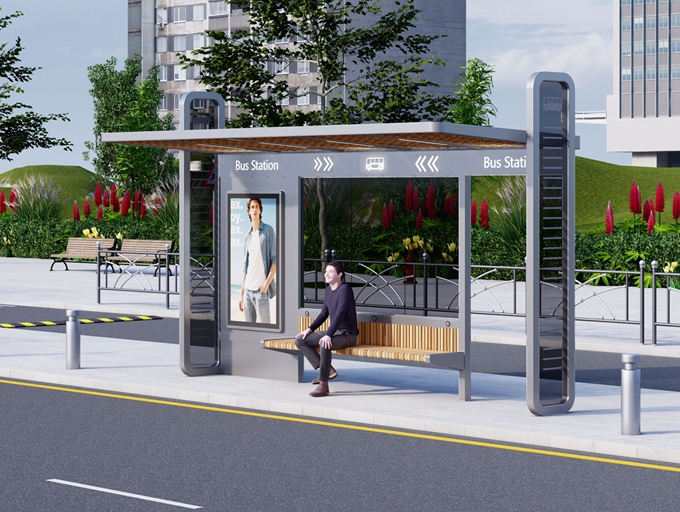
Precision Cutting and Forming: From Flat Sheet to 3D Frame
Once materials clear inspection, they move to YEROO's CNC processing zone. The facility operates multiple Trumpf and Amada laser cutting machines capable of ±0.1 mm tolerance on steel up to 12 mm thick. This precision matters: frame components must interlock cleanly during assembly, and misaligned bolt holes create field-fit problems that delay installation and weaken joints.
Roof panels and side cladding are cut on CNC turret punches and hydraulic shears. Complex curved elements — increasingly requested for modern bus shelter design projects — are formed on CNC press brakes with custom tooling. YEROO's engineering team programmes each bend radius to account for spring-back, ensuring that formed channels mate precisely with flat panels during welding.
For high-volume orders, YEROO nests parts on sheet metal using automated nesting software that minimises offcut waste. Typical material utilisation rates exceed 92%, reducing both raw material costs and environmental impact. Offcuts above 300 mm are retained for small bracket production; smaller scrap is collected for mill recycling.
The forming stage also produces the internal cable management channels and mounting plates for smart bus shelter electronics. These components require tighter tolerances — ±0.05 mm — to ensure IP-rated sealing when displays, routers, and charging modules are installed.
Welding and Structural Assembly: Building the Skeleton
Welding is where a bus shelter earns its structural integrity. YEROO employs both robotic MIG welding stations for repetitive frame joints and certified manual welders for complex assemblies and cosmetic seams. All welders hold EN ISO 9606-1 or equivalent certification, and the quality department conducts monthly weld-procedure qualification tests.
The main frame — typically comprising four corner posts, roof beams, and base rails — is assembled on jigs that maintain squareness within 1 mm per metre. Robotic cells handle the longitudinal roof beam welds, producing consistent penetration and bead profile. Manual welders then attach cross-bracing, seat mounting plates, and advertising panel frames.
Post-weld, every joint undergoes visual inspection under 10× magnification. Critical load-bearing welds are dye-penetrant tested for surface cracks. For projects in seismic zones or high-wind regions, YEROO performs random ultrasonic testing on 10% of production units to verify internal weld soundness.
The assembled frame is then blasted with steel grit to SA 2.5 cleanliness standard, removing mill scale, weld spatter, and surface contamination. This step is non-negotiable: any residue trapped beneath the coating system will propagate corrosion within 24 months, regardless of how premium the paint is.
Surface Treatment and Coating: The 15-Year Barrier
YEROO operates a fully automated powder-coating line with seven-stage pre-treatment. The process sequence is:
Degreasing — alkaline spray removes cutting oils and fingerprints
Rinsing — multi-stage cascading water wash
Activation — titanium-based conversion coating for aluminium; zinc phosphate for steel
Passivation — chrome-free seal for environmental compliance
Drying — convection oven at 120 °C
Powder application — electrostatic spray with automatic reciprocators and manual touch-up
Curing — 180–200 °C for 15–20 minutes depending on powder chemistry
The facility uses polyester powder coatings formulated for exterior architectural applications. Standard colours — RAL 7016 anthracite, RAL 9005 jet black, RAL 9016 traffic white — are held in stock. Custom colours are matched to client specifications with ΔE < 1.5 against reference samples.
For marine and coastal environments, YEROO applies a duplex system: hot-dip galvanising to EN ISO 1461 followed by powder coating. The zinc layer provides sacrificial corrosion protection even if the topcoat is scratched. Accelerated salt-spray testing to ASTM B117 confirms 3,000+ hours to first red rust on duplex-coated samples — equivalent to 15+ years in moderate coastal conditions.
Stainless steel shelters skip the galvanising step but receive a passivation treatment in citric acid solution to restore the chromium oxide layer damaged during fabrication. This ensures the self-healing corrosion resistance that makes 316-grade steel viable for Dubai, Sydney, and Lisbon installations.
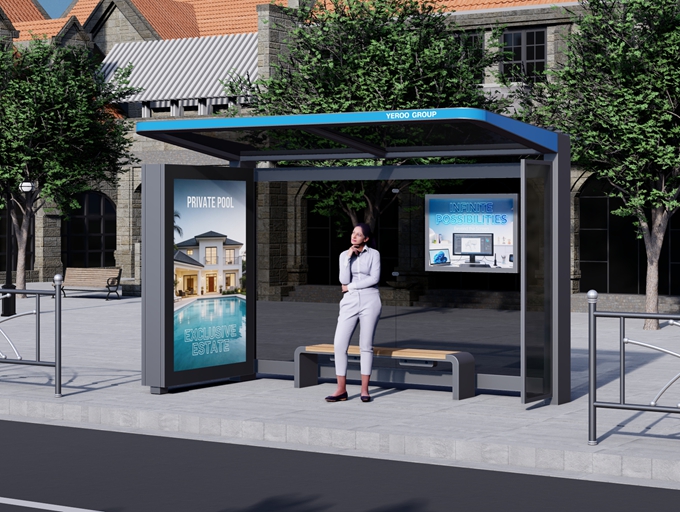
Component Integration and Final Assembly
With the coated frame cured and cooled, assembly moves to the finishing line. Workers install tempered glass panels using EPDM gaskets and stainless steel security fasteners. The gasket profile is designed with dual compression lips: the outer lip sheds rainwater, while the inner lip maintains an air seal that reduces condensation on the glass interior.
For smart bus shelter orders, the electronics integration team installs LED backlighting, real-time display screens, USB charging modules, and Wi-Fi routers. Each unit is powered up for a 48-hour burn-in test that cycles temperature between 10 °C and 50 °C while running full display brightness. Failures during burn-in — typically less than 0.8% — are diagnosed and repaired before shipment.
Advertising panel frames receive either LED backlighting kits or traditional flex-face tensioning systems, depending on the client's media strategy. YEROO's DOOH-ready shelters include cable conduits pre-routed to the roof for future 5G small-cell or environmental sensor upgrades.
Seating is installed last — usually powder-coated steel benches with optional timber or recycled plastic slats. Anti-vandal fasteners with tamper-resistant heads are standard; some transit authorities specify security Torx or tri-groove drives to deter theft of aluminium trim pieces.
Quality Control and Pre-Shipment Inspection
YEROO's quality system is built around ISO 9001:2015 with additional checkpoints derived from client audit requirements. Every shelter receives:
Inspection Stage | Method | Acceptance Criteria |
Dimensional verification | Laser measurement | ±3 mm on overall length/width/height |
Coating thickness | Eddy current / magnetic gauge | 80–120 µm average, no spot < 60 µm |
Adhesion | Cross-hatch test (ISO 2409) | GT 0–1 (no peeling > 5% area) |
Glass impact | 45 kg pendulum (EN 12600) | Class 1(C)1 — no dangerous fragments |
Electrical safety | Earth continuity & insulation resistance | < 0.1 Ω earth bond; > 2 MΩ insulation |
Functionality | 48-hour powered burn-in | Zero critical failures, < 3 minor faults |
Pre-shipment inspection includes photography of each unit from six angles, packed into a digital dossier shared with the client. For large municipal contracts, third-party inspectors from SGS or Bureau Veritas witness the final inspection and seal containers.
Packaging uses steel-frame crates with foam-lined contact points and moisture-barrier VCI film. This protects coated surfaces from abrasion during ocean freight and prevents condensation corrosion in containerised environments. YEROO's logistics team has shipped to 110 countries; packaging designs are refined after each damage report, with current freight damage rates below 0.3%.
From Factory Floor to City Street: Installation and Commissioning
Manufacturing excellence means little if the shelter fails during installation. YEROO provides detailed foundation drawings, anchor bolt layouts, and lifting-point diagrams with every shipment. For turnkey projects, the company dispatches installation supervisors who coordinate local civil contractors and verify that concrete foundations achieve the specified 25 MPa compressive strength before frame placement.
Typical installation sequence:
Foundation preparation — excavate to 400–600 mm depth, place reinforcement cage, pour concrete with anchor bolts set to ±2 mm tolerance
Curing period — 7 days minimum before frame loading; 28 days for full strength
Frame placement — crane or forklift sets frame onto anchor bolts; levelling shims correct minor foundation irregularities
Panel installation — glass, advertising faces, and roof panels fitted; security fasteners torqued to specification
Electrical connection — mains or solar panel hook-up; earth bonding verified
Commissioning — functional test of all systems; handover documentation signed
YEROO maintains an after-sales support desk with response commitments of 24 hours for technical queries and 72 hours for spare-part dispatch. Common spare parts — gasket sets, fastener kits, replacement LED drivers — are stocked in Foshan for immediate shipment.
FAQ: Bus Shelter Manufacturing
What certifications should a bus shelter manufacturer hold?
Look for ISO 9001 for quality management, ISO 14001 for environmental compliance, and welding certifications such as EN ISO 9606-1. For smart shelters, IEC 62368-1 electrical safety certification is essential. YEROO holds ISO 9001 and maintains weld-procedure qualifications for all structural grades.
How long does bus shelter manufacturing typically take?
Standard designs require 4–6 weeks from order confirmation to ex-works. Custom designs with new tooling or special finishes extend to 8–10 weeks. Large municipal orders of 50+ units are scheduled in batches to maintain consistent quality without overwhelming the coating line.
What is the typical lifespan of a manufactured bus shelter?
A properly fabricated and coated steel shelter lasts 12–15 years in urban environments. Duplex-coated (galvanised + powder-coated) units achieve 20+ years. 316 stainless steel shelters in coastal conditions routinely exceed 25 years with minimal maintenance.
Can manufacturers customise shelters for specific climates or branding?
Yes. YEROO customises roof pitch for snow load, ventilation louvres for tropical humidity, and colour matching for city branding. Custom advertising panel sizes, seating configurations, and smart-feature packages are standard offerings.
What quality checks matter most during a factory audit?
Focus on incoming material certificates, weld-procedure documentation, coating-line pre-treatment stages, and dimensional inspection records. Ask to witness a live salt-spray test or review third-party test reports. A credible manufacturer will have these readily available.
Does YEROO offer OEM and ODM manufacturing?
Yes. YEROO operates both models: OEM production of client-designed shelters with YEROO's manufacturing expertise, and ODM development where YEROO's design team creates custom solutions from concept sketches. Both paths include prototyping, testing, and volume production.
Conclusion: Manufacturing Transparency Builds Procurement Confidence
The difference between a bus shelter that fades after five years and one that serves commuters for two decades is visible on the factory floor — in the mill certificates, the weld beads, the coating-line chemistry, and the burn-in test logs. Procurement officers who understand these processes can audit suppliers with precision, specify requirements with authority, and justify budget allocations with engineering evidence.
YEROO's 25-year manufacturing track record, 31,000-square-metre facility, and 110-country deployment history provide the E-E-A-T signals that modern procurement demands. Whether you need a classic steel shelter for a suburban route or a fully integrated smart station for a flagship smart-city corridor, the manufacturing rigour behind every unit remains consistent.
Ready to specify your next transit shelter project? Request a detailed quotation including material specifications, coating options, and delivery timelines tailored to your municipality or media network.










 Address:North Tower 904,New World Times Center,Guangyuan Dong Road ,Guangzhou,China
 Phone: +86 13826225776
 Email:yeroo10@3dyeroo.com


