Verify a bus shelter factory with three checks before ordering: documentary (business licence, ISO 9001 certificate, EN 1090 welding certification, export record), physical (laser cutters, CNC bending, powder-coating line on site), and transactional (direct Alibaba export history, bank account matching the company name). A factory passes all three; a trading company fails the physical check almost every time.
Most procurement failures in bus shelter projects do not start with the product. They start with the supplier. A shelter is a 15-to-25-year structural asset, and the party who controls the welding, the coating line and the QC process is the party who controls your warranty risk. This guide gives you the verification steps YEROO's own customers use, in the order that costs you the least time.
Why factory verification matters more for shelters than for ordinary steel products
A bus shelter combines structural steelwork, architectural glazing, electrical systems and often digital displays in one certified assembly. Unlike a simple steel fabrication, a shelter failure is public: it stands on a city street, it carries a municipal contract, and a coating failure or weld defect is visible to every passenger and every journalist.
Three consequences follow for buyers:
Warranty claims need a manufacturing counterparty. If your supplier is a trader, the factory's warranty is a promise between strangers. If the supplier is the factory, corrective action starts on the production line, not in a negotiation.
Certification must be traceable. EN 1090-1 Execution Class 2 (minimum for public-realm structural steelwork in Europe) and ISO 9001 quality management apply to the organisation that makes the product — not to an intermediary.
Spare parts in year 5 need drawings and tooling. Only the original factory holds the jigs, panel tooling and profile dies needed to supply matching replacement panels five years later.
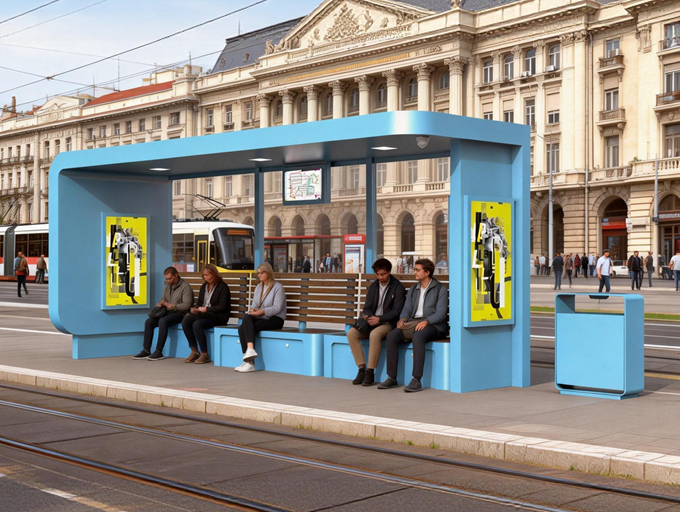
The three-layer verification method
Layer 1 — Documentary checks (remote, one day)
Document | What it proves | How to verify |
Business licence with manufacturing scope | The legal entity is registered as a manufacturer | Check registration date and registered capital via China's National Enterprise Credit Information system |
ISO 9001 certificate | Quality management system, audited | Request the certificate number and confirm it on the certification body's public register — not just a PDF copy |
EN 1090 / welding certification (ISO 3834) | Competence in structural steel fabrication | Ask which execution class the factory is certified for and which body issued it |
CE documentation for electrical components | Displays, lighting meet EU directives | Ask for the Declaration of Conformity and the notified body, not just the CE mark |
Export record | The factory has shipped to your region before | Request 2–3 anonymised export references (bill of lading copies with quantities redacted) |
YEROO holds ISO 9001 certification and supplies 【YEROO DATA NEEDED: current certificate numbers and validity dates for ISO 9001 / CE / EN 1090 certificates】 with every tender documentation package on request.
Layer 2 — Physical verification (video audit, half a day)
A 30–45 minute live video walk-through tells you more than any brochure. Require the supplier's production manager — not a salesperson — to show:
Equipment or area | Why it matters | Red flag if… |
CNC laser cutting / plasma cutting | Accurate panel and post cutting | Only manual cutting or outsourced parts shown |
CNC bending and rolling | Consistent canopy curvature and post geometry | "Bending is done by our partner" |
Welding bays with jigs/fixtures | Repeatable geometry across units | Welders working without fixtures on the floor |
In-house powder-coating line (or a named partner with address) | Coating adhesion and thickness control — the single biggest durability factor | Coating "outsourced" with no partner identified |
Glazing handling area | Tempered/laminated glass cut and installed without breakage | Glass stored loose or cut on open ground |
Assembly and QC station with torque tools and test logs | Structured inspection, not visual-only QC | No written QC checklist at the station |
Finished goods yard with shelters staged for export | Real volume, real projects | Yard empty and no recent project references |
If a supplier refuses a live video walk-through of production — not just a showroom — treat that as a material risk factor and price it accordingly.
Layer 3 — Transactional and reference checks (remote, one day)
Match the bank account to the company name. Payment should go to an account in the exact registered name of the manufacturing entity. Third-party accounts are the classic diversion risk.
Check the export history on the platform record. On Alibaba.com, years of export transactions, transaction level and verified on-site video are visible. YEROO's export record covers 【YEROO DATA NEEDED: verified export years, transaction level and on-site verification status on the Alibaba store】.
Ask for two references in your climate zone. A factory experienced in Hungary's freeze-thaw cycle and de-icing salt handles a Central European tender differently from one that has only shipped to the Gulf. YEROO's project history includes deployments in Hungary, Australia, Romania and across Southeast Asia — reference contacts can be arranged under NDA.
Order one sample unit before a multi-unit programme. A single-unit pilot order tests the entire chain — engineering, production, coating, packing, freight — for the cost of one shelter.
Which verification route should you choose?
Your situation | Recommended route | Cost | Lead time added |
Order value < USD 50,000, supplier already verified by platform | Documentary + video audit | Travel cost: nil | 2–3 days |
Order value USD 50,000–250,000 | Video audit + one sample unit + reference calls | One unit cost | 1–2 weeks |
Public tender or order value > USD 250,000 | Third-party audit (SGS, TÜV, Bureau Veritas) or your own visit | Audit fee: typically USD 300–800/day (indicative global range) | 2–3 weeks |
Multi-city or multi-year framework agreement | Third-party audit + annual re-audit + resident inspection of first batch | Negotiated programme | 3–4 weeks initially |
For public tenders, add one requirement most buyers miss: ask the factory — not the trader — to sign the tender's technical compliance annex. A factory that manufactures what it signs can be held to it.
Common verification mistakes and what they cost
Mistake | Why it happens | Typical consequence |
Accepting a PDF certificate without checking the register | Certificate looks official; register check takes 10 minutes | Expired or falsified ISO 9001 discovered only when the tender is audited |
Visiting the showroom instead of the production floor | Showrooms are polished and close to the airport | Trading company passed off as a factory; your order is subcontracted to the lowest bidder |
Paying a deposit to a third-party account | "Our accountant's account is easier for foreign exchange" | Funds recovery becomes a legal case in another jurisdiction |
Skipping the sample unit on a large order | Production slots look full and delays feel costly | A systemic defect (e.g. coating adhesion) is discovered across 100 units instead of 1 |
Verifying capacity only by asking | "Yes, we can do 200 units per month" is free to say | Lead time slips by 2–3 months mid-programme; see our guide on factory capacity and multi-unit orders |
Not testing salt-spray or weld quality on site | Testing feels like the factory's job | Defects surface after installation, when every repair involves traffic management and council permits |
A third-party audit report (SGS, TÜV, Bureau Veritas all offer factory audits in China) costs a few hundred US dollars and closes most of these gaps in one visit.
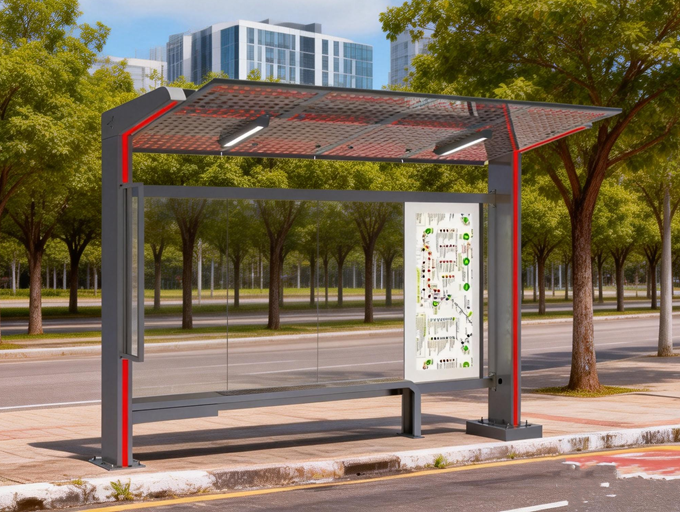
What YEROO opens to buyers before an order
YEROO operates a 31,000 m² manufacturing facility in Foshan, Guangdong, producing bus shelters, solar benches, lightboxes and LED display structures for export to 100+ countries. Before any order, prospective buyers can:
Join a live video factory walk-through with the production manager, covering cutting, welding, coating and QC stations
To arrange a factory verification session, contact the YEROO export team with your project country, unit quantity and target delivery window. See also our bus shelter product range and completed projects for context.
FAQ
How do I know if a bus shelter supplier is a factory or a trading company?
Require a live video walk-through of production — cutting, welding, coating and QC in one continuous visit. Factories show equipment in operation; traders offer showrooms, catalogues and "our partner workshop" answers. Also check that the business licence scope says manufacturing and that the bank account name matches the licence.
Is a video factory audit enough, or do I need to visit China?
For orders up to roughly USD 50,000 with a platform-verified supplier, a structured video audit plus document checks is proportionate. For public tenders or orders above USD 250,000, commission a third-party audit (SGS, TÜV, Bureau Veritas) or visit in person — the audit cost is trivial against the contract value.
What certificates should a bus shelter factory provide?
At minimum: ISO 9001 quality management (verify the number on the certification body's register), EN 1090 or ISO 3834 for structural welding if you are in Europe, CE declarations of conformity for lighting and displays, mill test certificates for stainless and galvanised steel, and salt-spray test reports for the coating system.
Can I buy a single bus shelter first before a large order?
Yes — and you should. A pilot unit tests engineering, coating, packing and freight at the cost of one shelter. Confirm the pilot's specification, price and lead time with the supplier: 【YEROO DATA NEEDED: YEROO single-unit / pilot order policy, pricing and lead time】.
How long does factory verification add to a procurement schedule?
Documentary and transactional checks take 1–2 days. A video audit takes half a day plus scheduling. A third-party on-site audit typically adds 2–3 weeks. Build this into the tender timetable rather than compressing it after contract award, when your leverage is gone.
What is the biggest red flag when verifying a Chinese bus shelter factory?
A payment request to a bank account whose name differs from the registered company name. It combines two risks in one signal: the "supplier" may not be the manufacturer, and your deposit may be unrecoverable. Every other issue has a cheaper fix.










 Address:North Tower 904,New World Times Center,Guangyuan Dong Road ,Guangzhou,China
 Phone: +86 13826225776
 Email:yeroo10@3dyeroo.com


