Nine considerations decide a bus shelter purchase: site data, shelter type, climate-driven material grade, compliance documents, factory verification, total cost of ownership, lead time and payment terms, warranty and spares, and installation support. Decide each before requesting quotations — every one you leave open becomes a variation order after the contract is signed.
Most bus shelter purchases are lost money in the gap between the enquiry email and the signed contract. The buyer sends a drawing, the supplier returns a price, and the two sides discover — at the foundation stage, or at customs, or in year three when a panel breaks — that neither of them asked the questions the other assumed were settled.
This guide is the buyer's map of those questions, in the order they should be answered. Each consideration is tied to what it costs to leave it open. For the deeper treatment of individual points, the specifications checklist for procurement officers covers clause-level detail, and the cost breakdown for 2026 covers pricing mechanics; this article is the sequence above both.
What must you decide before you request a quotation?
Six decisions must be fixed before an enquiry goes out: site dimensions, footfall, power availability, climate exposure, advertising intent, and budget envelope. A quotation written against undefined inputs is not a price — it is an assumption, and assumptions are repriced after the contract.
Decision | What it fixes | Cost of leaving it open |
Site survey: clear footway in mm, kerb line, underground utilities | Footprint, module length (4 m, 6 m or 8 m), whether a standard unit fits at all | Redesign at approval stage; 6–10 weeks lost |
Peak footfall per day | Shelter depth and seating capacity; whether a standard or BRT-class structure is needed | Overcrowded or overbuilt units; either way the money is wrong |
Power: distance to mains in metres, or solar exposure | Mains, solar or hybrid supply; whether any smart feature is possible | Electrical variation order after fabrication |
Climate: ISO 9223 corrosivity category, wind zone, snow load | Material grade, coating build, frame section, foundation | Under-specification shows up as rust or deflection inside warranty period — and the claim fights begin |
Advertising intent: revenue panels or none | Poster aperture, illumination, structural reinforcement, media-contract compatibility | Panels fabricated to the wrong opening cannot be sold |
Budget envelope: capital, concession or grant | Which funding model the specification is written for | A specification nobody can fund stalls at committee |
None of these requires a supplier. All of them change the price by more than the supplier's margin does.
Which shelter type fits the project?
Match the type to four site conditions — footfall, power, climate and revenue intent — not to the catalogue. The table below is the decision logic in the form a buyer can lift into a tender justification.
Site condition | Choose | Because |
Standard stop, under 1,500 boardings/day, no power needed | Classic 4–6 m shelter | Lowest capital and maintenance cost; nothing in the site demands more |
No mains within 150 m, or grid connection cost exceeds the solar premium | Solar shelter | Off-grid lighting and information displays run on a sized panel and battery array; no trenching, no utility approvals |
Above 1,500 boardings/day AND a live information or advertising requirement | Smart shelter with screen | Real-time arrivals and DOOH revenue justify the electronics; below that footfall the return does not arrive |
BRT corridor or interchange, over 3,000 boardings/day | BRT-class long shelter (10–26 m modules) | Passenger flow in and out must not block the queue; wider platforms, reinforced structure |
Extreme heat (above 40 °C sustained) with high-comfort requirement | AC shelter | Closed and climate-controlled; only defensible where dwell time is long or political expectation is high |
Type choice is the single largest price lever — the gap between a classic unit and a smart unit is typically the largest line in the whole programme, which is why it is decided by site conditions and not by the catalogue page that looked best.
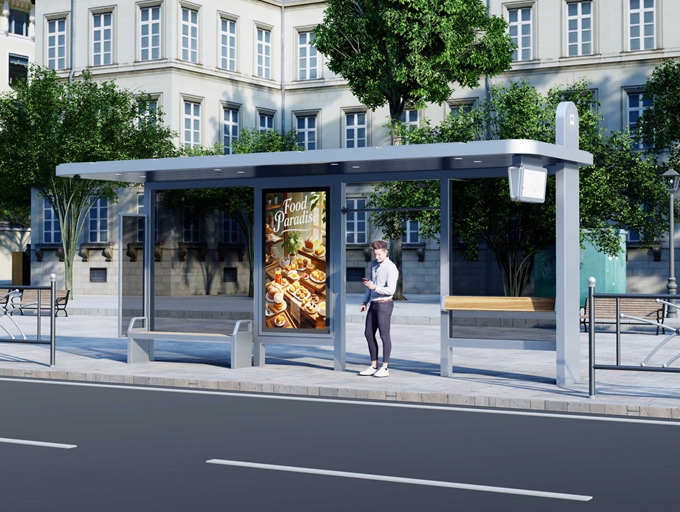
What material specification does your site demand?
The environment sets the material grade, and the grade sets both the price and the service life. Classify the site against ISO 9223 before specifying anything: category C3 inland runs a 304 stainless or hot-dip galvanised frame with a polyester powder coat of at least 80 μm; C4 and C5 coastal or de-iced corridors demand 316L stainless or a duplex galvanised-plus-powder system, because 304 pits within a few seasons under salt deposition.
The full grade logic, including the coating build-ups behind each choice, is set out in the material selection guide for 304, 316L and galvanised steel. The buyer's action is one line in the tender: state the corrosivity category, require the material certificate to match it, and reject any bid priced on a lower grade than the site demands — that bid is not cheaper, it is a different product.
Which documents must come with the shelter?
Require a document set, not logos. A factory that manufactures to standard can produce the paperwork within days; a trader cannot produce it at all, which is exactly why the document gate belongs in the tender as pass/fail.
Document | Governing standard | Gate |
Quality management system certificate | ISO 9001 | Pass/fail — certificate number verified, not a logo |
Factory production control for structural steelwork | EN 1090-2, execution class EXC2 | Pass/fail for welded load-bearing frames |
Structural calculation package for the site's wind and snow values | EN 1991-1-4 / EN 1991-1-3 national annex values | Pass/fail — calculations to your site, not to a generic case |
Full-scale structural load test report with deflection data | Project-specific load case | Scored — proves the calculation, not just the model |
Tempered glass certificate | EN 12150-1 (or ANSI Z97.1 / AS-NZS 2208 by market) | Pass/fail per glazing batch |
Ingress protection test for electrical enclosures | IEC 60529, IP65 | Pass/fail for any powered unit |
Coating thickness and salt-spray test report | Project spec in μm and hours | Scored — this is where coastal projects are won or lost |
【YEROO DATA NEEDED: current certificate list with numbers and validity dates to attach as standard annex】. Until that annex exists, the tender should require bidders to submit certificate numbers and verification links, and award nothing to a bidder who offers only a marketing PDF.
How do you verify the supplier is a factory?
Verify in three layers before any money moves: documentary, video, and transactional. Check the business licence scope for manufacturing, confirm the export record against the claimed market history, then require a live video factory walk through the welding, powder-coating and assembly lines — a trading company will offer a showroom, not a coating line.
The complete method, including the red-flag table that separates a factory from an agent, is set out in the factory verification checklist for buyers. YEROO's own position is verifiable rather than claimed: a 31,000 m² facility, 25 years of manufacturing, delivery to 109 countries, with the project record — from a smart shelter with LED display in Hungary to a 26 m BRT structure in Laos — published case by case. A supplier who cannot show you a welding line should not be selling you a welded structure.
What should the quotation comparison actually measure?
Compare fifteen-year cost of ownership, not unit price. Freight, foundations, installation, spares and energy each move the total by more than the gap between the cheapest and second-cheapest bid, and a unit price quoted without an incoterm is a number with no meaning.
Cost line | What to demand on the quote | Typical trap |
Unit price | Priced against the locked specification, core and options split | "Similar to" pricing that diverges at fabrication |
Freight and incoterm | FOB, CIF or DDP stated per tranche | CIF quotes that exclude destination port charges and inland haulage |
Foundation and installation | Concrete volume in m³, crane requirement, crew days | The largest hidden line; a 300 kg anchor assembly changes the crane class |
Electrical connection | Point of supply, cable run, who pays the utility | Solar-looking quotes that quietly assume a mains trench |
Spares first pack | Glazing panels, drivers, fasteners, touch-up paint, priced | Zero spares quoted; every breakage becomes an import order |
Lead time and MOQ | Stated per tranche in weeks and units | 【YEROO DATA NEEDED: standard lead time, custom lead time and MOQ policy for the quotation annex】 |
Payment terms | Milestone schedule tied to fabrication stages | 【YEROO DATA NEEDED: standard payment terms and Trade Assurance coverage】 |
For order quantities of 10, 100 or 500 units the volume mechanics change again; the analysis of what changes at 10, 100 and 500 units is the reference for that negotiation.
What must warranty and spares terms cover?
Warranty must be split by component — structure, coating, glazing, electrical, solar — because the failure clocks run at different speeds. A single "5-year warranty" sentence hides the fact that LED drivers and batteries fail years before frames do, and the buyer pays for the difference unless the contract says otherwise.
【YEROO DATA NEEDED: per-component warranty durations, after-sales response time commitment and spare-parts supply policy】. In the tender, require: warranty duration per component in years; the response time for a warranty claim in working days; a named spares list with prices fixed for the warranty term; and the drawing and O&M documentation in your language as a delivery item, not an afterthought. Anything not written into the contract is a negotiation you will have in year three, from a weaker position.
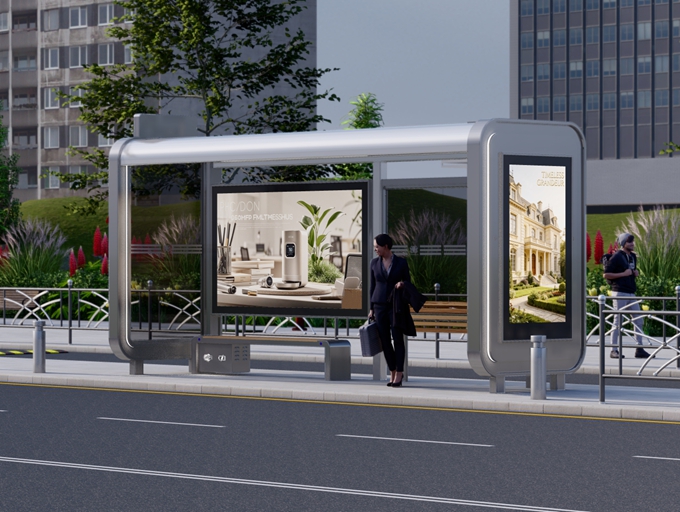
Which buying mistakes cost the most?
Five mistakes account for most of the lost money in shelter procurement, and each one is preventable at the enquiry stage for the cost of a question.
Mistake | When it surfaces | Correction cost |
Buying on unit price alone, ignoring TCO | Year 1–3, as freight, spares and rework accumulate | Typically exceeds the original price gap several times over |
No site-specific wind or snow calculation | Approval stage, or first storm | Re-engineering and re-approval: 8–14 weeks plus retrofit |
Wrong corrosivity grade for a coastal site | Year 2–4, as coating failure and pitting | Recoating or frame replacement at full mobilisation cost |
No spares pack purchased with the order | First broken panel | Single-panel import orders with minimum-run pricing and long waits |
No acceptance test before sign-off | Handover, then disputes | Snagging without leverage; defects paid for twice |
The pattern behind all five is the same: the question that was cheap to ask at the enquiry stage is expensive to answer after fabrication.
Common questions from buyers
What is the first thing to decide when buying a bus shelter?The site, not the model. Clear footway width, footfall, power availability and climate exposure determine which shelter types are even possible. Deciding these first prevents the most expensive failure in procurement: falling for a specification the site cannot accept.
How do I know which material grade I need?Classify the site against ISO 9223. Inland C3 sites run 304 stainless or galvanised steel with an 80 μm powder coat; coastal C4–C5 sites need 316L or a duplex system. Ask each bidder for the material certificate, and reject any price built on a lower grade than your site's category.
What documents should a bus shelter supplier provide?At minimum: ISO 9001 certificate with number, EN 1090-2 EXC2 factory control for welded frames, structural calculations to your site's wind and snow values, glass certificates to EN 12150-1, IP65 test reports to IEC 60529 for powered units, and coating test data in microns and hours. Treat missing documents as a fail, not a follow-up.
How can I tell a factory from a trading company?Three layers: check the licence scope for manufacturing, require a live video walk through welding and coating lines — not a showroom — and match the export record against claimed project history. A trading company can quote anything; it cannot show you a powder-coating line.
Is the cheapest quote ever the right one?Only when every other consideration is fixed. With the specification, incoterms, spares and warranty locked, price comparison is legitimate. Before that, the cheapest quote is simply the one that assumed the most — and each assumption is repriced later, when you have no leverage.
What should I order together with the shelters?A first spares pack: glazing panels, LED drivers, fasteners and touch-up paint, priced and held against the warranty term. It is the cheapest insurance in the whole purchase — a spare panel in a local store turns a broken shelter from a ten-week import order into a same-week repair.
A bus shelter purchase is decided by nine considerations, and the buyer controls all of them before the first quotation arrives: site data, type, material grade, document set, factory verification, total cost, lead time and terms, warranty and spares, installation support. Answer each in the enquiry; leave any open and it returns as a variation order, a customs surprise or a year-three repair bill.
YEROO turns this checklist into deliverables: a tender-ready specification pack built from your site data, the full compliance document set with verifiable certificate numbers, and an itemised quotation split into core unit price, options, freight and spares — the format that lets you compare bids line by line. Send your site list and requirements through the contact page, and review the bus shelter product range it is quoted against.










 Address:North Tower 904,New World Times Center,Guangyuan Dong Road ,Guangzhou,China
 Phone: +86 13826225776
 Email:yeroo10@3dyeroo.com


