Specify galvanised steel with a duplex coating for inland urban sites with low salt exposure. Specify 304 stainless steel for typical city environments with moderate pollution and cleaning access. Specify 316L stainless steel within 5 km of coastlines, in industrial zones, or wherever ISO 9223 classifies the site as corrosivity category C4 or C5. The choice is decided by the environment, not the budget.
Every material decision you make at specification stage compounds over a 15-to-25-year service life. The right grade keeps lifecycle cost low and appearance consistent; the wrong grade produces corrosion claims, panel replacement and premature refurbishment. The sections below map each environment to the correct material specification.
Why the environment should choose the material, not the buyer's preference
Most material-selection failures happen because the buyer selects a finish before mapping the corrosivity of the site. ISO 9223 defines six atmospheric corrosivity categories from C1 (very low) to CX (extreme). A bus shelter manufacturer should ask for the site location and exposure class before recommending a grade.
If the project site falls into C1–C3, galvanised steel with an 80 μm duplex coating (zinc primer plus polyester or PVDF topcoat) is structurally adequate and cost-efficient. If the site is C4–C5, 316L stainless steel with 2–2.5% molybdenum becomes the lowest-risk specification. If the site is within sight of salt water or a chemical plant, 316L or a 2205 duplex grade is required; 304 will fail aesthetically within 8–10 years and structurally within 15.
YEROO's standard material offering covers galvanised steel, 304 stainless and 316L stainless, with frame thicknesses from 2.0 mm to 4.0 mm and glazing supports in matching grade. All structural steelwork is cut, welded and finished to EN 1090-1 Execution Class 2 minimum.
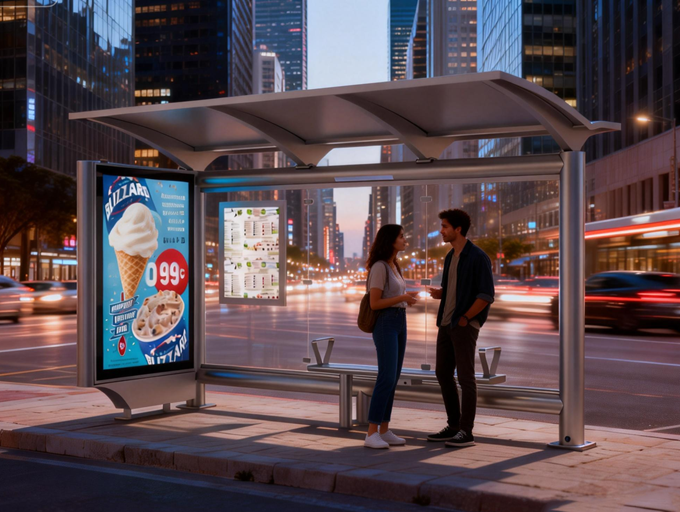
Material comparison: galvanised steel, 304 and 316L
Property | Galvanised steel + duplex coating | 304 stainless steel | 316L stainless steel |
Base standard | EN 10346 / ASTM A653 / ISO 1461 hot-dip zinc | EN 10088-2 1.4301 / ASTM 304 | EN 10088-2 1.4404 / ASTM 316L |
Chromium content | — | 18% | 16–18% |
Molybdenum content | — | 0% | 2–3% |
Typical frame thickness | 2.5–3.0 mm | 2.0–3.0 mm | 2.0–3.0 mm |
Coating system | Zinc layer 60–80 g/m² + epoxy primer + polyester/PVDF | Passivated; optional PVD coating | Passivated; optional PVD coating |
Design life in C3 | 12–18 years | 18–25 years | 25+ years |
Design life in C5 | 5–8 years without repair | 8–12 years (pitting risk) | 20–25 years |
Relative unit material cost | 1.0× (baseline) | 1.4–1.7× | 1.9–2.4× |
Best application | Inland cities, sheltered campuses, covered interchanges | Urban streets, moderate pollution, regular maintenance | Coastal roads, industrial zones, tropical humidity, de-icing salt |
Maintenance requirement | Inspect coating every 3–5 years; local repair if damaged | Wash every 6–12 months to remove chlorides | Wash every 6–12 months; minimal repair |
The cost premium for 316L is recovered quickly in C5 environments because the alternative is premature panel replacement or full recoating. In C2–C3 environments, 316L is technically superior but economically unnecessary unless the client mandates a maintenance-free service life of 25 years.
Environmental decision matrix: if-then rules for material selection
Site condition | ISO 9223 class | Recommended material | Minimum coating/specification | Why |
Inland city, low pollution, no de-icing salt | C2–C3 | Galvanised steel + duplex coating | Zinc 60–80 g/m², 80 μm polyester/PVDF | Lowest lifecycle cost; adequate corrosion resistance |
Inland city with road-salt spray in winter | C3–C4 | 304 stainless or galvanised + enhanced coating | 304 with passivation; or zinc 120 g/m² + epoxy + PVDF | Chloride accumulation accelerates galvanised coating failure |
Coastal site within 5 km of shoreline | C5 | 316L stainless | 2–3% Mo, 2.5 mm minimum wall, passivated finish | Salt-laden air causes pitting in 304 within 8–10 years |
Industrial zone with SO₂ or chemical exposure | C4–C5 | 316L stainless | 2.5–3.0 mm, optional PVD or powder-over-steel | Acidic deposits attack zinc and low-alloy stainless grades |
Tropical high-humidity site | C4 | 316L stainless | Passivated, washed at 6-month intervals | Constant moisture film promotes crevice corrosion |
Heritage or premium urban street | C3 | 304 or 316L with PVD/brushed finish | Matching-grade fixings | Aesthetic consistency and scratch repairability |
Off-grid or remote site with infrequent maintenance | C3–C4 | 316L stainless | Low-maintenance specification | Reduced site visits lower total cost of ownership |
These rules are the starting point. YEROO's engineering review also checks wind load, snow load, foundation type and glazing configuration before finalising the material schedule.
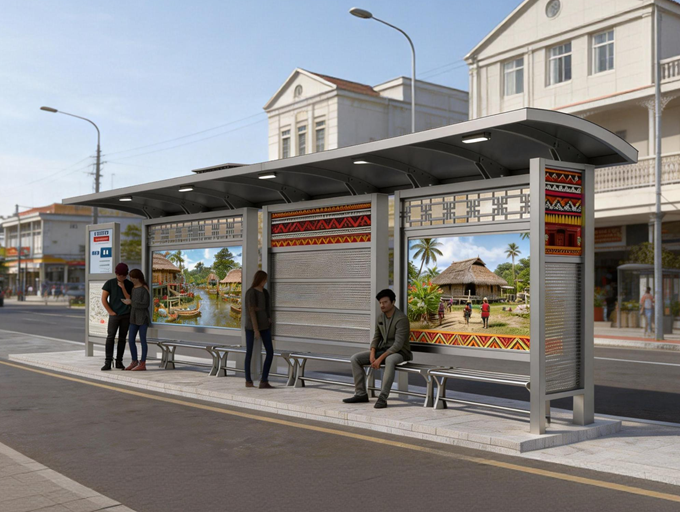
What each material specification actually means for procurement
Galvanised steel + duplex coating
Hot-dip galvanising to ISO 1461 gives a zinc layer that protects the steel sacrificially. A duplex system combines galvanising with a thermoset powder coat — typically an epoxy primer and a polyester or PVDF topcoat to a total dry-film thickness of 80–120 μm. The powder coat blocks the environment; the zinc layer protects any cut edge or scratch.
Specify ** Qualicoat Class 2** or GSB Florida 1 minimum for the powder coat if the shelter will receive direct UV exposure. For coastal or tropical sites, specify PVDF rather than polyester: PVDF retains colour and gloss for 15–20 years, while polyester may chalk within 7–10 years in harsh UV.
304 stainless steel
Grade 304 (EN 1.4301) contains 18% chromium and 8% nickel. It forms a passive chromium oxide film that self-repairs in oxygenated air. It performs well in urban atmospheres and is the standard choice for public-realm furniture where appearance matters.
304 is not suitable for prolonged chloride exposure. Road de-icing salt, coastal salt spray and splash zones will eventually cause pitting and tea staining. If the site is C4 or C5, upgrade to 316L or budget for cleaning at 3-month intervals.
316L stainless steel
Grade 316L (EN 1.4404) adds 2–3% molybdenum, which dramatically improves resistance to chlorides and crevice corrosion. The "L" denotes low carbon, reducing sensitisation risk during welding. YEROO uses 316L for coastal projects in Australia, humid city projects in Southeast Asia, and any European site classified C5 by the consultant.
Specify 316L with matching-grade fasteners. Using 304 bolts on a 316L frame creates a galvanic cell and localised corrosion at the connection. The same rule applies to glazing clamps, brackets and ground anchors.
Common material mistakes and their corrective cost
Mistake | Why it fails | Typical consequence | Corrective cost |
Specifying 304 within 1 km of the coast | Chloride pitting begins within 2–4 years | Visible rust staining; structural weakening at fixings | Panel replacement at 40–60% of new shelter cost |
Using galvanised steel in C5 without enhanced coating | Zinc layer consumed in 5–8 years | Red rust breakthrough; aesthetic failure | Full blast and recoat, or structural panel replacement |
Mixing 304 and 316L fasteners | Galvanic corrosion at dissimilar metal contact | Localised pitting around bolt holes | Component replacement and reassembly |
Omitting drainage holes in hollow sections | Standing water + salt = crevice corrosion | Internal corrosion not visible until advanced | Section replacement or full frame replacement |
Selecting powder coat only without galvanising | Topcoat scratches expose bare steel | Rapid rust propagation from any impact point | Blast, galvanise and recoat — effectively a rebuild |
Ignoring road-salt exposure | De-icing salt is a C3–C4 accelerant | Premature corrosion on lower panels and legs | Upgrade to 316L or wash programme every 3 months |
The cheapest fix is always at specification stage. A material-grade upgrade adds a predictable percentage to the unit cost; a remedial replacement adds mobilisation, site clearance and passenger disruption.
How to specify the material on your project
Obtain the ISO 9223 corrosivity category for the site. If the consultant has not provided one, YEROO can map the location using ISO 9223 guidelines and project experience.
Confirm the exposure direction. A shelter facing the sea receives direct salt spray; one sheltered behind a building may be one category lower.
Check the maintenance plan. If the authority cannot commit to washing twice yearly, specify 316L in any C4 environment.
Match all fixings and hardware to the frame grade. Mixed grades are a common cause of premature failure.
Request a coating warranty in writing. YEROO's standard coating system is backed by 【YEROO DATA NEEDED: coating warranty duration and scope】 — confirm the current warranty schedule with the sales team.
Ask for material certificates. Mill test certificates for stainless grades and galvanising compliance certificates should be included in the handover documentation.
For project-specific material recommendations, YEROO's technical team reviews site photos, salt-spray data and expected service life before issuing a material schedule.
FAQ
Which is better for coastal bus shelters: 316L stainless or galvanised steel?
For coastal sites within 5 km of the shoreline, choose 316L stainless steel. Galvanised steel will require recoating within 5–8 years in C5 conditions, whereas 316L remains structurally sound for 20+ years with standard cleaning.
Is 304 stainless steel enough for a city-centre bus shelter?
Yes, if the site is ISO 9223 category C3 or lower and is washed regularly. 304 provides an 18–25-year design life in typical urban atmospheres. If the shelter is exposed to road salt, sea spray or industrial pollutants, upgrade to 316L.
How close to the coast can I use galvanised steel?
In C3 inland conditions, galvanised steel with an 80 μm duplex coating is adequate. Within 5 km of the coast, the site is normally C5; galvanised steel is not recommended unless an enhanced coating system and frequent inspection are budgeted.
What coating thickness should I specify for a galvanised bus shelter?
Specify a hot-dip zinc layer of 60–80 g/m² per side as a minimum, followed by an epoxy primer and a polyester or PVDF topcoat to a total dry-film thickness of 80–120 μm. For C4 environments, increase the zinc layer to 120 g/m² and use PVDF.
Does YEROO supply material certificates with the shelter?
Yes. YEROO provides mill test certificates and galvanising compliance documentation with standard structural materials. Specific certificate requirements — including EN 10204 3.1 or third-party test reports — should be confirmed at quotation stage.
What is the price difference between 304 and 316L bus shelters?
316L stainless steel typically adds 40–70% to the material cost of a 304 specification, depending on sheet thickness, finish and global nickel/molybdenum prices. The premium is recovered in C4/C5 environments through avoided maintenance and replacement.
Conclusion
Material selection for a bus shelter is a risk-management decision driven by the site's corrosivity category. Choose galvanised steel with a duplex coating for low-risk inland sites, 304 stainless for normal urban conditions, and 316L stainless for coastal, industrial or high-humidity environments. The cost difference between grades is small compared with the cost of premature failure.
If you are specifying a shelter network and need a material schedule by site, YEROO's technical team can classify each location against ISO 9223 and recommend the right grade, coating and maintenance plan.
Get a project-specific material recommendation: Contact YEROO Technical Team or request a bus shelter specification checklist.










 Address:North Tower 904,New World Times Center,Guangyuan Dong Road ,Guangzhou,China
 Phone: +86 13826225776
 Email:yeroo10@3dyeroo.com


