An off-grid bus shelter runs entirely on a solar array and battery bank sized for the worst month of the year at the site's latitude. Buyers must lock down daily energy demand, worst-month peak sun hours, battery autonomy days and winter temperature ratings before tender — under-specifying any one of these is the leading cause of dead screens and warranty disputes within the first year.
Sites without grid power — rural routes, new suburbs ahead of utility rollout, park-and-ride edges, island communities — are exactly where real-time passenger information matters most, and exactly where the cheapest generic shelter fails. This guide is written for the procurement officer or programme manager who has to sign the specification, defend it at tender evaluation, and still have working displays in year five. Every parameter below is tied to what you write into the tender, what evidence you demand from bidders, and what it costs to get it wrong.
What must be fixed before you go to tender?
Before tender, fix four numbers: daily energy demand (Wh/day), worst-month peak sun hours (PSH) at the site latitude, battery autonomy days, and the lowest design temperature the battery and electronics must survive. These four values determine every other specification, and each one must appear as a named requirement in the tender data sheet — not as a bidder's assumption.
The energy audit is the single most consequential document in the whole procurement. Count every load and its duty cycle:
Load | Typical power | Duty cycle | Daily energy (indicative) |
LED passenger information display (32"–43") | 60–150 W | 16 h/day | 960–2,400 Wh |
Interior / task lighting | 20–40 W | 6 h/day (dusk-to-midnight) | 120–240 Wh |
Advertising lightbox | 60–120 W | 5 h/day | 300–600 Wh |
Digital advertising screen (43"–55") | 150–350 W | 16 h/day | 2,400–5,600 Wh |
CCTV / sensor / connectivity node | 10–30 W | 24 h/day | 240–720 Wh |
Ranges are indicative industry figures — require each bidder to state actual rated wattages for the equipment they propose. The pattern is stark: a shelter with lighting only needs roughly 300–500 Wh/day; add a real-time information display and you are at 1,500–3,000 Wh/day; add a full digital advertising screen and you are at 4,500–6,000+ Wh/day. In PS-06 terms, a full digital screen on a truly off-grid site often forces an array of 1,500 W or more — if your budget cannot carry that array and its mounting, specify an e-paper or low-power information display instead rather than a screen that will go dark every winter.
Write the four numbers into the tender as fixed inputs, and require bidders to return a signed load-balance calculation showing panel wattage, battery capacity and autonomy at those inputs. A bidder who cannot produce that calculation in the bid stage will not produce it during commissioning either.
How should the solar array and battery be sized — and what evidence do you demand?
Size the array with the formula: required array wattage = daily Wh × 1.33 ÷ worst-month PSH, then verify the battery: capacity = daily Wh × autonomy days ÷ 0.85 (usable depth of discharge for LiFePO4). Demand the calculation sheet, not just the resulting numbers, and reject any bid that sizes against annual-average sun instead of the worst month.
Worst-month PSH varies enormously by latitude, and this is where generic proposals fail. Indicative worst-month values (confirm against Global Solar Atlas for the exact site — see https://globalsolaratlas.info):
Latitude band | Example locations | Worst-month PSH | 2,000 Wh/day load → indicative array |
0°–20° | Singapore, Guam, Laos | 4.0–4.5 | ≈ 600–670 W |
20°–35° | Cairo, Guangzhou, Marrakesh | 3.0–4.0 | ≈ 665–890 W |
35°–50° | Madrid, Rome, Budapest | 1.8–2.8 | ≈ 950–1,480 W |
50°–60° | London, Prague, Copenhagen | 0.8–1.8 | ≈ 1,480–3,300 W |
Above 60° | Reykjavík, Anchorage | 0.3–0.8 | 3,300 W+ — grid or hybrid supply required |
The 1.33 factor covers panel soiling, temperature derating, charge-controller losses and ageing; if a bidder proposes a smaller factor, require third-party test evidence or an energy-yield simulation (PVsyst or equivalent) for the site coordinates.
On batteries, lithium iron phosphate (LiFePO4) is the correct choice for public infrastructure in 2026: 3,000–6,000 cycles at 80% DoD, and it tolerates the charge profile of intermittent winter sun far better than sealed lead-acid, which suffers permanent capacity loss if left partially charged. Two conditions go in the tender verbatim:
If design temperature falls below 0 °C → require LiFePO4 cells with a self-heating or low-temperature-charge-protected BMS, and state the charging cut-off temperature in the datasheet. Charging lithium below 0 °C without protection permanently damages cells — this is the most common hidden failure in northern European off-grid tenders.
If winter load exceeds winter solar yield (anything above roughly 50° latitude with an information display) → require either a hybrid generator/socket contingency input or an agreed winter degraded-mode profile (screen sleeps at night, lighting only), written into the acceptance criteria rather than discovered in January.
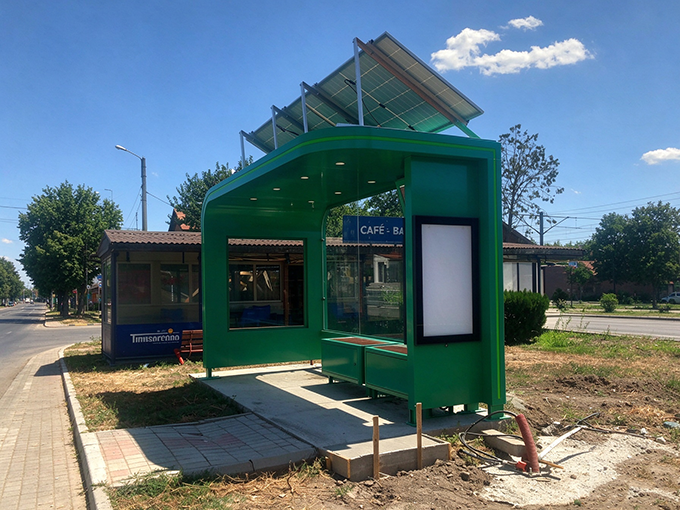
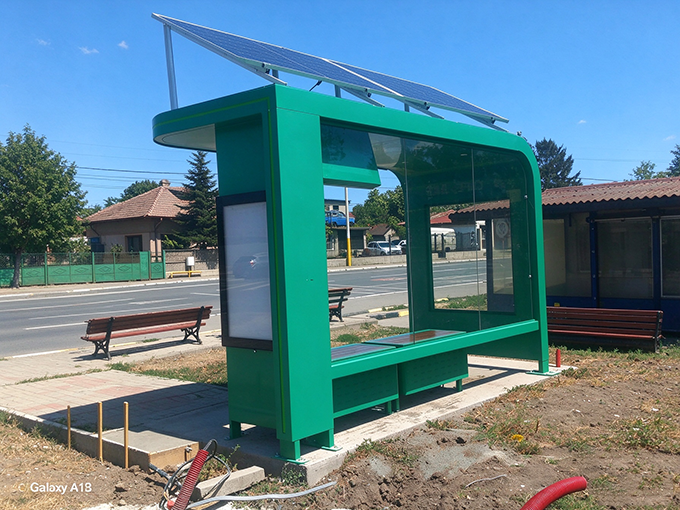
YEROO's solar shelter projects in Australia and Romania (see the solar-powered e-bike and scooter shelter in Romania and the multi-functional smart solar bench in Australia) were both specified on worst-month yield, not annual averages — for sites in the 35°–50° band this distinction typically means a 40–60% larger array than an annual-average calculation suggests. 【YEROO DATA NEEDED: standard solar kit configurations (panel wattage / battery capacity / autonomy days per kit) and warranty durations for panels, batteries and charge controllers】
Which compliance documents and test evidence should the tender require?
Require five document groups: structural (EN 1090 or equivalent execution class with wind-load calculation to EN 1991-1-4 or ASCE 7-22), electrical (IP65 minimum for all outdoor enclosures, IEC 62109 for the charge controller/inverter), battery certification (UN 38.3 transport test for cells, plus IEC 62619 for stationary storage), panel certification (IEC 61215-1 plus IEC 61730), and the contractor's load-balance calculation signed by a named engineer. Each maps to a tender pass/fail line, and each has a specific failure it prevents.
Document group | Named standard | What it prevents | Tender treatment |
Structural calculation | EN 1991-1-4 (wind) / ASCE 7-22 | Panel arrays act as sails; uncalculated uplift in storms | Pass/fail |
Array & controller | IEC 61215-1 + IEC 61730; IEC 62109 | Fire risk, premature panel degradation, controller failure | Pass/fail |
Battery storage | UN 38.3; IEC 62619 | Shipping refusal, thermal runaway, false capacity claims | Pass/fail |
Ingress & environment | IP65 (IEC 60529); operating range stated | Water/dust ingress killing electronics in year one | Pass/fail |
Energy yield proof | Signed load-balance calc; PVsyst or equivalent simulation | Undersized system, dead screens in winter | Scored |
The scored item matters most at bid evaluation. A bidder can copy any standard number into a compliance matrix; a signed energy calculation for your coordinates cannot be faked. Require it as a bid-stage submission, weighted in the technical score, and make the acceptance test (below) verify it.
How should buyers score suppliers for an off-grid shelter?
Score suppliers on five weighted criteria: energy calculation quality (25%), battery and BMS specification (20%), off-grid project references at similar latitude (20%), component brand transparency (15%), and winter degraded-mode design (20%). A supplier who sells the same solar kit for Singapore and Reykjavík should score zero on the first and fifth criteria.
Criterion | Weight | What "excellent" looks like | Evidence demanded |
Energy calculation | 25% | Site-specific PSH from Global Solar Atlas, per-load wattage table, month-by-month yield simulation | Signed calculation + simulation file |
Battery & BMS | 20% | LiFePO4, stated cell brand, low-temp charge protection, cycle life at stated DoD | Datasheets + UN 38.3 / IEC 62619 certs |
Latitude-matched references | 20% | At least one installed off-grid project within ±10° latitude of your site | Project references with contactable clients |
Component transparency | 15% | Named panel, controller and battery brands in the bid, not "high-efficiency" | Brand and model list per line |
Winter degraded mode | 20% | Written load-shedding profile and how it is configured and verified | Configuration description + acceptance test step |
Verify references the way described in how to verify a bus shelter factory before you order: ask the referenced client specifically what their system did in its first winter, not whether they were satisfied. Ask for photos of the battery enclosure and a copy of the commissioning energy readings.
What goes into delivery, acceptance and the maintenance contract?
Acceptance must include a measured energy test, not just a visual check: commission the shelter, log battery state of charge and load currents for a minimum 72-hour period including one full night, and compare against the bid-stage calculation. Acceptance also fixes the asset register — panel serial numbers, battery pack serials, controller configuration file, BMS settings — because without that register no one can source a matching replacement battery in year four.
Write these clauses into the contract:
Acceptance energy test — 72-hour logging; measured consumption within ±10% of the bid calculation, or the supplier retunes and retests at their cost.
Asset register handover — serial-numbered schedule of panels, batteries, controller, BMS firmware version, and the controller configuration export. Payment of the final milestone is conditional on it.
Spare parts terms — 【YEROO DATA NEEDED: standard spare-parts policy and recommended on-site spares holding (batteries, charge controllers, LED modules)】— as a minimum, require the supplier to guarantee battery and controller availability for seven years and to state current part numbers.
Annual preventive maintenance — panel cleaning schedule, torque check on panel fasteners, BMS log review, capacity test at year 1 and every two years thereafter. A LiFePO4 pack that drops below 80% of rated capacity within the warranty period is a warranty claim; you can only prove it with the logged baseline.
Remote monitoring — require the controller to report state of charge and faults remotely. An off-grid shelter you only discover is dead when a resident complains has already cost you the goodwill the shelter was bought to build.
For the wider delivery-and-maintenance framing that applies to any shelter procurement — grid or off-grid — the bus shelter installation guide: from foundation to final commissioning and the bus shelter specifications checklist for procurement officers cover the structural and acceptance stages in detail; the clauses above are the off-grid additions on top of that baseline.
What does under-specifying actually cost?
The cost of getting an off-grid specification wrong is not a repair bill — it is a dead asset in its most visible location. Because there is no grid to fall back on, an undersized system has no degradation curve; it simply fails every winter from year one.
Under-specification | Typical symptom | Corrective cost (indicative) | Contract protection |
Array sized on annual-average sun | Screens dark November–February | Array rework + 30–50% capacity uplift, second crane mobilisation | Worst-month calculation as pass/fail |
Battery without low-temp charge protection | Permanent capacity loss after first winter, full replacement | Battery replacement + labour ≈ US$800–2,500 per shelter | IEC 62619 + stated BMS cut-off |
No load-shedding profile | Complete blackout during extended overcast periods | Firmware/controller retrofit per unit | Degraded-mode clause in acceptance |
No asset register or spares guarantee | Non-matching replacement parts, months of downtime | Service loss for full winter season | Final payment tied to register |
No remote monitoring | Failures discovered by public complaints | Reputation cost, unplanned site visits | Monitoring as delivery requirement |
Ranges are indicative global figures for planning purposes only and must be confirmed against local labour and logistics costs. In a 20-shelter programme, a single winter of dark screens typically costs more in public complaints and council time than the entire array-uplift budget would have.
Conditional specification rules
Consolidated if-then rules for the tender:
If site latitude > 50° and a full digital advertising screen is required → do not tender a purely off-grid shelter; require grid connection, or specify e-paper information display plus lighting only.
If daily load ≤ 500 Wh (lighting only) and latitude ≤ 35° → single 400–500 W array with 2–3 days autonomy is sufficient; reject oversized bids as poor value.
If design temperature < 0 °C → LiFePO4 with low-temperature-charge-protected BMS is mandatory; state the cut-off temperature.
If the site is a pilot (1–3 shelters) → add a winter trial clause: acceptance only after one full winter of logged performance.
If budget cannot fund the worst-month array → reduce the load (smaller display, dusk-to-midnight lighting) rather than shrink the array; a load reduction is a design choice, an undersized array is a defect.
If advertising revenue funds the programme → the digital screen is the revenue asset, so its winter availability percentage becomes a contractual KPI with remedies, not a nice-to-have.
FAQ
How many solar panels does an off-grid bus shelter need?It depends on load and latitude, calculated — not guessed. A lighting-only shelter at low latitude needs about 400–500 W; a shelter with a real-time display at 40–50° latitude needs 1,000–1,500 W. The correct method: daily Wh × 1.33 ÷ worst-month peak sun hours, verified by a signed calculation for the site coordinates.
Can a solar bus shelter power a digital advertising screen?Yes below roughly 50° latitude if the array is sized at 1,500 W or more with adequate battery autonomy — but the energy cost is 2,400–5,600 Wh/day for the screen alone. Above 50° latitude, winter solar yield makes a full digital screen uneconomic off-grid; use e-paper or a grid/hybrid supply instead.
How long do solar bus shelter batteries last?Quality LiFePO4 packs last 3,000–6,000 cycles, typically 8–12 years in shelter duty, versus 3–5 years for sealed lead-acid under partial-charge conditions. Specify LiFePO4 with UN 38.3 and IEC 62619 certification, require a year-1 capacity baseline in the acceptance test, and guarantee spare availability for seven years.
What happens when there is no sun for several days?The battery bank carries the load for the specified autonomy period — normally 3–5 days for information shelters. Beyond that, a written degraded-mode profile takes over (screen off at night, lighting priority). If no degraded mode is configured, the system shuts down completely and may suffer deep-discharge damage, which is why the profile must be an acceptance-test item.
Do solar bus shelters work in winter in northern Europe?They work for lighting and low-power information displays if sized on worst-month yield — roughly 0.8–1.8 PSH at 50–60° latitude. Full digital advertising screens are not viable off-grid at those latitudes. Require a PVsyst or equivalent simulation for the site, a low-temperature-protected BMS, and a one-winter trial clause for pilot deployments.
How do I stop solar panels being stolen or vandalised?Specify anti-tamper Security fixings (one-way shear bolts or keyed fasteners), panels bonded into the shelter roof structure rather than surface-mounted on rails, tamper alarms reported through the remote monitoring system, and panels covered by the structural warranty. Vandalism targeting panels is a design problem solved at fixing level, not an insurance problem.
An off-grid bus shelter is an energy system wearing a shelter's clothes: the aluminium, glazing and coating matter, but the array, battery and load profile decide whether the asset delivers its purpose every winter for a decade. Fix the four numbers before tender, demand signed calculations rather than standard numbers, make the 72-hour acceptance test and asset register conditions of final payment, and put the degraded-mode profile in writing. YEROO has delivered solar-powered transit and street furniture across latitudes from Laos to Iceland — request our off-grid specification pack, including load-balance calculation template, compliance document checklist and an itemised quotation for your site coordinates, via our contact page, or browse the full bus shelter range and solar shelter solutions. For material and coating decisions on the shelter body itself, see bus shelter material selection: 304 vs 316L vs galvanised steel, and for funding routes see smart bus shelter technology: how IoT is transforming transit infrastructure.










 Address:North Tower 904,New World Times Center,Guangyuan Dong Road ,Guangzhou,China
 Phone: +86 13826225776
 Email:yeroo10@3dyeroo.com


