The humble bus shelter has quietly undergone the most significant transformation in its century-long history. What was once a roof, two side panels and a bench is now an intelligent, connected node in the urban mobility network — capable of displaying real-time arrivals, charging passenger devices, monitoring air quality, and generating advertising revenue. Smart bus shelters represent the fastest-growing segment of the global transit infrastructure market, driven by the smart city movement, the expansion of digital out-of-home (DOOH) advertising, and falling sensor and display costs.
For city planners, transit authorities and infrastructure investors evaluating smart shelter deployments in 2026, the question is no longer whether to go smart — it is how far to go, and which technology stack delivers the best return on investment. This guide breaks down the core technologies, the architecture behind them, and the business case for connected shelters.
1. Core Technologies Inside a Modern Smart Bus Shelter
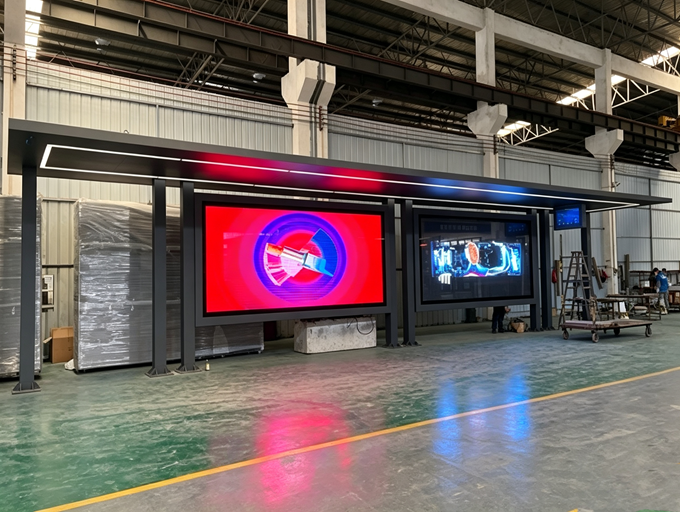
A smart bus shelter is best understood as three integrated technology layers working together: sensing, connectivity, and user experience. Each layer must be engineered for outdoor durability, power efficiency and remote management.
The Three-Layer Architecture
Layer | Components | Function |
Sensing layer | Arrival prediction module, occupancy sensors, environmental monitors (air quality, temperature, noise), CCTV cameras | Collects real-time data about transit operations and passenger environment |
Connectivity layer | 4G/5G modem, Wi-Fi router, IoT gateway, GPS receiver | Transmits data between shelter, transit control centre, and cloud platforms |
User experience layer | Real-time LED/LCD displays, USB charging ports, speakers, interactive kiosks, wayfinding touchscreens | Delivers information and services to waiting passengers |
The sensing layer feeds the connectivity layer, which in turn powers the user experience layer — but the real value emerges when these layers are orchestrated through a central management platform. YEROO's smart bus shelter solution demonstrates this integration, combining GPS positioning, real-time arrival prediction, environmental sensing and voice announcement through a unified control system.
Key Technology Components Explained
Real-time arrival displays: Connected to transit data feeds (GTFS-Realtime or SIRI protocols), these displays show countdowns to the next bus, route maps, and service disruption alerts. Modern displays use high-brightness LED (1,500-2,500 nits) to remain legible in direct sunlight.
IoT sensors: Air quality monitors (PM2.5, PM10, NO₂), temperature sensors, and foot-traffic counters provide data for both transit planning and environmental reporting. Cities like London, Singapore and New York are already deploying AI-powered shelters that monitor usage patterns.
2. The Business Case: Why Cities Are Investing in Smart Shelters
Smart shelters are not simply a technology upgrade — they are an economic decision. Transit authorities increasingly fund smart shelter programmes through a combination of operational savings, advertising revenue, and data value.
Revenue and Cost-Saving Drivers
Driver | Mechanism | Typical Impact |
DOOH advertising revenue | Digital displays sell premium, dynamically-targeted ad space (time-of-day, weather, audience-based pricing) | 2-5× higher revenue per panel vs static advertising |
Reduced maintenance costs | Remote monitoring detects faults early, predicting failures before they cause passenger-facing outages | 20-40% reduction in reactive maintenance spend |
Energy self-sufficiency | Solar integration eliminates or reduces grid electricity costs over a 15-year shelter lifecycle | Full ROI on solar upgrade in 4-7 years at current panel prices |
Data monetisation | Anonymous footfall and dwell-time data can be licensed to urban planners and retailers | Secondary revenue stream, increasingly standard |
Grant funding eligibility | Smart, sustainable infrastructure attracts public transport and smart-city grants | Offsets 20-50% of capital cost in qualifying programmes |
The digital display is the financial anchor of most smart shelter programmes. Media operators such as JCDecaux, Clear Channel and Global have built their business models around advertising-funded transit furniture, and the shift to digital has multiplied the revenue per unit. For a municipality, this can mean installing smart shelters at zero net capital cost in exchange for a share of advertising revenue.
Real-World Deployment Evidence
Cities deploying smart bus shelter networks report measurable outcomes. The integration of real-time arrival information has been shown to reduce perceived waiting time by up to 30%, which directly improves passenger satisfaction and transit ridership — the two metrics most city leaders are judged on. Combined with accessible features such as voice announcements and high-contrast displays, smart shelters also strengthen compliance with accessibility legislation.
3. Engineering for the Outdoor Environment
Smart technology is only as reliable as the enclosure protecting it. A bus shelter sits in one of the harshest environments for electronics: direct sun, rain, dust, humidity, temperature swings from -30°C to 60°C, and vandalism risk. The engineering decisions made by the manufacturer determine whether the electronics last five years or fifteen.
Critical Engineering Considerations
Ingress protection: Displays and control cabinets should be rated IP65 or higher (dust-tight, protected against water jets). Cable entry points need sealed glands to prevent moisture ingress.
Thermal management: In hot climates, displays and batteries need passive or active cooling. Solar systems need charge controllers with temperature compensation to protect battery life.
Surge protection: Public infrastructure is exposed to lightning-induced surges and grid fluctuations. A proper shelter specification includes surge protection devices (SPD) on both power and data lines.
Remote management: Every smart component should be remotely monitorable — display status, battery health, sensor readings, network connectivity — so faults are detected from the control room, not by a passenger complaint.
Modularity: Components should be individually replaceable. When a display fails, swapping a module on site should take minutes, not weeks. Modular design is the difference between a 30-minute repair and a 3-day shelter shutdown.
Solar System Sizing — the Detail That Matters
For solar bus shelters, system sizing is the make-or-break engineering decision. A correctly sized system accounts for:
Ask any supplier for their solar calculation methodology — a manufacturer with real engineering capability will happily share the worksheet. If the answer is vague, that is a red flag.
4. Procurement Considerations for Smart Shelters
Procuring smart bus shelters differs from traditional shelter procurement in several important ways. The technology stack introduces new stakeholders, new contract terms, and new lifecycle considerations.
What to Include in a Smart Shelter Specification
Specification Item | What to Define |
Display specification | Size, resolution, brightness (nits), viewing angle, operating temperature range, IP rating |
Data integration | Which transit data protocols (GTFS-RT, SIRI), who provides the data feed, uptime requirements |
Remote management | Management platform ownership, SLA for fault response, remote diagnostic capabilities |
Connectivity | SIM/data plan ownership, network coverage requirements, failover behaviour |
Power architecture | Grid vs solar vs hybrid, battery autonomy, backup behaviour |
Lifecycle & upgrade path | Component lifespan commitments, software update policy, upgradeability to future features (e.g., 5G, EV charging) |
Selecting the Right Manufacturer
Not every bus shelter manufacturer has genuine smart technology capability. Many offer "smart" shelters by bolting a third-party display onto a standard shelter — which works, but limits integration depth and after-sales accountability. A vertically integrated manufacturer like YEROO designs the structure, the power system, the connectivity architecture and the management software as one system, backed by 25 years of manufacturing experience and deployments across 110+ countries.
When evaluating suppliers, ask for:
A documented system architecture diagram showing how hardware, software and connectivity integrate
Reference deployments with contactable project owners
The management platform demonstration — can they show remote monitoring of live shelters?
Warranty terms covering electronics separately from structure (electronics: 2-3 years; structure: 10-15 years is typical)
5. The Road Ahead: 5G, AI and the Autonomous Shelter
The smart bus shelter of 2026 is already capable, but the roadmap is longer. Three trends will shape the next generation of connected shelters:
AI-powered personalisation: Displays will increasingly serve personalised, context-aware content — weather-based advertising, crowd-aware service messages, and multimodal journey planning that integrates bus, rail, bike-share and ride-hail.
Frequently Asked Questions
What is a smart bus shelter?
A smart bus shelter is a transit shelter equipped with connected technology — real-time arrival displays, IoT sensors, USB charging, Wi-Fi, and often solar power — that communicates with transit control systems to deliver live information and services to passengers. It operates as a node in the city's smart mobility network.
How much does a smart bus shelter cost?
Smart bus shelters typically cost 3,000-8,000 per unit depending on features, compared to 800-2,000 for basic shelters. The premium is offset by advertising revenue (digital displays earn 2-5× more than static) and reduced maintenance costs from remote monitoring. Solar integration typically adds 15-25% but eliminates grid power costs over the lifecycle.
How do smart bus shelters get their power?
Through grid connection, solar power, or a hybrid system. Solar-powered shelters pair photovoltaic panels with lithium battery banks sized for 3-5 days of autonomy, allowing full smart functionality in locations without reliable grid access. Hybrid systems use solar as primary with grid backup for extreme weather periods.
What maintenance do smart bus shelters require?
Electronics require less routine maintenance than structures, but benefit from remote monitoring: displays and sensors report their own status, enabling predictive maintenance. Typical schedules include display cleaning and inspection quarterly, battery health checks annually (lithium batteries replaced every 5-7 years), and software updates as needed — all remotely deployable.
Can existing bus shelters be upgraded to smart shelters?
Yes, in many cases. Standard shelters can be retrofitted with solar panels, displays, and IoT sensors if the structure has sufficient load-bearing capacity and power provisions. Retrofit costs are typically 40-60% of a new smart shelter. Some manufacturers offer modular upgrade kits for their own shelter ranges.
Are smart bus shelters accessible for all passengers?
Modern smart shelters are designed with accessibility in mind: high-contrast displays, voice announcement systems, tactile wayfinding elements, and appropriate lighting. Audio-visual arrival information helps visually and hearing-impaired passengers, and many smart shelter specifications now reference accessibility standards such as the UK's Equality Act and the US ADA.
Building the Connected Shelter Network
Smart bus shelter technology has moved from pilot project to mainstream infrastructure investment. The cities that deploy well-engineered, truly integrated smart shelters gain a measurable edge: higher ridership satisfaction, new advertising revenue streams, lower lifecycle costs, and a visible commitment to modern, sustainable transit.
If your city or organisation is evaluating a smart shelter programme, YEROO's smart bus shelter solution brings together the full technology stack — structure, solar power, real-time displays, IoT sensors and centralised management — under one accountable manufacturer. With 26 years of manufacturing experience and deployments in Hungary, Australia, Romania and beyond, we design shelters that perform as well in year 15 as they do on day one.










 Address:North Tower 904,New World Times Center,Guangyuan Dong Road ,Guangzhou,China
 Phone: +86 13826225776
 Email:yeroo10@3dyeroo.com


