How do the two frames actually differ?
The two frames differ most in weight, stiffness and the way each handles corrosion. Aluminium weighs roughly one-third as much as steel (2,700 vs 7,850 kg/m³), but its stiffness (elastic modulus 69 GPa vs 210 GPa) is also about one-third, so an aluminium profile must be 30–50% deeper to carry the same load. The table below sets out the numbers that matter when you compare quotations side by side.
Property | Aluminium frame (6063-T5) | Galvanised steel frame (S235/S355) |
Density | 2,700 kg/m³ | 7,850 kg/m³ |
Yield strength (EN 755-2 / EN 10025-2) | ≥145 MPa (6063-T5); 240 MPa+ for 6082-T6 | 235–355 MPa |
Stiffness (E modulus) | 69 GPa | 210 GPa |
Corrosion route | Natural oxide layer + 60–80 µm polyester or PVDF powder coat (Qualicoat) | Hot-dip galvanising 70–85 µm to ISO 1461:2022, then powder coat |
Thermal expansion | 0.023 mm/m/°C | 0.012 mm/m/°C |
Profile freedom | Extruded shapes, flush jointing, sharp modern lines | Roll-formed or fabricated sections, visible welds |
Field repair | Limited — welding softens the heat-affected zone; mechanical joints preferred | Weldable on site; re-galvanise repair zones to ISO 1461 Annex C |
Impact resistance | Dents under force | Better resistance to bending and denting |
Frame weight, 6 m × 1.5 m unit | ≈150–220 kg (indicative) | ≈400–550 kg (indicative) |
Ex-works cost index | 1.25–1.60 | 1.00 |
Two consequences follow directly from these numbers. First, freight and installation: an aluminium frame for a standard 6 m unit is typically 200–300 kg lighter (indicative), which means more units per 40 ft container and a smaller crane on installation day. Second, thermal movement: over a 6 m span and a 40 °C temperature swing, an aluminium frame grows about 5.5 mm against 2.9 mm for steel, so drawings must show slotted fixings and 4–5 mm glazing clearance — a detail YEROO builds into every aluminium project drawing.
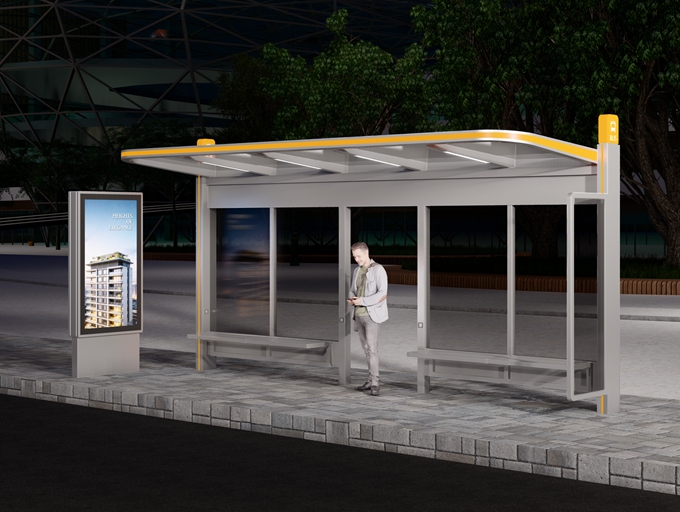
Which conditions favour aluminium — and which favour steel?
The material decision is driven by five site conditions: corrosivity class, snow load, vandalism exposure, design brief and installation logistics. Apply the if-then rules below to your site survey and you will arrive at one material for the whole fleet, which keeps spare parts and repaint cycles simple.
If your project... | Then choose... | Because |
Sits within 500 m of the shoreline (ISO 9223 C5) | Powder-coated aluminium, or 316L stainless if budget allows | Aluminium needs no sacrificial coating; galvanised steel at C5 needs a duplex system and per-batch µm records |
Faces snow loads above ≈1.5 kN/m² | Galvanised steel | Steel's higher stiffness keeps roof members shallow under EN 1991-1-3 loads |
Is in a high-vandalism corridor | Galvanised steel | Steel panels and sections resist denting; aluminium glazing frames deform under repeated impact |
Requires sharp, modern architectural lines (civic or developer brief) | Aluminium 6063-T5 | Extrusion allows flush, seamless profiles steel cannot form |
Installs on a roof deck or a site with crane restrictions | Aluminium | 200–300 kg less weight per unit (indicative) widens crane and access options |
Is a classic-budget fleet of 20+ units | Galvanised steel | Lowest unit cost and the widest choice of standard modules |
Combines solar panels or a LED screen | Either — decide on the roof load case | Point loads and deflection limits determine section depth, not material |
One caution applies to every aluminium specification: never pair aluminium members with unprotected carbon-steel or even direct stainless fixings in wet chloride environments. Galvanic corrosion attacks the aluminium at the contact face. Specify A2/A4 stainless fixings with EPDM or nylon isolation washers, and check that detail appears on the drawings before production starts.
What does each frame cost over 15 years?
Unit price is not the whole number. Over 15 years, freight, installation labour, repaint cycles and repair behaviour move the gap between the two materials closer together — or, on constrained sites, in aluminium's favour. The figures below are indicative global ranges and must be confirmed against a project-specific quotation.
Cost line (15 years) | Galvanised steel | Aluminium | What changes the outcome |
Frame ex-works cost index | 1.00 | 1.25–1.60 | Alloy price and profile complexity |
Freight per unit | Higher — heavier frames fill container weight limits sooner | 20–30% lower (indicative) | Shipping distance; matters most on long export lanes |
Installation | Larger crane, more crew hours | Smaller crane, faster lift | Site access restrictions |
Coating maintenance | Powder coat refresh at 8–12 years; zinc-rich touch-up to ISO 1461 Annex C after damage | Powder coat refresh at 8–12 years; no zinc layer to maintain | UV exposure and colour choice |
Repair after impact | Weld and re-coat locally | Replace the extruded section | Spare-parts policy at order time |
End-of-life value | Scrap steel value, lower per kg | Higher scrap value per kg | Local scrap market |
The practical reading: for a standard city fleet on a straightforward site, galvanised steel wins on purchase price and the 15-year totals stay close. For coastal, roof-level or architecturally driven projects, aluminium's freight, handling and profile advantages recover much of the unit-price premium.
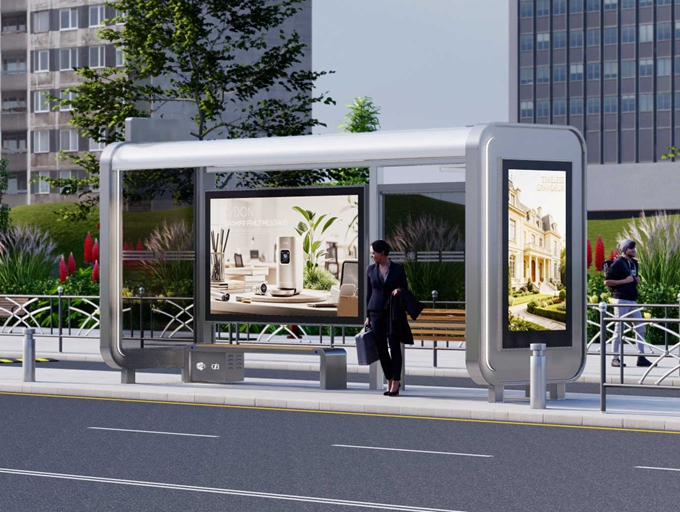
Five frame mistakes that cost money later
Mistake | Consequence | Corrective cost (indicative) |
Specifying aluminium for a deep-snow cantilever without resizing sections | Deflection exceeds limit; redesign or re-die late in the project | USD 1,500–4,000 redesign and re-tooling |
Carbon-steel fixings on an aluminium frame at a coastal site | Galvanic pitting at every fixing point within 2–3 years | USD 300–800 per unit in fixings and labour |
Buying "maintenance-free aluminium" with no powder coat | Surface chalks and dulls; recoating aluminium is impractical | USD 500–1,200 per unit panel and section replacement |
Rigid glazing fixed to an aluminium frame without 4–5 mm movement clearance | Thermal expansion cracks roof or side panels | USD 400–900 per unit re-glazing |
Field-welding a galvanised frame without ISO 1461 Annex C zinc repair | Rust streaks within 2–3 winters | USD 200–500 per unit re-treatment |
Each of these is avoidable with one action: ask the supplier for the material-specific drawing package — fixing schedule with isolation washers, movement clearances and repair notes — before approving production drawings.
FAQ: Aluminium vs Steel Bus Shelter Frames
Does an aluminium bus shelter rust?No. Aluminium forms a natural oxide layer that stops corrosion from progressing, so it needs no galvanising. A 60–80 µm polyester or PVDF powder coat is still specified — not for corrosion but for colour, UV stability and cleanability. The real risk is galvanic corrosion from the wrong fixings, which isolation washers eliminate.
Which is cheaper: aluminium or galvanised steel bus shelters?Galvanised steel is cheaper ex-works — an indicative index of 1.00 against 1.25–1.60 for aluminium. On long export routes or crane-restricted sites, aluminium's lower freight and installation cost recovers part of the premium. Confirm both figures on an itemised quotation before comparing.
Can an aluminium frame carry solar panels or a LED screen?Yes, provided the extrusion section is designed for the point loads. Solar arrays add roughly 15–20 kg/m² of dead load and screens add concentrated loads at the head member. Ask for the structural calculation for your exact configuration rather than accepting a catalogue figure.
Are aluminium shelters suitable for snowy climates?They are, if the sections are sized to the site's EN 1991-1-3 snow load. As a working rule, steel is the better choice above roughly 1.5 kN/m² (indicative) because its three-times-higher stiffness keeps roof members shallow. Below that, both materials perform.
How long does each frame last?Both reach 15–25 years with correct specification. Corrosion rarely ends either frame's life; appearance does. Powder coat refresh at 8–12 years keeps either material looking new, and the coating decision matters more than the substrate choice.
Does YEROO manufacture both frame types?Yes. YEROO produces galvanised steel, aluminium and stainless steel shelters at its 31,000 m² Foshan facility — for example the Athens stainless steel project in Greece and standard steel fleets across Europe and Asia. Request a material recommendation against your site's corrosivity class and load case.
Conclusion: decide on the site, not on the brochure
Aluminium and galvanised steel are both proven bus shelter frames; neither is universally "better". Match the material to your five site conditions — corrosivity class, snow load, vandalism exposure, design brief and installation logistics — and hold the supplier to the material-specific details: ISO 1461:2022 coating thickness on steel, Qualicoat powder coat and isolated fixings on aluminium, and movement clearances on both.
YEROO supplies a material recommendation, structural calculations for your exact configuration and an itemised quotation comparing galvanised steel and aluminium options for the same design. Send your site survey to contact YEROO and receive the comparison pack before you commit to either frame.
Further reading:










 Address:North Tower 904,New World Times Center,Guangyuan Dong Road ,Guangzhou,China
 Phone: +86 13826225776
 Email:yeroo10@3dyeroo.com


