For bus shelters within 1 km of salt water, specify 316L stainless steel or hot-dip galvanised steel with a minimum 80 μm zinc layer plus a 100 μm marine-grade powder coat. Avoid untreated 304 stainless or standard polyester coatings within 500 m of breaking spray, because chloride pitting and edge corrosion typically appear within 3–5 years.
Which material specification survives a coastal bus shelter project?
Specify 316L stainless steel for the primary structural members and fixings if the site is within 500 m of the sea or exposed to regular wind-borne salt. 316L contains 2–3% molybdenum, which resists chloride pitting far better than 304 in C4–C5-M marine atmospheres.
For sites 500 m–3 km from the coast, hot-dip galvanised carbon steel to ISO 1461 with a zinc coating thickness of 80–100 μm is acceptable, provided it is finished with a marine-grade powder coat. YEROO's coastal-series shelters use 304 or 316L frames depending on the customer's stated corrosion category, with galvanised steel substructures where hidden from direct salt spray.
Aluminium 6063-T5 or 6061-T6 is a viable alternative for non-load-bearing cladding and roof panels in coastal zones, but it must be isolated from dissimilar metals to avoid galvanic corrosion. Never mix uncoated aluminium and carbon steel fixings in the same joint.
Location vs sea | ISO 9223 class | Primary structure | Fixings / hardware | Cladding / roof |
0–500 m, direct spray | C5-M / Im2 | 316L stainless steel | 316L bolts, A4-80 | Marine-grade aluminium or 316L |
500 m–1 km, high salt | C4–C5-M | 316L or HDG + marine coat | A4-70 minimum | Powder-coated aluminium |
1–3 km, moderate salt | C3–C4 | HDG ≥80 μm + powder coat | A2-70 minimum | Powder-coated galvanised steel |
3–10 km, low salt | C2–C3 | HDG ≥60 μm + powder coat | A2-50 minimum | Powder-coated steel |
>10 km inland | C1–C2 | HDG ≥40 μm + standard coat | Zinc-plated acceptable | Standard powder-coated steel |
How do ISO 9223 corrosivity categories map to shelter materials?
ISO 9223 classifies atmospheric corrosivity from C1 (very low) to C5 (very high) plus CX for extreme offshore and Im categories for immersed or splash zones. Coastal bus shelters usually fall into C3, C4 or C5-M, depending on distance from the sea, prevailing wind and local humidity.
C3 covers rural or urban areas with low salt burden. C4 covers industrial or coastal zones with moderate salt. C5-M covers coastal and marine environments with high chloride deposition. If your project is on a promenade, ferry terminal or island with regular salt spray, treat it as C5-M regardless of the distance figure.
The standard gives corrosion rates for carbon steel, zinc, copper and aluminium. A C5-M atmosphere can corrode unprotected carbon steel at 500–700 μm per year and zinc at 10–20 μm per year. That is why a 60 μm galvanise layer, which is adequate for C3, would be consumed in 3–6 years in C5-M. Use this mapping to justify the material upgrade to stakeholders who only see the initial cost difference.
ISO 9223 class | Typical environment | Unprotected steel loss/year | Zinc loss/year | Shelter material rule |
C2 | Arid inland | <25 μm | <0.7 μm | Standard galvanised steel |
C3 | Urban / mild coastal | 25–50 μm | 0.7–2.1 μm | HDG ≥60 μm + polyester coat |
C4 | Industrial / 1–3 km coast | 50–80 μm | 2.1–4.2 μm | HDG ≥80 μm + marine powder |
C5-M | Marine / <1 km coast | 80–200 μm | 4.2–8.4 μm | 316L or HDG ≥100 μm + full seal |
CX / Im2 | Splash / tidal | >200 μm | >8.4 μm | 316L + cathodic protection review |
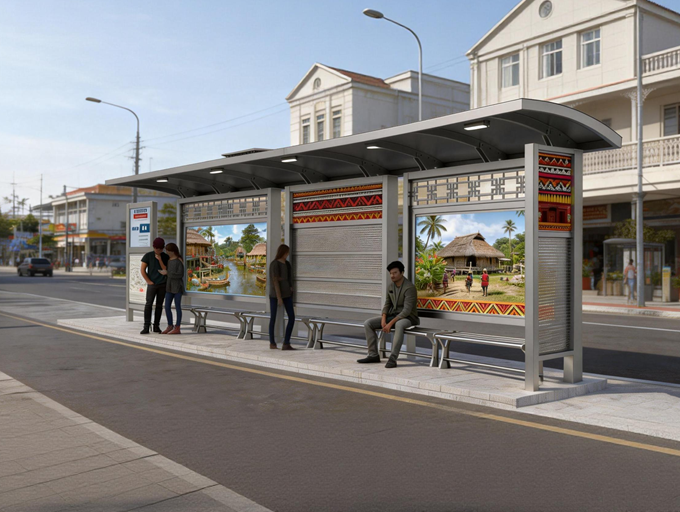
What coating system gives a 15-year service life near the sea?
A 15-year service life in C4–C5-M requires a duplex system: hot-dip galvanising as the sacrificial base, followed by surface preparation and a thermosetting powder coat. The galvanise layer must be 80–100 μm, not the 40–60 μm common on inland furniture. The powder coat should be a polyester- or polyurethane-based marine formulation with a minimum dry-film thickness of 80–100 μm.
Surface preparation is the most common failure point. Galvanised steel must be degreased, lightly abrasive-blasted or sweep-blasted, and primed with a zinc phosphate or chromate-free wash primer before powder application. Without this, the powder coat will peel at edges and welds within 2–4 years, letting salt reach the zinc layer underneath.
YEROO applies Qualicoat-class powder coating with controlled film thickness and salt-spray testing to relevant substrates. 【YEROO DATA NEEDED: standard coating thickness range, salt-spray test duration in hours, and coating warranty period for coastal installations.】 For critical coastal projects, request a coating inspection report listing adhesion grade, film thickness measurements and holiday detection results.
Coating layer | Function | Minimum thickness | Test standard |
Hot-dip galvanise | Sacrificial corrosion barrier | 80–100 μm (C4/C5-M) | ISO 1461 |
Conversion primer | Adhesion promotion | 5–8 μm | ISO 8502-3 |
Marine powder topcoat | UV + salt barrier | 80–100 μm | ISO 9227 salt spray |
Edge seal (optional) | Cut-edge protection | Brush-applied | ASTM D1653 / project spec |
Which design details fail first in high-salt air?
Crevices, overlapping plates and closed box sections trap salt-laden moisture and are the first places to fail. The joint between roof panel and side frame, the base plate-to-column connection, and any internal channel where condensation collects are high-risk zones.
Specify fully welded joints with continuous sealing where possible, and avoid overlapping steel plates that create capillary gaps. Drain holes must be large enough to clear salt crust and oriented so rain washes debris out. Fasteners should be A4-70 stainless steel, with nylon washers or EPDM gaskets to isolate dissimilar metals.
Electrical enclosures and solar bus shelters need IP65-rated junction boxes and sealed cable glands. Salt air corrodes copper contacts and printed circuit boards faster than structural steel, so electronics should be mounted inside sealed cabinets with desiccant packs or positive-pressure vents.
Detail | Common failure | Corrective spec |
Overlapping roof sheets | Capillary salt trapping | Standing seam or fully welded cap |
Closed base channels | Condensation + salt ponding | Drain slots ≥10 mm, sloped to outside |
Mild-steel fixings into 304 frame | Bimetallic galvanic corrosion | A4-70 bolts with insulating washers |
Exposed cut edges on galvanised parts | Edge rust propagation | Touch-up zinc repair + seal coat |
Ungasketed advertising frame gaps | Salt ingress behind posters | EPDM gasket + weep holes |
What documentation should a coastal shelter order include?
Every coastal bus shelter order should ship with material certificates, coating test reports and a structural calculation note. The material certificate must state the stainless-steel grade (304 or 316L), galvanise thickness range and batch numbers. Coating reports should include dry-film thickness readings, adhesion test results and salt-spray duration.
Request a declaration of compliance with EN 1090-2 for steel structures and ISO 9223 for the selected corrosivity category. If the shelter carries advertising equipment or electrical systems, CE marking and an IP rating certificate are also necessary. 【YEROO DATA NEEDED: list of standard certifications supplied with YEROO coastal shelters, including ISO 9001 scope, CE marking categories and available test report types.】
For tender packages, YEROO can provide a corrosion-resistance statement that maps the proposed material schedule to the project environment. This document is useful when procurement officers must justify a higher-spec bid against a cheaper inland-grade alternative.
Common mistakes and their corrective cost
Mistake 1: Selecting 304 stainless steel for a C5-M site. 304 will pit within 3–5 years within 300 m of breaking waves. Corrective cost: full cladding replacement at 40–60% of initial shelter price.
Mistake 2: Specifying a 40 μm galvanise layer near the coast. The zinc will be consumed in under 10 years in C4 and under 5 years in C5-M. Corrective cost: recoating on site at $800–1,500 per shelter, or premature structural replacement.
Mistake 3: Ignoring hidden crevices. Saltwater pooling inside closed sections causes internal rust that is invisible until failure. Corrective cost: structural remediation or replacement of columns and roof beams.
Mistake 4: Using standard polyester powder coat without primer. Delamination starts at welds and corners. Corrective cost: full abrasive blast and recoat at 30–50% of replacement cost.
Mistake 5: Mixing aluminium and steel without isolation. Galvanic corrosion destroys the interface in 1–3 years. Corrective cost: replacement of affected panels and fixings, plus labour to isolate remaining joints.
FAQ
Can I use standard galvanised steel within 500 m of the sea?
No. Standard galvanised steel with a 40–60 μm zinc layer is insufficient within 500 m of breaking spray. Specify 316L stainless steel or hot-dip galvanised steel with at least 80–100 μm of zinc and a marine-grade powder coat. In ISO 9223 terms, this zone is C5-M, and the zinc loss rate is 4–8 μm per year.
How close to the coast requires 316L stainless steel?
Use 316L for primary structure within 500 m of the sea or on any site with direct salt spray. Between 500 m and 1 km, 316L is the safe choice for long-life projects, while duplex-coated galvanised steel may be acceptable for lower-budget programmes with shorter replacement cycles.
Does powder coating stop salt corrosion?
A powder coat slows salt corrosion but does not stop it if the substrate or edges are unprotected. It must be applied over a galvanised or passivated base, with full edge sealing and holiday-free coverage. A single coat on bare steel will fail by under-film corrosion within 2–4 years in C5-M.
What maintenance schedule does a coastal shelter need?
Wash salt deposits off the shelter every 2–4 weeks during storm season and inspect fixings, gaskets and drainage every 6 months. Re-apply edge sealant and touch up coating damage immediately. Annual professional inspection is recommended for C5-M sites.
How long should a coastal bus shelter last?
A correctly specified coastal shelter in C4 should last 15 years with scheduled maintenance. In C5-M, 12–15 years is achievable with 316L primary structure and a duplex coating system. Uncoated or underspecified shelters may need major refurbishment in 5–8 years.
Is aluminium a good alternative to stainless steel near the sea?
Aluminium performs well in salt air if it is 6063-T5 or 6061-T6 and isolated from steel and copper fixings. It is suitable for cladding, roof panels and non-structural trims. Do not use aluminium for primary load-bearing columns in high-vandalism or high-wind zones without a full structural check.
Conclusion: specify once, avoid replacement
Coastal bus shelter corrosion is a specification problem, not a maintenance problem. Choose 316L within 500 m of the sea, use duplex galvanise-plus-powder systems for moderate salt zones, and seal every crevice and edge. Get material certificates and coating reports before shipment, and budget for quarterly salt washing.
If you are planning a coastal shelter rollout, send YEROO your site coordinates and salt-exposure conditions. Our technical team will map the project to ISO 9223 categories and propose a material schedule with named component grades and coating thicknesses. Browse our bus shelter range and project references to see specifications used in Hungary, Australia and Romania.










 Address:North Tower 904,New World Times Center,Guangyuan Dong Road ,Guangzhou,China
 Phone: +86 13826225776
 Email:yeroo10@3dyeroo.com


