Desert bus shelters do not fail from corrosion — arid zones sit in ISO 9223 C2–C3 — they fail from UV, heat and dust. Specify super-durable powder coat in light colours, tempered glazing, ventilated double-skin roofs, IP66 dust-sealed electronics rated to 60°C+, and 5–7 mm expansion allowance on 6 m aluminium spans.
What actually fails first on a bus shelter in desert heat?
In desert climates, the first failures are the coating, the seals and the electronics — not the structure. Standard polyester powder coats chalk within 3–5 years under extreme UV, elastomer gaskets harden in cyclic 25–80°C surface heat, and consumer-grade displays shut down above 50°C while the galvanised steel frame remains structurally sound.
This is the opposite failure profile to a coastal project. On the coast, the budget argument is about metal grades; in the desert, the frame is rarely the problem. A dark powder-coated steel roof panel in 48°C ambient air with full sun routinely reaches 80–90°C surface temperature. That surface heat drives three failure mechanisms at once: UV photodegradation of the coating, thermal cycling that fatigues seals and joints, and heat soak into everything mounted under the roof — screens, batteries, LED drivers and wiring insulation.
Dust adds a fourth mechanism. Sand particles abrade unprotected surfaces, clog ventilation gaps and, in the case of solar equipment, cut photovoltaic yield by 10–25% within weeks of a storm if panels are not cleaned. Procurement officers who specify against corrosion alone will therefore sign off a shelter that looks correct on paper and fails on every painted, sealed and powered component within one to four summers.
Failure mode | Driver | Typical onset (inland-grade spec) | Corrective specification |
Powder coat chalking and colour fade | UV dose + 80–90°C surface temps | 2–4 years | Super-durable (Class 2) polyester or PVDF coat, light colour |
Glazing sealant hardening, loss of adhesion | Cyclic 25→80°C swings | 3–6 years | High-temperature neutral-cure silicone rated to 150°C |
Polycarbonate yellowing, embrittlement | UV with thin or absent UV layer | 2–4 years | Tempered glass, or PC with ≥50 μm co-extruded UV layer |
Display shutdown and blackouts | Air above 50°C in afternoon sun | First summer | Industrial panel rated −20 to +70°C in shaded, vented housing |
Battery charge blockage, capacity fade | Cell temperature above 45°C when charging | First summer | Shaded, ventilated LFP pack with temperature-managed BMS |
PV yield loss | Dust soiling after storms | 10–25% within weeks | Steep tilt for dust shedding + scheduled cleaning programme |
Which materials and coatings survive desert UV and 80°C surfaces?
Specify hot-dip galvanised steel to ISO 1461 for the structure — desert atmospheres sit in ISO 9223 corrosivity class C2–C3, so 316L stainless is an unnecessary cost — and spend the budget on a Qualicoat Class 2 super-durable powder coat in a light colour, applied at 80–100 μm over the galvanise.
The logic inverts the coastal decision in our coastal corrosion guide. Arid inland air carries almost no chloride, so a standard ISO 1461 galvanise layer (60–85 μm depending on section thickness) gives decades of protection at C2–C3. Carrying a coastal-grade material schedule into a desert tender simply moves money away from the components that actually degrade. YEROO builds both environments on the same structural platform and changes the finish package, which is why the finish specification deserves the closest review.
Coating selection is a colour decision as much as a chemistry decision. Dark roofs and columns in RAL 9005-class blacks reach 80–90°C in full sun; light greys and creams (RAL 7035, RAL 9001, RAL 1015) run 10–20°C cooler because they reflect more solar radiation. Chemistry matters equally: standard polyester is the inland-grade option, while super-durable polyester or PVDF systems to Qualicoat Class 2 are formulated for exactly the high-irradiance conditions a desert produces. As a recommended acceptance criterion, request weathering test reports to ISO 4892-3 (or ISO 16474-3 for coatings) with colour change ΔE ≤ 3 and gloss retention ≥ 50% after 1,000 hours — indicative global practice, to be confirmed against the supplier's test data. 【YEROO DATA NEEDED: YEROO coating weathering test data for high-UV climates — test hours, gloss retention, ΔE values, and coating warranty duration for desert installations.】
Thermal expansion is the second silent killer. Aluminium expands at roughly 23 μm per metre per °C and steel at 12. A 6 m aluminium roof beam swinging through a 50°C day-night range moves 6.9 mm; the equivalent steel beam moves 3.6 mm. Long glazing panes and roof sheets need slotted fixing holes, compliant sealant joints and rebates sized for the full expansion range, or the first summer will crack glass and buckle panels. Glazing itself: specify tempered glass to EN 12150-1, which tolerates thermal stress; avoid annealed glass and dark-tinted panes in direct sun, both of which are prone to thermal breakage. Polycarbonate is acceptable only with a substantial co-extruded UV layer — see the full trade-offs in our glazing decision guide.
Component | Inland standard spec | Desert minimum spec | Why it changes |
Structure finish | Galvanised + standard polyester, any colour | Galvanised + Qualicoat Class 2 coat, light colour | UV dose and 80°C+ surfaces |
Roof | Single skin | Ventilated double-skin or reflective-coated | Cuts radiant heat into waiting zone |
Glazing | Tempered glass or standard PC | Tempered glass; PC only with ≥50 μm UV co-extrusion | Thermal stress and UV yellowing |
Seals and gaskets | EPDM | High-temperature silicone | EPDM hardens under cyclic heat |
Electronics enclosure | IP54 | IP65–IP66 (dust-tight IP6X) | Sand ingress and abrasion |
Seat surface | Solid powder-coated panel | Perforated or slatted, light colour | Solid dark seats exceed 70°C |
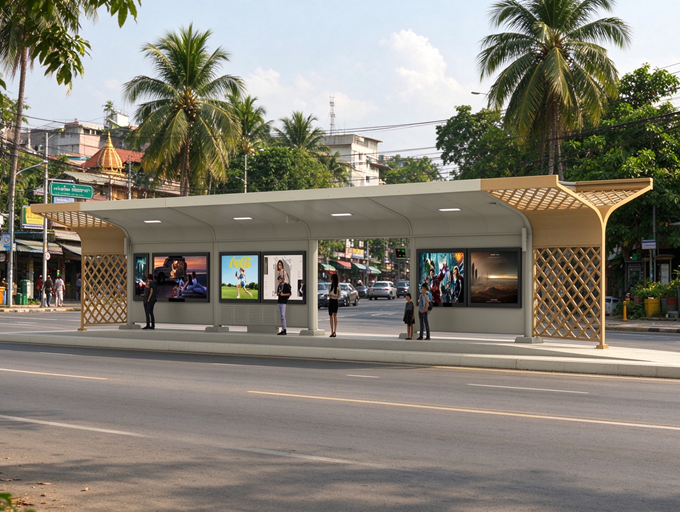
How do you keep passengers and electronics below their limits?
Passive shade and airflow hold the waiting zone well below surface extremes, but electronics need hard temperature limits, not hope. Mount screens and batteries on the shaded elevation, specify industrial-grade components rated −20°C to +70°C, and design the roof to shed, not trap, heat.
For passengers, three passive measures do most of the work. Extended eaves of 600–1,000 mm shade the seating line through the low-angle morning and afternoon sun. Fully open sides, or generous openings on the long elevations, let hot air leave instead of pooling. A ventilated double-skin roof — two separated panels with an air gap — stops the outer skin radiating heat down onto waiting passengers. Seat choice completes the picture: solid dark metal seats can exceed 70°C and become unusable at midday, so specify perforated stainless or slatted timber-look seats in a light finish. In condition X terms: if the project budget cannot deliver all three, prioritise the roof, because radiant heat from above is the largest single comfort factor.
Electronics have published limits, and desert conditions cross them. Commercial LCD displays are typically rated 0–50°C; an unshaded screen in a Gulf-summer shelter exceeds that every afternoon, throttling to black at the exact hours advertisers pay for. Specify industrial panels rated −20 to +70°C with 2,500–3,000 nits brightness for direct-sun readability, mounted on the shaded elevation — north-facing in the northern hemisphere — inside a ventilated housing. Lithium batteries must not be charged above 45°C: most battery management systems block charging above that point, so a sun-soaked battery box produces a shelter that goes dark precisely when the solar resource peaks. Use LFP chemistry for its superior heat tolerance, and mount the pack in a shaded, ventilated bay.
Solar generation needs the same discipline. Crystalline silicon modules lose roughly 0.35–0.45% of output per °C above 25°C cell temperature; desert cell temperatures of 65–80°C cut real output 15–25% below laboratory ratings. Size the array on hot-weather derating, not nameplate figures — the full method is in our solar sizing guide — and select modules qualified to IEC 61215-1, noting that the 2021 edition directs hot-climate projects with 98th-percentile operating temperatures above 70°C to the stricter IEC TS 63126 test levels. Add a soiling plan: quarterly cleaning, monthly during dust season.
Device | Standard-grade rating | Desert minimum specification |
LCD advertising display | 0–50°C, 1,500 nits | −20 to +70°C, 2,500–3,000 nits, shaded vented housing |
Battery (solar shelters) | NMC, charging 0–45°C | LFP chemistry, temperature-managed BMS, shaded ventilated bay |
PV module | IEC 61215-1 qualified | Hot-climate qualification per IEC TS 63126; array oversized 20–25% |
Enclosure protection | IP54 | IP65–IP66, dust-tight, filtered pressure-relief vents |
Cable insulation | Standard PVC | High-temperature cross-linked insulation in roof void |
Which specification package fits your climate?
Match the specification package to measured peak temperature and annual dust-storm days, not to country names. Below 45°C peaks, a UV-hardened standard shelter is sufficient; 45–55°C with sandstorms requires the full desert package; above 55°C or on exposed sites, add heat-mitigation measures or an air-conditioned design.
Project condition | Spec package | Key additions over inland standard | Indicative budget effect* |
Peaks 40–45°C, low dust (e.g. inland Australia, southern Europe) | UV-hardened standard | Class 2 coating, light colours, silicone seals, tempered glazing | +5–10% on finish package |
Peaks 45–55°C, sandstorms >10 days/year (Gulf and MENA corridor, northwest China) | Full desert package | IP66 electronics, shaded equipment bay, ventilated double-skin roof, expansion clearances, cleaning programme | +10–20% |
Peaks >55°C, or fully exposed west-facing site | Desert package + heat mitigation | Reflective roof system, extended eaves, active ventilation for electronics; evaluate air-conditioned shelter for premium sites | +20–35% |
No grid power | Desert package + hot-climate solar | Array oversized 20–25%, LFP battery bay, quarterly panel cleaning | Per sizing guide |
Advertising contract, footfall >1,500/day | Desert package + digital grade | Industrial display (−20 to +70°C, ≥2,500 nits), dust-sealed, shaded mount | Per ROI model |
*Indicative global ranges against an inland-standard shelter structure; confirm against the current YEROO quotation.
If-then specification rules:
IF peak ambient exceeds 45°C AND a screen is in scope, THEN specify an industrial display rated −20 to +70°C at ≥2,500 nits, because commercial 0–50°C panels shut down in afternoon sun.
IF sandstorms occur more than 10 days per year, THEN specify IP66 dust-tight enclosures, brush- or labyrinth-sealed vents and a contractual quarterly cleaning programme.
IF an aluminium roof span exceeds 4 m, THEN require slotted fixing holes and ≥6 mm expansion allowance per 6 m of span (23 μm/m/°C × 50°C swing).
IF the shelter is solar-powered, THEN specify LFP batteries in a shaded, ventilated bay, because charging above 45°C is blocked by the BMS and accelerates cell ageing.
IF the site combines coastal salt with desert heat (Red Sea and Gulf coasts), THEN combine this guide with the coastal corrosion spec: 316L structure AND Class 2 light-colour coating — both, not either.
IF the client requires an enclosed premium waiting lounge, THEN move from passive measures to an air-conditioned shelter evaluation, budgeting the power supply first.
Common mistakes and their corrective cost
Most desert shelter failures trace back to five procurement decisions, each with a known corrective cost. Treat this list as a tender-review checklist: if a supplier's offer is silent on any of these five points, that silence is where your project will fail first.
Mistake 1: Awarding an inland-grade powder coat. Standard polyester chalks and fades within 2–4 years under desert UV. Corrective cost: full abrasive blast and recoat at roughly $700–1,400 per shelter (indicative), or early reputational damage on a flagship corridor.
Mistake 2: Specifying dark-coloured roofs and seats. Surface temperatures of 80–90°C make seating unusable at midday and drive radiant load into the shelter. Corrective cost: reflective recoat or panel replacement, plus passenger complaints during the first summer.
Mistake 3: Installing commercial-grade screens. Panels rated 0–50°C throttle or shut down every hot afternoon, which is exactly when advertising revenue peaks. Corrective cost: swap to industrial panels at 1.5–2× the display price plus retrofit labour.
Mistake 4: Zero expansion clearance on long runs. Glass cracks and polycarbonate buckles when 6 m spans are rigidly fixed at both ends. Corrective cost: re-cutting and reglazing at $200–500 per shelter (indicative), with leak repairs following the cracks.
Mistake 5: No PV soiling plan. Uncleaned panels lose 10–25% of yield after dust storms, silently undersizing the battery budget. Corrective cost: an emergency cleaning contract and, frequently, a battery upgrade that a planned 20–25% array oversize would have avoided.
FAQ
Can a bus shelter withstand 55°C desert heat?
Yes. The galvanised steel structure is unaffected by ambient heat; the specification must target coatings, seals and electronics instead. Dark surfaces in full sun reach 80–90°C, so the defence is a Class 2 light-coloured coating, ventilated roof construction and components rated −20 to +70°C.
Does a desert bus shelter need air conditioning?
Not for open-sided shelters. Passive shade, open elevations and a ventilated double-skin roof keep the waiting zone tolerable at a fraction of the cost. Air conditioning is justified only for enclosed premium lounges with a reliable power supply, and it changes the power budget by kilowatts, not watts.
Which paint colour works best for desert bus shelters?
Light colours — light grey, cream, white families such as RAL 7035, 9001 and 1015 — reflect solar radiation and run 10–20°C cooler than dark colours. Pair light colours with a super-durable (Qualicoat Class 2) coating, because the same reflectivity means the coating still needs full UV resistance.
How do sandstorms affect bus shelters?
Sand abrades exposed surfaces, clogs ventilation gaps, blinds solar panels and finds every unsealed joint in electronics. Counter it with IP66 dust-tight enclosures, sealed glazing with weather-rated gaskets, downward-draining details that shed post-storm rain, and a cleaning schedule tied to the storm season.
Do solar panels still work at 50°C ambient?
Yes, with derating. Crystalline silicon loses roughly 0.35–0.45% of output per °C above 25°C cell temperature, and desert cell temperatures of 65–80°C cut output 15–25% below nameplate. Size the array on hot-weather figures, specify IEC 61215-1-qualified modules and schedule quarterly panel cleaning.
How often should desert bus shelters be maintained?
Wash and inspect quarterly, plus a post-storm check after any major dust event. Annual tasks include seal inspection, drainage clearance and coating touch-ups. Solar shelters need quarterly panel cleaning — monthly during dust season — because soiling losses compound directly into battery life.
Conclusion: build for heat, not rust
Desert bus shelter heat management is a finish-and-electronics problem, not a structural one. Keep the galvanised frame at inland grade, put the budget into Class 2 light-coloured coatings, ventilated roofs, tempered glazing, expansion allowances and IP66 industrial electronics, and contract the cleaning programme before the first sandstorm. A shelter specified this way holds its appearance and its uptime through 55°C summers; one specified on corrosion logic alone will not.
If you are planning a shelter programme for a hot-climate corridor, send YEROO your site coordinates, peak temperatures and dust exposure. Our engineers will map the project to the correct spec package and return a material and electronics schedule with named component grades. YEROO has delivered shelters to programmes across more than 100 countries, including installations in Australia and Europe — browse the bus shelter range and project references, and see how the same platform adapts from solar shelters to full desert specifications. 【YEROO DATA NEEDED: named desert/GCC project references — country, city, unit count, model and installation year — to strengthen E-E-A-T.】










 Address:North Tower 904,New World Times Center,Guangyuan Dong Road ,Guangzhou,China
 Phone: +86 13826225776
 Email:yeroo10@3dyeroo.com


