Before tendering a campus or hospital bus shelter, a smart-city buyer must lock five things: the boarding demand figure (peak-burst, not daily average), the accessibility standard the site must satisfy, the power route (grid or solar), the document set the supplier must submit, and the funding model. Most tenders that stall fail on these five, not on price.
What does a smart-city buyer actually have to decide?
For a campus or hospital shelter, the buyer decides four things: how much shelter to buy, which compliance regime it must satisfy, who pays for it, and who maintains it for the next five to ten years. The technical specification is an output of those decisions — not a starting point. Buyers who begin with a product specification end up with a shelter that meets the catalogue but fails the accessibility audit or the operations budget.
Smart-city programmes add one more layer. When shelters sit inside a smart-campus or smart-hospital framework, the buyer is also required to keep the asset data-compatible: shelters may need to feed occupancy, departure or environmental data into the city or estate platform. Retrofitting a data interface after installation costs more than specifying it in the tender.
So the procurement question is not "which shelter is best?" It is "which shelter configuration satisfies our accessibility duty, our power constraints, our funding model and our data obligations — at the lowest ten-year cost?"
What must be fixed before you go to tender?
Fix five data points in the pre-tender pack before writing the specification, and the tender answers itself. Missing any one of them pushes the risk onto the supplier's assumptions, which is exactly what buyers should avoid.
Data Point | What the buyer must record | Why it changes the purchase |
Peak-burst boarding demand | Passengers waiting at the worst 15-minute window (class changeover, shift change), plus daily boardings | Sets shelter length and number of modules — a 800/day stop can still need 60+ waiting positions |
Dwell profile | Longest typical wait (shuttle headway) and share of seated/vulnerable users | Drives seating count, weather closure and lighting level |
Accessibility standard | Which regime applies (ADA/PROWAG, Equality Act + Inclusive Mobility, EN 17210) | Determines 1,500 mm turning zone, level boarding surface, tactile paving and handrails |
Power route | Distance to nearest mains supply, or confirmed prohibition on trenching | Decides grid vs solar configuration and the site survey the supplier must carry out |
Site constraints | Wind exposure, salt/coastal proximity, snow load zone, heritage or planning restrictions | Sets material grade, coating system, structural design load and permissible finishes |
Add two more items if the project is being procured under a smart-city framework: the data interface requirement (what the shelter must report and to which platform) and the asset register format the estate department will use for maintenance planning. Both belong in the tender document, not in a post-award conversation.
The bus shelter specifications checklist used by procurement officers is a useful cross-check before the package goes out — it lists the structural, material, accessibility and technology items that should be stated explicitly rather than left to the supplier.
Which compliance documents should the tender require?
Require four document groups in the tender response: quality certification, structural and materials test evidence, accessibility conformity, and electrical/solar certification. A supplier that cannot produce all four in the bid stage will usually fail to produce them at handover, when you have less leverage.
Document Group | What to require | Acceptable evidence |
Quality management | ISO 9001 certificate with valid expiry date and issuing body | Certificate copy plus scope statement covering steel structure fabrication |
Structural evidence | Wind and snow load calculation to EN 1991-1-4 / EN 1991-1-3 (or ASCE 7 for US projects) for the site's design values | Signed calculation report; weld qualification to EN ISO 15614-1 where relevant |
Materials and coating | Steel grade certificates, hot-dip galvanising to ISO 1461, coating thickness and adhesion test results | Mill certificates, coating DFT readings (≥ 80 μm for external powder systems) and salt-spray results |
Glazing | Laminated glass conformity to EN ISO 12543 (or tempered to EN 12150-1 where permitted) | Supplier declaration plus test certificate; state whether laminated is mandatory on patient routes |
Electrical / solar | IP rating of enclosures (IP65 minimum for external), PV module certification to IEC 61215-1, battery chemistry and cycle life | Module datasheet, enclosure IP test report, battery specification |
Accessibility | Conformity statement against the applicable regime, with dimensions marked on drawings | Drawings showing boarding zone, turning circle, seat heights and handrail positions |
For public procurement in the EU, accessibility and environmental criteria can be written as award criteria under green and inclusive procurement rules — which means a supplier's accessibility documentation can legitimately earn marks rather than being pass/fail. Buyers in the UK, EU and North America should confirm their own regime before drafting.
【YEROO DATA NEEDED: the current list of YEROO certifications with certificate numbers, issuing bodies, valid dates and scope — needed so this guide can cite YEROO's actual compliance documents instead of generic categories】
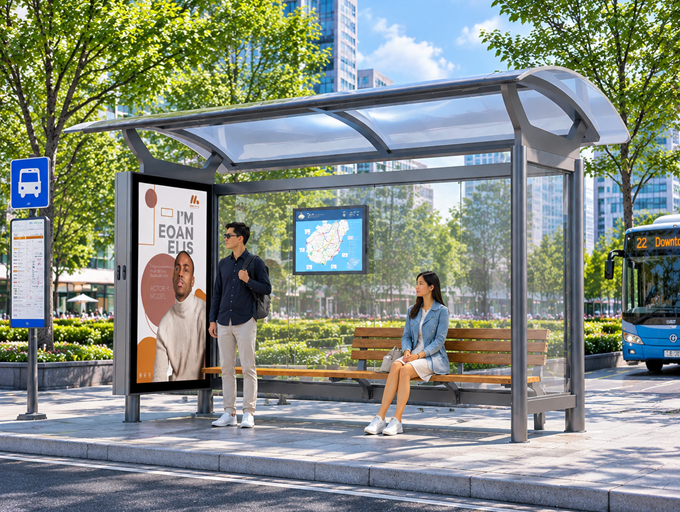
Who pays: three funding models for campus and hospital shelters
There are three funding routes, and the choice determines both the specification and the contract structure. Capital purchase buys the simplest contract and the highest control; advertising concession transfers capital cost to a media partner; an EPC or framework package bundles shelters into a larger works contract.
Model | How it works | Best For | What the Buyer Gives Up |
Direct capital purchase | Estate or city budget funds the shelters; the buyer owns and maintains the asset | Hospitals, campuses with grid power and a maintenance team; 1–20 units | Full capital outlay; maintenance obligations retained |
Advertising concession | A media operator funds, installs and maintains shelters in exchange for advertising rights for a fixed term (typically 8–15 years) | Campus and hospital approaches with high footfall and commercial sightlines | Advertising content control; long lock-in on layout and location |
EPC / main-contract package | Shelters specified inside a wider transit, landscape or building contract delivered by a contractor | Multi-stop rollouts within a larger capital programme | Interface risk between trades; less direct control over shelter choice unless named as a specified product |
Phased capital programme | Split delivery over budget cycles — lighting and accessibility first, digital elements later | Estates that cannot fund full specification in one cycle | Requires shelters to be specified "smart-ready" up front; retrofitting interfaces costs more than reserving them |
For digital or advertising-funded shelters, run the ROI threshold test before committing: in low-footfall campus locations without an advertising contract, a smart shelter will not pay back and a classic shelter with good lighting is the correct purchase. The ROI threshold guide sets out the footfall lines and disqualifying conditions.
If-then rules for the tender document
Use these rules to convert site conditions into specification clauses. The first matching rule sets the minimum, and later rules add to it.
If the site serves patients or reduced-mobility passengers then the specification must state laminated glass, a level 1,500 mm boarding zone and armrest bench seats — because these three items are the accessibility non-conformities that most often fail audit after installation.
If trenching across landscaped or ambulance-route ground is prohibited then the clause must require a solar configuration with LFP battery and worst-month sizing — because cabling cost, not panel cost, is what blows the budget on restricted-ground sites.
If the stop is served after 22:00 then require 200 lux minimum, motion-boosted to 300 lux, IP65 fixtures, 3,000 K warm white — because personal-security complaints, not structural failures, generate the estates escalations.
If buses run on a fixed timetable only (no GTFS-RT feed available) then specify an e-paper or static display and do not pay for real-time hardware — because real-time hardware without a live data feed delivers no passenger value and creates a maintenance liability.
If the estate operates a smart-campus or smart-hospital platform then require a documented data output (API or protocol list) and asset register format at bid stage — because integrating a shelter after commissioning costs more than specifying the interface.
If the site is within planning-conservation or heritage control then require a finish sample and pre-approval drawing stage before production — because a rejected finish after fabrication means re-coating or scrapping the units.
If the order exceeds roughly 20 units or spans multiple phases then require a rolling delivery schedule, unit-level nameplate numbering and a spare-panel allowance — because phased sites frequently need matched units delivered a year apart, and unmatched finishes are visible.
How should buyers score suppliers?
Score suppliers on deliverability, not on catalogue looks: documented factory capability, project references at comparable scale, engineering support, and spares commitment. A shelter is a fabricated steel asset with a 10–15 year service life — the supplier relationship is a decade-long decision, not a transaction.
Assessment Area | What to Check | Weighting Guidance |
Factory capability | Verified production site, fabrication and coating lines, capacity per month against your delivery window | Weight highest for orders above 50 units; verify through a factory audit before awarding |
Project references | Comparable projects (campus, healthcare, transit interchange) with country, unit count and configuration | Require contactable references, not photo galleries only |
Engineering support | Willingness to produce site-specific load calculations, drawings and accessibility conformity statements | A supplier that cannot produce these shifts compliance risk onto you |
Compliance documentation | All four document groups (see table above) submitted with the bid | Treat missing documents as a scored deduction, not a clarification item |
Delivery and installation support | Delivery schedule against your site programme; site supervision or installation guidance availability | Critical for phased estates and restricted-access hospitals |
Spares and after-sales | Spare glazing panels, LED modules, coating touch-up kits, response time commitment | Ask what a panel replacement costs and takes in year five |
Verify the factory itself rather than relying on trading-company paperwork — the factory verification checklist sets out the documentary, video and transactional checks that separate manufacturers from intermediaries. YEROO manufactures in a 31,000 sqm facility in Foshan and has delivered shelter projects in Hungary, Spain, Romania, Iceland, Laos and Guam, including configured solutions for institutional and interchange environments. Ordering at scale changes the commercial terms, so read what changes across 10, 100 and 500 units before fixing quantities.
Common procurement mistakes and what they cost
The five errors below account for most campus and hospital shelter disputes. Costs are indicative global ranges and require project-specific confirmation.
Mistake | Consequence | Indicative Corrective Cost |
Specifying from a catalogue photo instead of site data | Structure and length wrong for the site; variation order mid-project | Variation orders of 10–25% of contract value |
Leaving accessibility (turning zone, level boarding) to the supplier's standard detail | Fails audit; works must be reopened under live bus operations | $3,000–10,000 per stop |
Awarding on lowest price without checking factory or spares | Panels unavailable in year five; unmatched replacement glazing | Full re-purchase or bespoke re-tooling of glazing 【YEROO DATA NEEDED: spare-panel policy and replacement lead time】 |
Buying real-time displays without a live data feed | Screens show a placeholder or are switched off; passenger trust lost | Hardware cost written off; $1,500–5,000 per unit |
No pre-approval of finish on heritage or listed estates | Re-coating or scrapping fabricated units | 15–30% of unit cost in rework 【YEROO DATA NEEDED: custom finish cost multiplier and approval lead time】 |
Two commercial facts also need confirming before award: the minimum order quantity the manufacturer will accept for a custom configuration, and the standard versus custom lead time. 【YEROO DATA NEEDED: MOQ policy, standard and custom lead times by unit volume, and payment terms for institutional buyers】
FAQ
How many bus shelters does a hospital or campus need?Size on peak-burst demand, not daily totals. Count the passengers waiting in the worst 15-minute window (hospital shift change, class changeover) and allow roughly 1.5–2 positions per person. A stop with 800 daily boardings can need two 6 m modules if the shuttle headway exceeds 15 minutes. Use the peak-burst sizing method in the standard vs custom dimensions guide.
Does a campus shelter have to be accessible by law?Yes in most jurisdictions. Hospitals and universities are public-facing institutions covered by the ADA and PROWAG in the United States, the Equality Act and Inclusive Mobility guidance in the UK, and EN 17210 in the EU. Practical minimums are a level boarding surface, a 1,500 mm turning zone and seats with armrests. Confirm your own regime before drafting the tender.
Is a solar shelter acceptable for a hospital with critical loads?Solar is acceptable for lighting and static or e-paper timetables when sized on worst-month irradiance with LFP batteries. It is not acceptable as the sole supply for CCTV, real-time displays or climate control on a hospital site — specify grid power with solar backup for those loads, because a hospital estate cannot tolerate a dark display through a week of overcast weather.
Can advertising pay for campus and hospital shelters?Yes where footfall and sightlines support a media contract. Advertising concessions typically fund shelters on 8–15 year terms, and the operator carries installation and maintenance. Do not assume it works on every site: below roughly 1,500 daily boardings, or where planning restricts illuminated faces, a concession rarely returns the capital and the estate should fund the shelter directly.
What lead time should a buyer plan for?Plan the procurement timeline backwards from the site programme: tender period, sample or pre-approval stage on custom finishes, production slot, shipping and installation. Standard-configuration units move through production faster than custom fascias, which need a drawing approval cycle. Confirm per-volume lead times with the manufacturer before publishing your programme. 【YEROO DATA NEEDED: production and delivery lead times by configuration】
How do buyers avoid a supplier failing mid-project?Verify the factory before awarding: company registration, production line video call, capacity against your delivery window, and contactable references at comparable scale. Include the certification documents in the bid rather than accepting them post-award, and make the spare-panel availability an explicit contract term.
Conclusion: buy the outcome, not the shelter
A campus or hospital bus shelter is a fifteen-year public asset. Buyers who fix the pre-tender data pack, state the accessibility and documentation requirements as contract clauses, choose the funding model deliberately, and score suppliers on deliverability get a shelter that passes audit, serves patients and students properly, and can be maintained in year five. Buyers who start from a catalogue photo get variation orders.
Send YEROO your site plan, peak-burst boarding estimate and estate constraints, and the engineering team will return a specification pack — configuration, material and coating grades, accessibility conformity statement, certification documentation and an itemised quotation you can attach to your tender file. Start from the YEROO bus shelter range, review YEROO bus station and transit project references, or send your requirement through the contact page.
References and further reading
Internal:










 Address:North Tower 904,New World Times Center,Guangyuan Dong Road ,Guangzhou,China
 Phone: +86 13826225776
 Email:yeroo10@3dyeroo.com


