Aluminum bus shelters cost roughly 20–40% more than steel, but they resist corrosion for 20+ years with almost no maintenance — the right choice for coastal, humid, or high-image locations. Steel is stronger and cheaper, but needs galvanizing and repainting, making it better for inland, budget-driven, or heavy-load projects. Choose by climate and service life, not by price alone.
1. What is the difference between aluminum and steel bus shelters?
Material properties, not brand, separate the two. Aluminum is about one-third the density of steel, naturally forms a protective oxide layer, and never rusts. Steel is roughly 3× heavier, offers higher raw strength per cross-section, and must be protected with hot-dip galvanizing plus powder coating to avoid corrosion.
In practice this changes everything downstream: transportation cost, foundation size, installation crew, maintenance schedule, and how long the shelter stays presentable.
2. How much does an aluminum bus shelter cost vs a steel one?
Expect a 20–40% premium for aluminum. For a comparable 1-bay shelter, the difference comes from raw material price and profile extrusion costs, not from better craftsmanship. A steel shelter of the same design is the budget option — often 20–40% cheaper at the quotation stage.
But the first invoice is only part of the story: steel needs re-coating every 5–8 years in coastal environments, and those costs accumulate over the shelter's life. Total-cost-of-ownership (TCO) over 15 years often narrows or reverses the initial gap.
Note: figures are typical market ranges (2026); confirm exact pricing with the manufacturer based on your specification.
3. Which type lasts longer?
Aluminum wins on lifespan: 20–30 years in coastal conditions; steel typically 10–15 years before significant corrosion work. The deciding factor is the environment. In inland, low-humidity climates, properly galvanized and coated steel can also last 20+ years. Near the sea, in industrial air, or where roads are salted in winter, aluminum's self-protecting oxide layer is a decisive advantage.
Ask any supplier one question: "Do you have shelters installed in a coastal city for more than 10 years, and what did the maintenance look like?" The honest answer tells you more than any brochure.
4. Does weight really matter?
Yes — aluminum is about 1/3 the weight of steel, and that changes logistics and foundations. A lighter shelter means: lower shipping cost per unit, no heavy crane required at the site (a 2–3 person crew with basic tools can install), and a smaller, cheaper concrete foundation. In overseas projects, where freight and site access are recurring problems, weight savings can offset a large share of the material premium.
The trade-off: steel's weight and rigidity make it the default for very large spans, heavy glass roofs, or shelters that must withstand deliberate heavy loading.
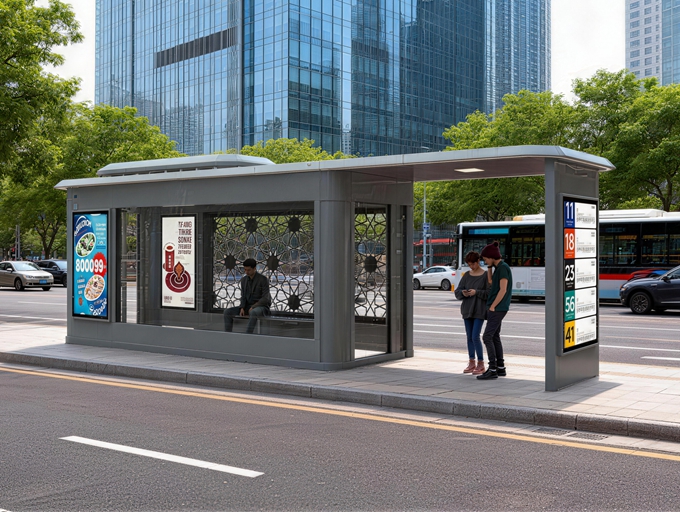
5. Is steel stronger than aluminum?
Steel has higher raw strength; aluminum achieves the required strength with thicker sections. For bus shelters, both materials are engineered to meet the same wind-load and snow-load standards (EN 1991, ASCE 7). The practical difference is not "one fails and the other doesn't" — it is that the aluminum design needs larger extrusions to reach the same stiffness, which is one reason for its higher cost.
For extreme load cases — very large advertising screens, exceptional wind regions, or structural cantilevers — steel often allows a more compact, economical structure. For standard shelters, well-designed aluminum is fully adequate.
6. Aluminum vs steel: decision table
Factor Aluminum Steel
Upfront cost 20–40% higher Lower
Weight ~1/3 of steel; cheaper shipping & installation Heavy; needs crane and stronger foundation
Corrosion Self-protecting; 20–30 yrs near coast Needs galvanizing + coating; 10–15 yrs coastal
Maintenance Minimal; occasional cleaning Re-coating every 5–8 yrs in harsh environments
Strength Adequate with thicker sections Higher raw strength; better for heavy loads
Recyclability ~95% recyclable, high scrap value Recyclable
Best for Coastal, humid, high-image, or remote sites Inland, budget-driven, heavy-load projects
7. How should a city decide?
Apply three tests before choosing: (1) Climate test — within 30 km of the coast, high humidity, or winter salting? If yes, strongly favor aluminum. (2) Lifecycle test — will the city keep the asset 15+ years and budget maintenance honestly? If yes, compare TCO, not first cost. (3) Load test — does the design carry oversized screens or extreme wind? If yes, let the engineer recommend steel or hybrid structures.
Many municipalities end up with a sensible hybrid policy: aluminum for coastal and flagship corridors, steel for inland standard stops — then use the savings where they matter.
8. FAQ
Is aluminum really worth 20–40% more?
In coastal or humid environments, yes — maintenance savings and lifespan easily cover the premium over 15–20 years. Inland, steel may be the better value.
Can steel bus shelters last 20 years?
Yes, if they are hot-dip galvanized, powder coated, and maintained — but in coastal or salted environments, expect recoating cycles that aluminum simply does not need.
Do aluminum shelters meet wind load standards?
Yes. Aluminum shelters are engineered with larger sections to meet the same EN 1991 / ASCE 7 wind and snow loads as steel. Always request the load calculation for your region.
Which is easier to install?
Aluminum. At about 1/3 the weight of steel, it can often be installed by a small crew without a crane, on a smaller foundation.
Can a shelter combine both materials?
Yes — many designs use aluminum profiles with steel reinforcement for heavy loading points. Ask the manufacturer about hybrid structures if you have extreme requirements.
Does aluminum scratch or dent easily?
It is softer than steel, but anodizing and powder coating provide durable protection, and profiles are sized for transit duty. Scratches do not rust, unlike damaged steel coating.
9. How to compare quotations fairly
Never compare two material quotes on price alone. Standardize these four items first: (1) material grade and wall thickness of profiles, (2) surface treatment specification (anodizing vs powder coating, layer thickness), (3) wind-load standard and calculation provided, (4) warranty terms for structure and coating. A cheaper steel quote with thin coating is not cheaper — it is a future maintenance bill.
YEROO — Bus Shelter Manufacturer Since 2000
26 years of transit manufacturing · 31,000㎡ factory · exported to 111 countries · OEM/ODM · ISO 9001 certified
We manufacture both aluminum and steel shelters with certified wind-load calculations. Request a TCO comparison for your city at www.yeroo.com 










 Address:North Tower 904,New World Times Center,Guangyuan Dong Road ,Guangzhou,China
 Phone: +86 13826225776
 Email:yeroo10@3dyeroo.com


