For a high-vandalism site, fix five things before tender: a documented incident profile, glazing rated to EN 12600 class 1B1, anti-graffiti powder coating, tamper-proof fixings, and night-lighting to 50–100 lux. Then demand test certificates, not brochure claims — and score suppliers on evidence, not price alone.
Vandalism and after-dark insecurity are not design problems — they are contract problems. When a shelter panel is smashed in month two, the question the taxpayer or the concession holder asks is simple: what did the tender actually require, and who pays? This guide is written for the procurement officer, estate manager or EPC contractor who has to answer that question in advance, and it organises every engineering parameter around one rule: no specification leaves the tender document without an evidence requirement and a consequence attached.
What must be fixed before you go to tender?
Fix five decisions before issuing tender documents: the site risk profile, the glazing class, the anti-graffiti strategy, the fixing system, and the night-lighting standard. Each one changes the bill of materials by 10–30%, so writing them after award invites variation claims you cannot refuse.
Start with a 90-day incident profile for each candidate site: graffiti reports, glass breakage, panel removal, arson attempts and recorded assaults or near-misses after 20:00. Classify each site as Low (incidental tagging only), Medium (recurring graffiti, occasional glass damage) or High (weekly damage, fire attempts, recorded night-time incidents). This single classification drives every downstream clause, because a Medium site and a High site should never share one specification — a common tender shortcut that either overpays everywhere or underprotects the worst location.
Then convert each decision into tender language. The table below is the pre-tender data pack your team should be able to complete in one afternoon:
Pre-tender decision | Data you must hold | What goes into the tender | Evidence to demand |
Site risk class | 90-day incident log, police data if available | Site-by-site risk schedule, not a blanket class | Signed off by the asset owner, not the supplier |
Glazing class | Boarding pattern, stone-throw history | EN 12600 minimum class, laminated requirement at High sites | Test report from an accredited lab naming the glass make |
Anti-graffiti strategy | Cleaning contract cost per m² today | Coating system + solvent-resistance clause | Qualicoat class or equivalent coating certificate |
Fixings | Recorded panel/theft attempts | Tamper-proof fixing schedule (bit type, torque, count) | Assembly drawing with fixing positions marked |
Night lighting | Measured ambient lux at stop | Minimum lux at floor and at timetable case | Photometric calculation, not a luminaire datasheet |
If you cannot fill the first column, delay the tender. A specification written without a risk profile is a specification written for the supplier's convenience, not yours.
Which compliance documents should the tender require?
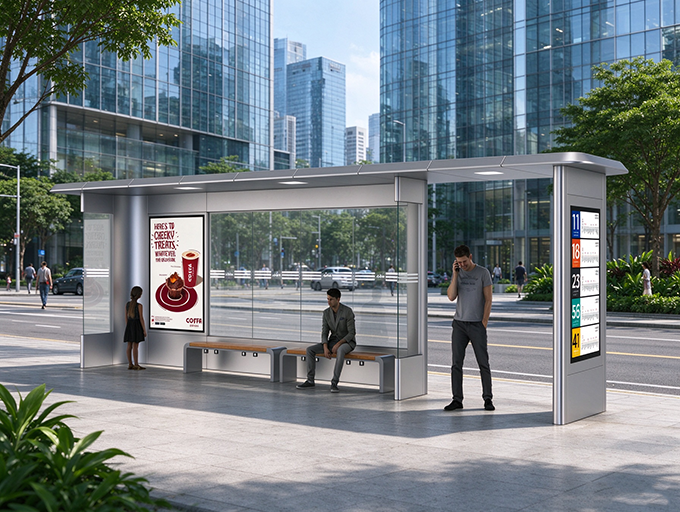
Require six document groups as pass/fail gates: structural design calculation to EN 1991 wind actions, glazing safety certificates, coating certificates, electrical safety certification for any illuminated unit, material traceability, and a spare-parts commitment. Any supplier who cannot produce all six before contract award should be scored zero on compliance — not "pending".
The distinction that matters is between tested and compliant-on-paper. A vandal-resistant claim is only tender-grade when it is backed by a named standard and a laboratory report. Use this table to set the gates:
Document group | Named standard / test | Pass/fail or scored | What failure costs you |
Structural calculation | EN 1991-1-4 wind + deliberate-load case | Pass/fail | Shelter collapse or deformation claim lands on your budget |
Glazing safety | EN 12600 classification, EN 12150-1 for tempered | Pass/fail | Glass injury liability; insurance may refuse the claim |
Anti-graffiti coating | Qualicoat Class 1/2 powder certification | Scored | Repaint cycles every 6–12 months instead of 3–5 years |
Electrical safety | IP65 ingress rating verified by test report | Pass/fail | Water ingress failures, whole-unit downtime |
Material traceability | Mill certificates for 304/316L stainless, steel grade | Pass/fail | Substituted materials discovered only at first corrosion |
Spares commitment | Written spares policy with response time | Scored | A broken panel keeps a shelter boarded up for months |
【YEROO DATA NEEDED: certification list with certificate numbers for structural, glazing, coating and electrical test reports】
At High-risk sites, add two clauses that suppliers will resist — which is exactly why they work. First, a deliberate-load clause: the structure and its fixings must resist a defined horizontal force at the panel line (indicative industry practice is 0.5–1.0 kN applied point-load; confirm the value with your structural engineer), because racking and kicking are the most common failure modes and are absent from standard wind calculations. Second, a panel-removal clause: no external fastener may be removable with a standard tool, verified on the assembly drawing and physically checked at factory inspection.
Who pays for damage — and which procurement model fits?
Choose the funding model before choosing the product, because the model determines who carries vandalism risk and therefore what the specification must contain. Four models dominate: capital purchase, advertising concession, EPC package, and phased smart-ready programme.
Model | Who carries vandalism cost | Spec implication | Best when |
Capital purchase | You (the asset owner) | Maximum-hard specification justified; lifecycle budget line mandatory | High-risk sites, long asset life expected |
Advertising concession | Operator, within contract limits | Contract must define repair response times and hand-back condition | Medium-risk sites with strong footfall |
EPC package | Contractor during defects period | Specify defects-liability duration and damage exclusions explicitly | Programme-funded builds with a single accountable party |
Phased smart-ready | Shared per phase agreement | Phase 1 hard-shell spec must not block Phase 2 electronics | Budget arrives in tranches; vandalism data still thin |
The advertising concession model deserves special caution at High-risk sites. Operators price vandalism exposure into their bid, so if your incident data is poor, they price for the worst case and your advertising revenue share shrinks. Conversely, if the concession contract caps the operator's repair obligation, a smashed screen at a revenue site can sit unrepaired for weeks — which suppresses ridership and invites more damage. Write the repair response time (indicatively 48–72 hours for safety-critical damage) and the escalation penalty directly into the concession schedule.
How should buyers score vandal-resistance — beyond the brochure?
Score suppliers on six evidence-based criteria, weighted so that test documentation and reference-site durability together carry at least half the total marks. Price alone should never exceed 25%, because in this product category the cheapest compliant offer is usually compliant on paper only.
Criterion | Weight | What "excellent" looks like | Evidence required |
Glazing & impact test documentation | 20% | Accredited-lab reports naming the actual installed glass | Test certificates with report numbers |
Coating system & anti-graffiti performance | 15% | Qualicoat-certified line, solvent-resistance data, colour-retention history | Coating certificate + 5-year reference photos |
Fixing & assembly security | 15% | Drawing-level tamper-proof schedule, factory inspection access offered | Assembly drawings + inspection invitation clause |
Reference projects in comparable risk environments | 15% | Named city or campus projects with 3+ years of service | Client contacts, not just project photos |
Night-lighting & visibility design | 10% | Photometric calculation meeting your lux clause | Calculation file, luminaire IP rating |
Spares, response time and price | 25% | Written spares policy; competitive landed price | Policy document + itemised quotation |
Two verification habits separate professional buyers from frustrated ones. First, call the reference sites, not just the references: ask the transit authority or estate team how many panels they replaced last year. Second, tie 10% of the contract price to a factory inspection where you witness glazing marking, coating thickness measurement (indicative target 60–80 μm for polyester powder on galvanised steel; confirm per your coating spec) and the tamper-proof fixing demonstration. A supplier who declines the inspection has answered your question.
How does the shelter integrate with night-safety and data obligations?
Treat night safety as a measured performance obligation with a data trail, not a lighting fixture in a catalogue. Three clauses make it enforceable: minimum maintained illuminance at the boarding area and timetable case, motion-activated or scheduled lighting behaviour, and — where the shelter is smart-ready — a lighting-fault alarm that reports to the city or estate platform the same way any other asset fault does.
The procurement logic is straightforward. A shelter that is well-lit at 22:00 and unlit at 23:00 because a lamp failed silently is a safety incident waiting for a claim. If your smart-city programme already includes asset data obligations (as most do), require that lighting faults raise an automatic alert with a defined acknowledgement time, and add the alert log to your 5-year maintenance review. At High-risk sites, specify impact or tamper sensors on glazing and panel lines as a scored option rather than a base requirement — the sensor itself is cheap, but the integration, monitoring and response workflow it implies must be budgeted and assigned in the maintenance contract before it goes in the tender.
【YEROO DATA NEEDED: smart shelter monitoring options and platform integration protocols offered by YEROO】
What does the wrong decision cost?
The cost of under-specifying is never the panel. It is the boarding-up, the emergency call-out, the claim, and the permanent ridership damage at a stop that people start avoiding after dark. Use this table to put numbers against each shortcut:
Common mistake | Typical corrective cost (indicative) | What it really costs |
Specifying annealed or thin tempered glass at a High-risk stop | Re-glazing repeatedly at 【YEROO DATA NEEDED: unit re-glazing price】 per incident | Stop boarded up for weeks; accessibility complaint; local press |
Skipping the anti-graffiti coating to save on coating cost | Repaint cycles every 6–12 months vs 3–5 years | 3–5× lifetime coating spend; visible neglect depresses the whole corridor |
Accepting brochure vandal-resistance claims without test reports | Claim denied after first major damage | Full replacement from your contingency budget |
No spares policy in the contract | Emergency fabrication at non-contract prices | 2–6 months of downtime per damaged unit |
Ignoring night lighting lux levels | Incident claim + retrofit lighting after award | Retrofit on occupied shelters costs multiples of factory-fit |
One blanket spec for Low and High sites | Overpayment at 80% of sites or underprotection at 20% | Either budget blowout or recurring damage at exactly the wrong stops |
The last row is the one buyers regret most. A risk-tiered specification costs one extra column in your schedule and nothing in hardware intelligence — yet it is the difference between a network that ages gracefully and one that generates a maintenance crisis file.
Frequently asked questions
What is the most vandal-resistant glazing for a bus shelter?For High-risk sites, specify laminated glass to EN 12600 class 1B1 or better: the interlayer holds fragments in place after impact, so the panel stays in the frame even when cracked. Tempered glass alone to EN 12150-1 shatters into granules and leaves the opening exposed. Indicative industry practice pairs laminated glazing with a security film at the worst locations — require test reports, not claims.
How much does a vandal-resistant shelter cost compared with a standard one?Indicative global ranges put a hardened specification at 20–40% above a standard equivalent, driven mainly by laminated glazing, thicker posts and anti-graffiti coating. That premium is recovered the first time one avoided re-glazing cycle is counted. Exact pricing depends on volume, finish and smart content — request an itemised quotation rather than a per-unit average.
Which standard should I cite for glazing safety in a shelter tender?Cite EN 12600 for the impact-safety classification and EN 12150-1 where tempered glass is used, and require the laboratory test report number in the compliance schedule. In North American procurement, ANSI Z97.1 and CPSC 16 CFR 1201 equivalents apply — name the regime in the tender rather than leaving suppliers to choose, or you will receive non-comparable offers.
How do I stop panels and parts being stolen from shelters?Require a tamper-proof fixing schedule in the tender: security bits or one-way fasteners, defined torque, no external fastener removable with standard tools, verified on the assembly drawing and at factory inspection. Add stainless fixings throughout — corroded fasteners turn every maintenance visit into a forced entry that weakens the assembly permanently.
Does lighting actually reduce vandalism at bus stops?Measured lighting is one of the few interventions with both incident-data and insurance support: specify 50–100 lux maintained at the boarding area (indicative range; align with your local lighting standard) and make the lux value a measurable acceptance item, tested at handover. Motion-activated lighting adds deterrence while cutting energy use, and fault alarms keep the promise from decaying silently.
Should vandalism risk change how I choose the manufacturer?Yes — weight evidence of durability above price. Ask for named reference projects in comparable risk environments with 3+ years of service, a written spares policy, and factory inspection access. YEROO, a 26-year OEM/ODM shelter manufacturer in Foshan, China, supplies hardened specifications to projects across Europe, the Middle East and the Pacific, and provides the test documentation set described in this guide.
Conclusion: get the evidence pack before the award
A vandal-resistant bus shelter is not a tougher product — it is a tougher contract. Fix the risk profile before tender, convert every parameter into a named standard with a test report, tier the specification by site, and tie a slice of the contract price to factory verification. YEROO provides tender-ready deliverables for exactly this process: a specification pack with material grades and coating systems, the compliance document set (structural, glazing, coating and electrical certificates), and an itemised quotation broken down by site tier. Send your site list and incident profile via our contact page and receive the pack within 【YEROO DATA NEEDED: standard quotation lead time】.
Internal resources for your tender file:










 Address:North Tower 904,New World Times Center,Guangyuan Dong Road ,Guangzhou,China
 Phone: +86 13826225776
 Email:yeroo10@3dyeroo.com


