Most smart-shelter tenders we review at YEROO specify the technology first and look for the business case afterwards. The order should be reversed. A shelter is a 15-to-25-year infrastructure asset; the electronics on it live 5–8 years and need a revenue or service line to justify replacement. This guide gives procurement officers the thresholds to test any smart specification against before it goes to tender.
At what footfall does a smart bus shelter pay for itself?
Use 1,500 daily boardings as the buy line for a full digital specification, and 500 as the line below which no connected feature pays. Between 500 and 1,500, only a real-time passenger information screen earns its place — and only where the transit operator funds the data feed and the screen's upkeep.
The threshold is a payback test, not a fashion choice. A smart shelter must recover its ten-year ownership premium from contracted revenue before the asset is renewed. As indicative planning ranges: a leased digital advertising face returns roughly 2,000–12,000 per year to the shelter owner in active markets — two to five times the lease value of a static face, a ratio consistent with the shift toward digital formats that the UK out-of-home trade body Outsmart tracks in its market revenue data. Run the test as payback (years) = ten-year smart premium ÷ annual net revenue to the shelter owner, and require payback within 7 years on a 15-to-25-year asset. At $2,000 per year of net revenue, only the lowest premium specification clears that bar; at $8,000 or more, the full digital specification clears it comfortably.
Footfall is the input to that revenue line, so measure it honestly. Request 12 months of boarding data from the transit operator — a single-day count will mislead, because seasonality routinely moves a stop between two bands. UITP, the international public transport association, publishes network planning guidance linking stop infrastructure and passenger information provision to observed demand; the bands below apply that logic.
Daily boardings | Advertising contract? | Correct specification | Expected payback (indicative) |
Under 300 | — | Basic shelter only; provision baseline, not a technology decision | Not applicable |
300–500 | No | Classic steel, LED lighting; solar kit if no grid | Never — do not add technology |
500–1,500 | No | Classic + RTPI screen only if operator funds feed and upkeep | RTPI: 8–12 years — borderline |
1,500–3,000 | Signed | Smart-ready body + RTPI; digital ad face where demand is proven | 6–9 years |
Over 3,000 | Signed | Full digital specification, 55″ class screen at 2,500-nit class brightness | 4–6 years |
The 1,500 boarding line matches the logic in our shelter type selection guide: it is the point where passenger information demand and advertising audience become large enough to fund the electronics above them. Below it, every connected feature you add is paid for by the transport budget rather than by the stop's own revenue.
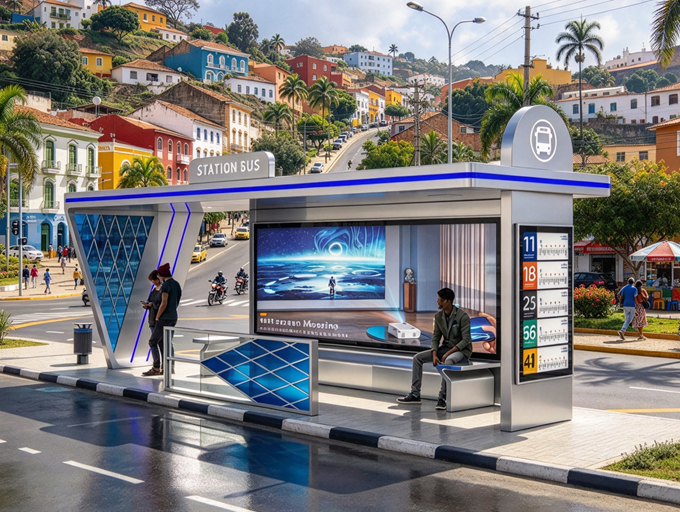
What does the smart premium actually cost above a classic shelter?
A smart specification adds 6,500–18,500 in hardware over a comparable mid-range classic unit, but hardware is only part of the true premium. Connectivity, software licences and a heavier maintenance schedule compound the gap to roughly 15,000–45,000 per shelter over ten years. Budget against the ten-year figure, not the invoice.
Procurement officers who compare invoice prices systematically understate the smart premium, because the recurring lines sit in a different budget than the capital line. The table below assembles the full ten-year cost of ownership for a single-bay shelter (all values are indicative global ranges for specification planning — confirm against project quotations):
Cost line | Classic (mid-range) | Smart (digital-ready) | Notes |
Hardware, ex-works | 3,500–6,500
| 10,000–25,000
| Screen, connectivity, power distribution, CMS hardware |
Connectivity | nil | 360–1,200 / year
| Data SIM or fibre backhaul, remote management |
Software licence | nil | 300–900 / year
| Screen CMS, content scheduling, firmware updates |
Maintenance | 1–2% of hardware / year | 3–5% of hardware / year | Screen cleaning, panel replacement, electrical checks |
Ten-year total | ≈ 4,000–8,000 | ≈ 19,000–53,000 | The delta of 15,000–45,000 is what revenue must repay |
Two consequences follow from the table. First, the recurring lines alone — connectivity plus licences — consume 6,600–21,000 over ten years per shelter, which is why a smart shelter without any revenue or service contract drifts into negative return from year one. Second, maintenance intensity is structural, not optional: an outdoor screen needs scheduled cleaning, brightness calibration and eventual panel replacement, so the 3–5% maintenance assumption is a floor, not a pessimistic case. 【YEROO DATA NEEDED: YEROO standard warranty periods for digital screen, battery and electrical components in smart shelters, to replace the indicative maintenance assumptions above】
Which site conditions disqualify smart features regardless of footfall?
Four conditions disqualify connected features whatever the passenger numbers: no power source that can carry the load, no data coverage, no live transit feed, and no maintenance contract. Footfall only decides how much technology pays back; these four decide whether the technology works at all. Clear them before reading the matrix.
Apply each rule as a hard filter:
If grid connection runs more than about 150 m AND the site sits above 45° latitude → specify classic. Roof-mounted PV caps out near 850–900 W on a standard shelter roof, which cannot carry a 24-hour connected load of 1.7 kWh/day or more through a northern-hemisphere December (see our solar sizing analysis). Check the site's worst-month solar resource on the Global Solar Atlas (World Bank Group) before believing any off-grid screen proposal.
If measured 4G coverage at the stop is below about −110 dBm RSRP AND fibre trenching is unfunded → specify non-connected. A screen showing stale departures damages trust in the network faster than no screen at all.
If the transit authority will not license a real-time feed (GTFS-RT or equivalent) → delete RTPI from the specification. Buy the static timetable case and spend the saving on lighting or seating.
If no organisation contracts a defined maintenance response → delete screens. A dead screen is worse than none: it erodes confidence and invites vandalism. This rule applies to entire tenders, not individual stops.
If the site records frequent vandalism or theft → specify laminated glazing and anti-graffiti coating first, and revisit screens at renewal. YEROO's vandal-resistant shelter programmes prioritise the enclosure; the electronics follow once incident rates are controlled.
These filters explain most of the mixed-corridor specifications YEROO supplies across Europe and Australia — including projects in Hungary, Romania and Australia — where classic bodies carry the majority of stops and digital screens concentrate at interchanges and city-centre sites where power, coverage and advertising demand all exist. 【YEROO DATA NEEDED: one or two named YEROO reference projects with corridor type and footfall band, for citation in this section】
What should you buy instead of a smart shelter?
Buy a smart-ready classic body: a standard steel shelter with power distribution, spare conduit, gland plates and screen mountings factory-fitted. The smart-ready option adds roughly 500–1,500 over a standard unit (indicative), and it converts every later upgrade from a structural retrofit into a plug-in swap. Stage the electronics by trigger, not by trend.
The staged path protects both budgets. The transport authority gets shelters now at classic prices, and the city avoids stranded assets when the advertising market or the transit data feed matures later. Each stage below has an explicit trigger — no trigger, no upgrade:
Stage | What is installed | Upgrade trigger (if-then) | Indicative premium over previous stage |
0 — Smart-ready body | Steel frame + conduit, power busbar, spare gland plates, screen mountings | Fit on every corridor stop flagged for growth in the network plan | +500–1,500 over standard classic |
1 — Power | Solar kit where grid is absent; grid connection where trenching is short | If lighting is required and grid >150 m → solar | +800–2,500 |
2 — RTPI screen | 32″ class sunlight-readable display, IP65 enclosure | If transit operator signs a real-time feed AND funds screen upkeep | +1,500–4,000 |
3 — Digital advertising | 55″ class screen, 2,500-nit class brightness, CMS | If ad operator contract signed AND footfall ≥ 1,500/day | +8,000–15,000 |
【YEROO DATA NEEDED: YEROO smart-ready option list price and the exact provisions included in the YEROO smart-ready build, to replace the indicative figures above】 The staged path also simplifies procurement: Stages 0 and 1 go to the infrastructure tender, while Stages 2 and 3 belong in a separate services tender with the transit operator and the media contractor respectively. YEROO supplies all four stages from one factory — see the smart bus shelter range and the classic shelter range — so the body and the electronics share one warranty interface.
What to avoid: five mistakes that turn smart shelters into cost centres
Every failed smart-shelter business case traces to one of five procurement errors, and each carries a measurable corrective cost. The pattern is constant: technology was bought before its revenue, feed, power or upkeep existed. Audit the five below against any specification before it goes to tender.
Mistake | What happens | Corrective cost (indicative) |
Digital specification signed before the advertising contract | Screen runs placeholder loops or stays dark | 8,000–15,000 per face written down, plus 1,500–3,000 static retrofit
|
RTPI screens bought where no live feed exists | Screen displays static times or "no data" | 1,500–4,000 hardware stranded per stop; contractual fix required
|
Full smart premium spent on a low-footfall pilot | No revenue line against the capital cost | 15,000–45,000 ten-year premium stranded per unit
|
Software licences unbudgeted after year one | CMS access lapses; screens freeze mid-network | 300–900 per unit-year restored, plus emergency call-outs
|
Connectivity treated as free | SIM and remote-management costs surface at invoice | 360–1,200 per unit-year unbudgeted
|
The first mistake dominates. Without a signed advertising contract, a digital shelter is a cost centre from the day it is energised — the decision point is contractual, not technical, and no screen brightness or sensor package changes that. Sequence every deployment as: power and connectivity proven → data feed contracted → advertising operator signed → hardware tendered.
Frequently asked questions
What footfall do I need to justify a smart bus shelter?
Around 1,500 daily boardings with a signed advertising contract is the working threshold for a full digital specification. Between 500 and 1,500, a real-time passenger information screen can be justified where the transit operator funds the data feed and maintenance. Below 500 boardings per day, specify a classic shelter with lighting and stop there.
How much more does a smart shelter cost than a classic one?
Hardware adds 6,500–18,500 over a comparable mid-range classic unit (indicative global ranges). The ten-year ownership gap is wider — roughly 15,000–45,000 per shelter — once connectivity, software licences and the heavier maintenance schedule are included. Treat the ten-year figure, not the invoice, as the real price of the smart decision.
Can a classic shelter be upgraded to smart later?
Yes, if it was built smart-ready: power distribution, spare conduit, gland plates and screen mountings factory-fitted. The smart-ready option adds roughly 500–1,500 at manufacture (indicative). Retrofitting those provisions to a shelter already installed costs more and usually needs a second site visit, so decide smart-readiness before the first order, not after.
Do digital bus shelters actually earn advertising revenue?
Only where a media operator has contracted the face. A leased digital face returns roughly 2,000–12,000 per year to the shelter owner in active markets (indicative global range) — two to five times a static face, because inventory sells by time of day and audience. Without a signed contract, the screen is a cost centre with no revenue line.
Is a solar-powered smart shelter a viable alternative off-grid?
Solar carries lighting and sensor loads reliably at most latitudes, but a 24-hour RTPI or screen load of 1.7–4.5 kWh per day exceeds what roof-mounted PV supplies through winter above 45° latitude. Off-grid sites should specify solar lighting with motion dimming, and connect screens to the grid wherever a connection exists.
What is the biggest reason smart shelter programmes fail?
Buying the technology before its operating model exists: no advertising contract, no real-time feed, no maintenance response, no licence budget. The hardware survives; the service does not. Sequence every deployment as power and connectivity proven, feed contracted, operator signed — then tender the hardware.
Conclusion: test the thresholds, then stage the spend
A smart bus shelter is not worth it below roughly 1,500 daily boardings without an advertising contract, at sites without power or data coverage, and in any tender without a maintenance budget. Where those conditions are met, the full digital specification pays back in 4–9 years and funds better passenger information for 15–25 years of asset life. Where they are not, the smart-ready body at +500–1,500 preserves every future option at classic prices.
Send YEROO your corridor map and 12 months of boarding data, and our engineers will return a stop-by-stop specification matrix — classic, smart-ready or full digital — with the payback test already run for each stop. Start from the YEROO bus shelter range, review our smart city shelter solutions, or browse delivered projects across Europe, Australia and Asia.










 Address:North Tower 904,New World Times Center,Guangyuan Dong Road ,Guangzhou,China
 Phone: +86 13826225776
 Email:yeroo10@3dyeroo.com


