Procurement officers rarely see the bus shelter materials decision until late in a tender cycle, by which point the architectural render is fixed and the budget is half-spent on civil works. Yet the choice between galvanised steel, aluminium and stainless steel quietly determines whether a shelter will look serviceable in year five or be condemned by year twelve. Each material behaves differently under salt spray, urban pollution, mechanical impact and thermal cycling, and the gap between them in lifecycle cost is often larger than the gap in purchase price. This guide draws on YEROO's 26 years of OEM/ODM shelter manufacturing across 110+ countries to give engineering teams, transit authorities and city planners a practical framework for choosing bus shelter materials with confidence.
Why Frame Material Is the Single Most Consequential Specification
A bus shelter is one of the few pieces of public infrastructure that combines permanent outdoor exposure, daily mechanical abuse and zero climate control. The frame must resist wind loads of 120–160 km/h in storm-prone regions, tolerate graffiti, road salt, diesel exhaust, thermal cycling between -20 °C and +55 °C, and remain safe and presentable for 15 to 25 years. Every other specification — glazing, lighting, smart electronics, advertising panels — is replaceable. The frame is not.
Material choice sits upstream of almost every other design parameter. It dictates section sizes, welding procedure, fastener grade, coating system, foundation depth and maintenance interval. YEROO treats material selection as the first design input on every project. The 31,000 sqm Foshan factory runs separate production lines for carbon steel, aluminium and stainless assemblies because each material demands different tooling, filler wires, surface treatment and quality control.
Galvanised Steel: The Workhorse of Mass Transit Deployment
Hot-dip galvanised mild steel remains the most widely used bus shelter material in the world, and for good reason. The combination of relatively low material cost, well-understood fabrication processes, and predictable structural performance makes it the default choice for high-volume municipal rollouts, particularly in North America, continental Europe, the Gulf states and parts of Southeast Asia.
Corrosion protection comes from a zinc coating metallurgically bonded to the steel substrate. When the zinc is scratched, it sacrifices itself to protect the underlying steel, providing cathodic protection that other coating systems cannot match. A typical 80–100 µm hot-dip galvanised layer delivers 30–50 years of protection in rural atmospheres and 15–25 years in industrial or coastal environments.
The structural advantages are equally important. Yield strength of 235–355 MPa allows slender, elegant frame profiles that span 6–8 metres without intermediate supports, supporting large roof canopies and advertising housings without visible bulk. Welding, bending and punching are straightforward, and field repairs are possible with basic tools.
The weaknesses are also clear. Zinc dissolves in acidic atmospheres, so shelters near heavy industry or road tunnels may need supplemental powder coating. Coastal chloride exposure accelerates zinc consumption, and unpainted galvanised surfaces can develop a dull grey patina that some city brand teams reject on aesthetic grounds. YEROO typically pairs hot-dip galvanising with a polyester powder topcoat (60–80 µm) for projects requiring colour stability over a 15-year cycle.
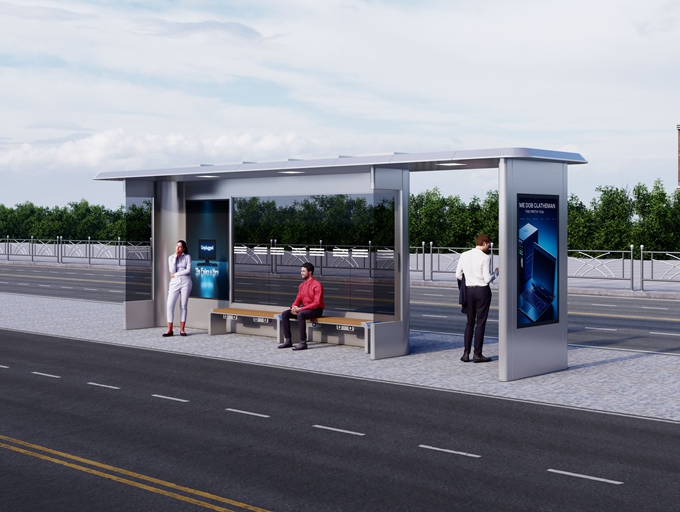
Aluminium: Lightweight, Corrosion-Resistant and Architecturally Expressive
Aluminium occupies the middle ground between galvanised steel and stainless steel in most procurement matrices. Its density of 2.7 g/cm³ is roughly one-third that of steel, which lowers transport costs, simplifies on-site handling and reduces foundation loads — a meaningful advantage for retrofits on historic pavements or elevated walkways where ground disturbance must be minimised.
The corrosion behaviour of aluminium is fundamentally different from steel. Instead of a sacrificial coating, aluminium forms a hard, self-healing oxide layer (Al₂O₃) that prevents further oxidation indefinitely in most atmospheres. There is no paint to peel and no zinc to deplete. In marine and urban environments, aluminium naturally passivates and ages to a soft silver-grey patina that many architects consider a feature.
Modern aluminium alloys used in shelter manufacturing — primarily 6063-T5 and 6061-T6 — offer yield strengths of 145–240 MPa and extrude cleanly into complex profiles that would require welded assemblies in steel, allowing integrated cable channels, hidden fixings and slim sightlines that designers prize. For prestigious streetscape projects in Europe, Australia and the Gulf, aluminium has become the preferred material when brand identity demands a refined architectural vocabulary.
The trade-offs are section size and dent resistance. Aluminium frames are typically 30–50% deeper than equivalent steel sections to achieve the same stiffness, which can conflict with low-profile briefs. The material is also softer: impacts leave visible dents that are difficult to repair. Aluminium must be electrically isolated from dissimilar metals to avoid galvanic corrosion — stainless fasteners (A2-70 or A4-80), EPDM isolation washers and anti-seise compounds at every contact point are non-negotiable when aluminium meets steel anchors or copper lightning conductors.
Stainless Steel: Premium Durability for the Most Demanding Sites
Stainless steel is the material YEROO specifies for projects where maintenance access is difficult, brand visibility is high, or environmental aggression is severe. Its chromium content (typically 16–18% in austenitic grades) forms a passive oxide layer that continuously self-repairs in the presence of oxygen. Even when scratched, the surface regenerates its protective skin within minutes, preventing the rust creep that undermines painted or galvanised steel.
Two austenitic grades dominate outdoor transit shelters. Grade 304 (A2) is the general-purpose option, offering excellent atmospheric corrosion resistance and a wide range of architectural finishes. Grade 316 (A4) adds 2–3% molybdenum, which materially improves resistance to chloride pitting and is the standard specification within roughly one kilometre of breaking surf or in regions that apply heavy de-icing salt in winter. The trade-off is material cost: 304 is typically 25–35% cheaper than 316, and 316 is roughly 2.5–3× the price of hot-dip galvanised mild steel at the commodity level.
A brushed No. 4 finish hides fingerprints and minor scratches, tolerates routine cleaning with mild detergents, and retains a visibly premium appearance after a decade of service. For YEROO clients operating in coastal Mediterranean, Gulf and Southeast Asian cities, stainless steel bus shelters are typically specified for flagship interchanges and tourist-corridor stops.
The honest disadvantages are fabrication cost, weight and lead time. Stainless needs TIG or MIG welding with matched filler wires, dedicated pickling and passivation after welding, and slower production cycles. Frames are heavier than aluminium equivalents, requiring more substantial foundations. While stainless is 100% recyclable, the initial embodied carbon per kilogram is higher than galvanised steel — a factor that matters for projects targeting strict embodied-carbon thresholds under LEED or BREEAM frameworks.
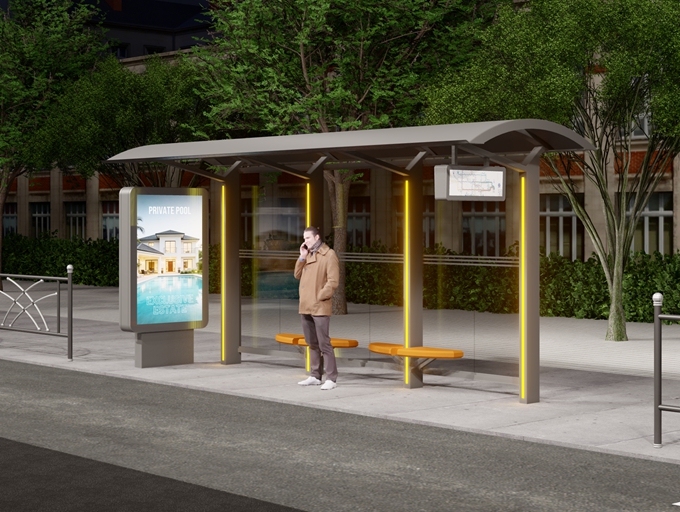
Side-by-Side Comparison: How the Three Materials Stack Up
The table below summarises the engineering and commercial properties of the three bus shelter materials most commonly specified in public tenders. Values are typical ranges for shelter-grade alloys and finishes.
| Property | Hot-dip galvanised steel (S235/S355 + zinc) | Aluminium alloy (6063-T5 / 6061-T6) | Stainless steel (304 / 316 austenitic) |
|---|
| Density | 7.85 g/cm³ | 2.70 g/cm³ | 8.00 g/cm³ |
| Yield strength | 235–355 MPa | 145–240 MPa | 220–260 MPa |
| Modulus of elasticity | 210 GPa | 70 GPa | 200 GPa |
| Corrosion mechanism | Sacrificial zinc + optional powder coat | Self-healing oxide layer | Self-healing chromium oxide layer |
| Coastal suitability | Limited (supplemental coating needed) | Very good (avoid galvanic contact) | Excellent with grade 316 |
| Typical frame weight (6 m shelter) | 280–340 kg | 140–200 kg | 320–400 kg |
| Finishing options | Powder coat, paint over galvanising | Mill finish, anodising, powder coat | Brushed, polished, bead-blasted, powder coat |
| Relative material cost (index) | 1.0 | 1.6 | 2.5–3.0 |
| Indicative service life | 15–25 years | 20–30 years | 25–40 years |
| Maintenance interval | 5–7 years (recoat) | 10–15 years (inspection) | 12–24 months (cleaning) |
| Recyclability | High (steel loop) | Very high (closed-loop recycling) | Very high (no quality loss) |
For a deeper dive into stainless grades, surface finishes and passivation, see YEROO's dedicated stainless steel bus shelter guide. For projects integrating solar PV, e-paper or LCD information displays, YEROO's smart bus shelter range is engineered primarily on galvanised or stainless substructures, with aluminium reserved for weight-sensitive retrofits.
How to Select the Right Material for Your Project
Translating the engineering data into a procurement decision is rarely a single-variable exercise. YEROO's engineering team scores each candidate material against five weighted criteria during design development.
Deployment environment. Coastal, industrial and high-humidity sites shift the balance towards aluminium or grade 316 stainless. Inland, dry, low-pollution environments remain the natural territory of galvanised steel with a powder topcoat. For multi-municipality projects, mixed-material specifications are common — grade 316 for seafront corridors, galvanised steel for suburban feeders, aluminium for heritage-sensitive districts.
Maintenance regime. If the client operates a small in-house crew with infrequent visits, the lowest-maintenance option wins on whole-life cost. Stainless needs washing, not painting. Aluminium needs inspection, not refinishing. Galvanised steel needs recoating, eventually. The labour cost of a single scaffold-and-repaint cycle can exceed the original material saving.
Brand and architectural intent. Aluminium and stainless accept architectural finishes and slim sightlines that galvanised steel cannot match without significant fabrication cost. For premium urban corridors, the visible quality of the frame is part of the city's brand. For utilitarian park-and-ride or suburban applications, the elegant economy of galvanised steel is hard to beat.
Sustainability targets. All three materials are recyclable, but with different carbon profiles. Galvanised steel has the lowest embodied carbon per kilogram but the shortest maintenance-free service life. Aluminium has high embodied carbon but is often produced with 75–95% recycled content, and its light weight reduces transport emissions. Stainless has the highest embodied carbon but the longest service life and 100% closed-loop recyclability.
Budget constraint. Initial capital rarely binds long-life public assets, but it often dictates which options remain on the table. YEROO models total cost of ownership over a 20-year horizon — including repainting, cleaning, repairs and end-of-life recovery — and presents the trade-off to the procurement authority. The bus shelter range covers all three material families, with like-for-like quotations against any specification.
Frequently Asked Questions
Which bus shelter material is best for coastal cities?
Grade 316 stainless steel is the most corrosion-resistant option within roughly one kilometre of breaking surf or in regions with heavy winter road salting. Aluminium also performs well in marine air but requires careful electrical isolation from dissimilar metals. Galvanised steel is the lowest-cost option but typically needs supplemental coating and shorter maintenance intervals in coastal service.
Is aluminium strong enough for large cantilevered bus shelter roofs?
Yes, provided section sizes are calculated correctly. Aluminium's lower modulus of elasticity (70 GPa versus 210 GPa for steel) means members must be roughly 30–50% deeper to match steel stiffness, but modern 6061-T6 extrusions easily support 4–6 metre cantilevers when properly engineered.
How long does a galvanised steel bus shelter last?
A hot-dip galvanised steel shelter with a polyester powder topcoat typically delivers 15–20 years of service in temperate climates, 10–15 years in coastal or industrial atmospheres, and 20–25 years in dry inland environments. The zinc layer is sacrificial, so routine inspection and touch-up of cut edges and weld zones is essential.
Which material has the lowest carbon footprint over 20 years?
Stainless steel typically wins on a per-shelter-year basis because its long service life spreads the initial embodied carbon over more years of useful life. Aluminium comes second when specified with high recycled content. Galvanised steel has the lowest initial embodied carbon but shorter service life, so lifecycle carbon depends heavily on the maintenance regime.
Can different bus shelter materials be mixed in a single network?
Yes, and many cities do exactly that. Specifying grade 316 stainless for seafront corridors, galvanised steel for suburban feeders, and aluminium for heritage-sensitive districts is a legitimate procurement strategy. The key is to document material and finish standards clearly so that maintenance crews can stock compatible fasteners, touch-up paints and cleaning chemicals across the network.
Does YEROO manufacture in all three materials?
YEROO operates dedicated production lines for galvanised steel, aluminium and stainless steel assemblies within its 31,000 sqm Foshan facility, with ISO 9001 and ISO 14001 certification. Procurement teams can request mill test certificates, sample weld coupons and reference projects in each material.
Conclusion: Match the Material to the Mission
Choosing between galvanised steel, aluminium and stainless steel is not a question of which is universally best. It is a question of which is right for the climate, the maintenance regime, the brand intent and the budget of a specific project. Galvanised steel remains the smartest choice for high-volume utilitarian networks. Aluminium is the right answer when weight, sightlines and architectural refinement matter. Stainless steel earns its place wherever corrosion, brand perception or service-life targets leave no room for compromise.
YEROO's 26 years of OEM/ODM experience and 31,000 sqm manufacturing footprint mean procurement teams can compare like-for-like quotations across all three material families from a single supplier. Start by reviewing the bus shelter product range, explore real-world installations in the project gallery, or contact the YEROO team for a project-specific material recommendation and quotation.










 Address:North Tower 904,New World Times Center,Guangyuan Dong Road ,Guangzhou,China
 Phone: +86 13826225776
 Email:yeroo10@3dyeroo.com


