A bus shelter is often the first piece of public infrastructure a visitor notices when they arrive in a new city. It frames the street, protects passengers from weather, carries real-time information, and — when done well — quietly reinforces civic identity. Yet for procurement officers and urban planners, the most fundamental decision is rarely discussed in tender documents: should the project follow a classic bus shelter design rooted in heritage and familiarity, or a modern bus shelter design built around glass, steel and smart-city integration?
Both approaches can deliver excellent passenger experience and long service life. The wrong choice usually comes from copying a photograph rather than matching the design to the surrounding architecture, passenger volume, climate and maintenance budget. This guide compares classic and modern bus shelter design on the factors that matter in real-world procurement, and explains how Yeroo manufactures both styles from a single 31,000sqm facility in Foshan for cities across 110+ countries.
What Defines a Classic Bus Shelter Design?
Classic bus shelter design draws from the street furniture traditions that shaped European, Australian and North American cities during the twentieth century. The visual language is familiar: pitched or hipped roofs, ornate cast or extruded aluminium columns, decorative end panels, timber or ribbed metal seating, and colour palettes that complement brick, stone or heritage streetscapes.
Materials in a classic shelter prioritise longevity and repairability over minimal weight:
Classic shelters suit conservation areas, historic high streets, railway forecourts and districts where planning authorities enforce strict design codes. They are also popular in tourism-heavy cities — think York, Prague, parts of inner Sydney — where the streetscape is itself an economic asset. Yeroo's classic bus shelter range reproduces these forms with modern corrosion protection: hot-dip galvanised steel to ISO 1461, marine-grade 316 stainless on request, and powder coating in RAL or custom heritage colours.
The practical advantage of classic design is predictability. Passengers instantly understand how to use the shelter, maintenance crews can source replacement bolts and panels without proprietary tooling, and the structure tends to hide minor wear better than high-gloss modern finishes. The trade-off is weight and footprint: a fully specified classic shelter can weigh 40–60% more than a modern equivalent, which affects foundation design and transport cost on large rollouts.
What Defines a Modern Bus Shelter Design?
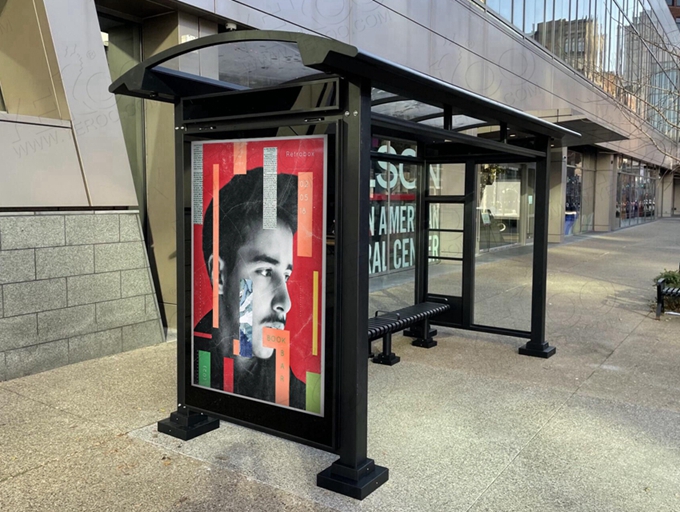
Modern bus shelter design emerged from the same movement that produced airport terminals and metro stations: clear spans, transparent barriers, integrated lighting, flat or single-pitch canopies, and a palette of glass, brushed stainless steel, aluminium and composite panels. The goal is not ornament but performance — maximum visibility, minimum visual clutter, and a platform for technology.
Key characteristics include:
Integration: recessed LED lighting, real-time displays, CCTV mounts, USB charging and solar panels as standard provisions.
Modern shelters dominate new business districts, hospital zones, university campuses, smart-city pilots and high-frequency transit corridors. They pair naturally with smart bus shelter technology because the clean frame already contains cable routes, mounting rails and service channels. Yeroo's modern profiles accommodate 32-inch passenger information displays, 55-inch DOOH advertising screens, environmental sensors and 5G small-cell brackets without visible surface cabling.
Durability is often misunderstood here. A minimal-looking shelter is not a lightweight shelter. Modern cantilevered canopies generate high bending moments at the column connection, so Yeroo uses 3 mm minimum wall thickness on primary structural sections, 8 mm aluminium composite roof panels with anti-UV coating, and wind-load calculations to Eurocode EN 1991-1-4 or the local equivalent. When specified correctly, a modern shelter matches or exceeds the 15–20 year life of a classic design.
Classic vs Modern Bus Shelter: Side-by-Side Comparison
The table below summarises how the two design directions compare across the criteria procurement teams actually evaluate:
Criterion | Classic Bus Shelter Design | Modern Bus Shelter Design |
Typical frame material | Cast aluminium / galvanised steel heritage sections | Box-section aluminium or stainless steel |
Roof style | Pitched, hipped or barrel-vaulted | Flat, mono-pitch or cantilevered |
Glazing emphasis | Moderate — framed panels and openings | High — full-height tempered or laminated glass |
Passenger capacity | Medium; suited to standard urban stops | High; deeper canopies suit BRT and busy corridors |
Smart-tech readiness | Retrofittable; more surface-mounted cabling | Built-in; concealed cable routes and mounting rails |
Maintenance access | Straightforward; standard fixings | Modular panels; some proprietary hatches |
Weight per shelter | 450–800 kg | 300–600 kg |
Typical service life | 15–20 years with galvanised frame | 15–20 years with correct specification |
Best context | Heritage districts, town centres, tourist zones | Business districts, campuses, smart-city corridors |
Relative cost | Equal or 5–15% higher due to detailing | Equal or lower on high-volume programmes |
Cost differences are usually smaller than people assume. A classic shelter with cast aluminium ends and hardwood seating can carry a premium, but a modern shelter with laminated glass, integrated LED edge lighting and a 55-inch display can quickly match it. The decisive factor is the specification sheet, not the style.
How to Choose Between Classic and Modern Bus Shelter Design
Procurement officers often receive conflicting guidance. Urban designers push for visual coherence; transit operators push for passenger throughput and technology; finance teams push for lowest capital cost. The most successful programmes start with four questions.
1. What does the surrounding streetscape demand?
A modern glass shelter can look out of place on a cobbled street lined with seventeenth-century façades. Conversely, a heavily ornamented classic shelter can fight the clean lines of a new commercial district. Yeroo runs design workshops with clients where the proposed shelter is rendered against photographs of the actual site. This single step prevents the most common procurement mistake: selecting a style in isolation from its setting.
2. What is the passenger profile and dwell time?
High-frequency corridors with standing passengers and short dwell times need deep canopies, open sightlines and easy boarding flows — strengths of modern design. Suburban or rural stops with lower frequency and seated waiting benefit from the enclosed, familiar feel of a classic shelter. Accessibility requirements such as tactile paving, level boarding and wheelchair turning circles apply regardless of style.
3. Is smart technology part of the brief?
If the programme includes real-time displays, CCTV, solar power or environmental sensors, a modern frame is usually the more economical host. The cabling, mounting and thermal management are designed in from the start rather than retrofitted. Yeroo's smart bus shelter solution offers both modern and classic aesthetic packages, but the modern package carries a lower integration cost because the architecture already anticipates the technology.
4. What is the total cost of ownership?
Capital cost is only one line item. Classic shelters with timber seating may need more frequent replacement of slats; modern shelters with large glass panels may need more frequent cleaning and graffiti-film replacement. Yeroo provides whole-life cost estimates based on the specified materials, coating systems and local climate conditions. On most programmes, the ten-year ownership cost converges to within 10% between the two styles when both are specified to the same durability standard.
Manufacturing Quality That Outlasts Style Trends
Whether a shelter looks classic or modern, its real value is determined by what cannot be seen in a rendering: the galvanising thickness, the weld quality, the gasket detailing, the powder-coat adhesion and the way water is channelled away from electrical compartments.
Yeroo manufactures bus shelters under ISO 9001 quality management and applies the following standards across both design families:
The factory spans 31,000sqm and includes dedicated lines for cutting, bending, welding, surface treatment, assembly and packing. That scale matters for mixed-style programmes — a city can order classic shelters for its heritage core and modern shelters for its new transit corridor from the same supplier, with consistent warranty terms, quality audits and project management. Yeroo's bus shelter projects include mixed-style deployments in Europe, the Middle East and Australia where this single-source approach reduced coordination risk.
Frequently Asked Questions
What is the most durable material for a bus shelter?
Hot-dip galvanised steel with a quality powder coat offers the best balance of strength, cost and corrosion resistance for most environments. For coastal cities or regions with heavy road salt, 316-grade stainless steel extends structural life beyond 25 years with minimal maintenance.
Can a modern bus shelter include classic design elements?
Yes. Many successful programmes blend the two: a modern cantilevered canopy with heritage-coloured columns, or a classic silhouette with frameless glass side panels and integrated LED lighting. Yeroo offers hybrid designs that satisfy planning officers while still supporting smart technology.
Are classic bus shelters more expensive than modern ones?
Not necessarily. Ornate cast aluminium and timber seating can raise the cost of a classic shelter, but a modern shelter with full-height laminated glass, embedded displays and solar integration can be equally expensive. Specification — not style — drives the final price.
Which bus shelter design is best for smart city projects?
Modern bus shelter design is usually the better starting point because the frame already conceals power, data and sensor cabling. That said, Yeroo's classic aesthetic packages can also host real-time displays, CCTV and USB charging when the planning context requires a traditional appearance.
How long does a bus shelter typically last?
A well-specified steel or aluminium shelter lasts 15–20 years in normal urban conditions, and 25+ years with stainless steel framing and proper maintenance. The biggest factor in premature failure is poor drainage or galvanising below ISO 1461 standards.
Can YEROO customise a bus shelter design to match city architecture?
Yes. Customisation is a core part of Yeroo's OEM/ODM service. The in-house design team adapts roof profiles, column sections, colours, glazing patterns, seating layouts and branding panels to match local design guidelines and city identity.
Classic and modern bus shelter design are not competitors — they are tools for different urban contexts. The right choice depends on the surrounding architecture, passenger volume, technology requirements and total cost of ownership rather than personal taste alone.
YEROO has spent 26 years refining both design languages. From heritage-style shelters that respect conservation-area guidance to frameless modern shelters built for smart-city integration, every unit leaves the Foshan factory with the same quality standards: ISO-certified processes, galvanised or stainless steel options, and a structural warranty backed by deployments in 110+ countries.
If your city or transit authority is planning a shelter rollout, explore the full bus shelter range or request a design consultation to compare classic and modern options against your specific brief.










 Address:North Tower 904,New World Times Center,Guangyuan Dong Road ,Guangzhou,China
 Phone: +86 13826225776
 Email:yeroo10@3dyeroo.com


