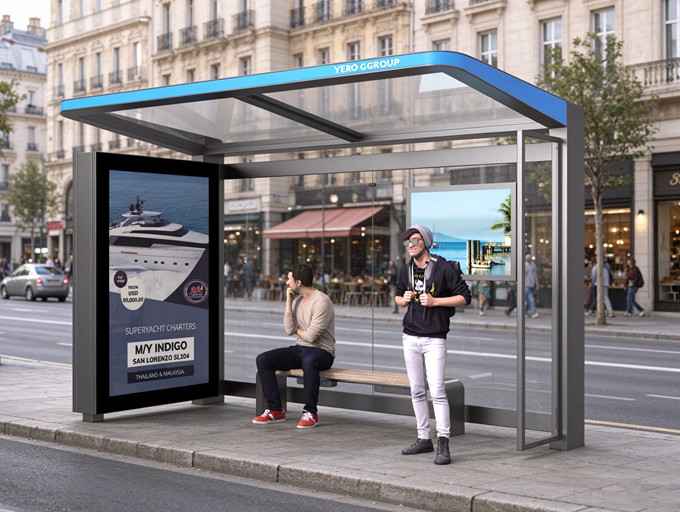
A classic shelter is defined by a small set of components that have stayed stable for years because they work. The frame is typically galvanised steel to ISO 1461 with a 70–85 μm zinc layer, or marine-grade aluminium for coastal sites, finished with a polyester powder coat of 60–80 μm. Side panels are tempered glass to EN 12150-1; the rear wall may be solid glass or a poster panel. The roof is translucent polycarbonate or glass for daylight. Standard lengths run in 4 m and 6 m modules at 1.5 m depth, matching the sizing logic in our bus shelter dimensions guide. Add-ons are predictable: LED strip lighting, a stainless steel seat, a timetable case, and space left in the frame for a lightbox panel.
This simplicity is the product's main advantage: fewer components mean fewer failures and a straightforward maintenance schedule of cleaning, seal checks and lamp replacement.
When is a classic shelter the right choice?
Classic shelters win on total cost of ownership wherever smart features have no revenue or data job to do. Compare the three families on their economics, not their feature lists:
Factor | Classic shelter | Solar shelter | Smart / digital shelter |
Indicative unit cost (ex-works) | Baseline — lowest | +25–40% over classic | +150–300% over classic |
Power requirement | Mains for lighting only | None (self-powered) | Mains or hybrid, higher load |
Typical maintenance | Annual clean + lamp change | Battery replacement every 3–5 years | Screen service, CMS, firmware, battery |
Best fit | High-stop-count networks, tight budgets | No grid within cable reach | Advertising revenue, real-time info, high footfall |
The if-then rules that follow from this table:
If the site is coastal, choose a classic frame in 316L stainless steel or aluminium, not standard galvanised steel. C4–C5 corrosivity environments eat through standard coatings far faster than an inland site.
If vandalism is a known problem at the site, stay classic but upgrade the glazing specification to laminated panels rather than paying for smart
electronics that will be broken.
5 product checks before you order a classic shelter
# | Check | What to look for | Why it matters |
1 | Frame material and coating | Steel galvanised to ISO 1461 (70–85 μm zinc) plus 60–80 μm powder coat; aluminium or 316L for coastal | The coating system decides whether the frame reaches 15 years or rusts at 5 |
2 | Glazing grade | Tempered glass to EN 12150-1 as standard; ask for laminated upgrade in vandalism-prone areas | Tempered glass breaks safely; laminated glass does not shatter into the waiting area |
3 | Roof quality | UV-stabilised polycarbonate or laminated glass with stated thickness | Cheap roofs yellow and leak within 2–3 years |
4 | Lighting provision | LED strips wired to a weather-rated IP65 enclosure with conduit space left for later upgrades | Lighting is the most-used feature after the roof; missing conduit blocks future RTI screens |
5 | Structural load rating | Wind-load calculation stated for your site's wind zone | Roof panels and posts fail at the fixings long before the frame looks wrong |
Ask each supplier for the same five answers on every quote, and the comparison becomes arithmetic rather than brochure reading.
Common mistakes when buying classic shelters
Mistake | Result | Typical fix |
Buying the shortest module at a high-footfall stop | Crowding spills outside the shelter in rain | Add a second module or extend the roof — USD 1,500–4,000 per unit (indicative) |
Standard galvanised frame at a coastal site | Rust streaks within 2–4 years | Repaint or replace; specify 316L/aluminium from the start |
No conduit or spare capacity in the frame | Cannot add RTI screen or lightbox later without cutting the structure | Retrofit wiring costs multiples of pre-installed conduit |
Skipping the roof UV specification | Yellowed, brittle roof panels by year 3 | Roof replacement per unit, plus site visits |
Ordering the poster panel "later" | Frame not prepared; panel retrofit looks bolted-on and costs more | Decide the advertising face at order stage |
Every one of these is a specification-stage decision that costs minutes on the drawing.
Frequently asked questions
What is the standard size of a classic bus shelter?Most manufacturers, YEROO included, build around 4 m and 6 m lengths at 1.5 m depth, which fits standard container shipping and covers typical waiting groups. A 6 m unit seats 4–6 people under cover; longer BRT or interchange platforms are usually built from multiple modules rather than a single custom span.
How long should a classic bus shelter last?A correctly specified galvanised steel frame with ISO 1461 coating and a maintained powder-coat surface is engineered for a 15-year service life; coastal sites need upgraded materials to reach the same figure. Glazing and lighting are renewal items within that period, not frame failures.
Is a classic shelter cheaper than a smart shelter?Yes, substantially — as an indicative global range, classic units run at roughly a third to half the ex-works price of a smart shelter with a digital screen. The real comparison is total cost of ownership: smart shelters add screens, CMS subscriptions and higher-value components to maintain across the same 15 years.
Can a classic shelter be upgraded to smart later?Partly, if you plan for it: leave conduit and electrical capacity in the frame at order stage, and a real-time information screen or upgraded lighting can be added without structural surgery. What cannot be retrofitted economically is the advertising lightbox face if the frame was not prepared for it.
What maintenance does a classic shelter need?An annual wash, seal and fixing inspection, LED lamp replacement as needed, and touch-up of the powder coat where panels are scratched. That is the entire schedule — which is exactly why high-stop-count networks choose classic models.
A classic bus shelter is not the budget option that sacrifices quality — it is the workhorse product whose economics win whenever there is no advertising contract, no data platform and no power problem to solve. Get the five checks right (frame material and coating, glazing grade, roof UV quality, lighting provision, wind-load rating) and the same design serves a network for 15 years with one maintenance visit a year.
YEROO manufactures classic, solar and smart shelters in a 31,000 sqm factory for transport programmes in more than 110 countries — see the classic bus shelter range, the full bus shelter line-up, how classic and modern designs compare, and our bus station project references. Send your stop count, site environment and power availability, and we will quote the right module via the YEROO contact page.










 Address:North Tower 904,New World Times Center,Guangyuan Dong Road ,Guangzhou,China
 Phone: +86 13826225776
 Email:yeroo10@3dyeroo.com


