A smart bus stop typically adds $3,000–15,000 per unit over a standard shelter, depending on features. Cities recover that investment through advertising revenue, transit-operations savings, and measurable ridership gains — commonly reaching ROI within 2–5 years on flagship corridors. Start small, measure everything, and scale what works.
1. What exactly is a smart bus stop?
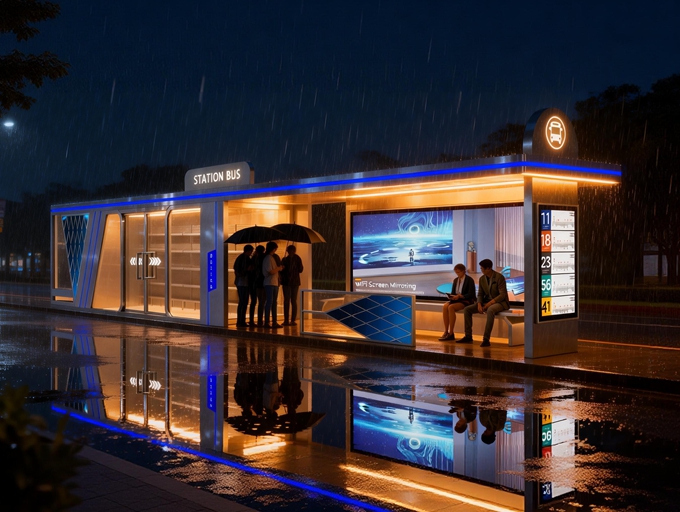
A smart bus stop is a standard shelter plus connected digital equipment. The core difference is data: the stop receives real-time arrival information, powers interactive services, and reports its own status back to the transit center. A standard shelter is furniture; a smart stop is an endpoint in the city's digital infrastructure.
The equipment list is modular — cities can add features corridor by corridor instead of buying an all-in-one package.
2. What features can be added?
Each feature has a cost tier and a purpose; most can be retrofitted later. Here is the practical menu:
Feature
| Typical added cost | What it delivers |
|
Real-time arrival display (e-ink / LCD) | $1,000–4,000 | Reduces perceived wait time; #1 rider-requested feature |
USB / wireless phone charging | $300–1,200 | Daily-use utility; strong passenger goodwill |
Wi-Fi hotspot | $500–1,500 | Public connectivity; usable by city services |
Surveillance camera | $800–2,500 | Safety perception + vandalism evidence |
Environment sensors (air quality, noise) | $500–2,000 | Public health data for city planning |
Solar power system | $2,000–6,000 | Zero electricity bill; off-grid capability |
Emergency call button | $400–1,500 | Safety; connects to city response center |
Digital advertising screen | $3,000–15,000 | Recurring advertising income stream |
Note: figures are typical ranges (2026); confirm with the manufacturer for your market and specification.
3. How much does a smart bus stop cost in total?
Budget 1.5–2.5× the cost of a standard shelter for a fully equipped smart stop. A standard shelter may cost X; a smart version with display, camera, solar, and charging typically lands at 1.5–2.5X. The equipment itself is only part of the cost — power supply, network connectivity (4G/5G or city fiber), and ongoing data service subscriptions all add up and must be in the budget from day one.
The smartest procurement approach is tiered: standard stops for low-ridership routes, mid-tier smart stops (display + charging) for regular corridors, flagship stops with full features and advertising at high-visibility sites.
4. What ROI do cities actually see?
ROI comes from three measurable streams:
Advertising revenue: digital screens at high-traffic stops can generate meaningful monthly income per unit — the most direct payback channel.
Operations savings: real-time data reduces the cost of managing delays, rerouting, and passenger information calls; remote monitoring cuts on-site inspection trips.
Ridership and revenue: transit agencies report that better waiting experiences and reliable information increase ridership on served corridors — more fares, less car congestion.
Combined, cities commonly report full payback in 2–5 years on flagship corridors where advertising is included, and strong intangible returns (safety perception, public trust) even where direct revenue is modest.
5. What do successful cities do differently?
They pilot, measure, and scale — they do not buy citywide in year one. The pattern that works: (1) select 5–20 stops on one busy corridor, (2) define KPIs before installation — wait-time satisfaction, ridership change, screen revenue, uptime, (3) run 6–12 months, (4) expand only the features that earned their cost. Cities that bought full smart systems without KPIs typically report under-used equipment and no measured return.
6. What are the common pitfalls?
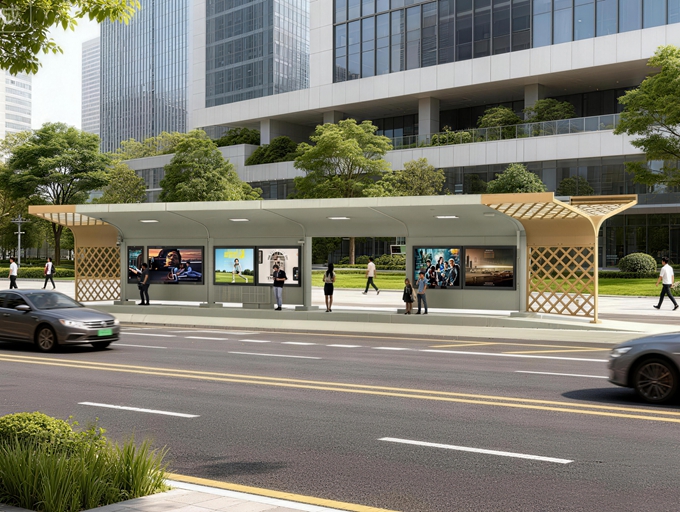
Four failures repeat across cities: (1) No connectivity plan — a "smart" stop with dead Wi-Fi or unreliable 4G is a dumb stop with a screen; confirm network coverage before ordering. (2) Vendor lock-in — proprietary software that makes future tenders hostage to one supplier; demand open data formats and standard APIs. (3) Ignoring maintenance — screens and cameras need cleaning, software updates, and repairs; budget 3–5% of capex per year. (4) Power surprises — retrofitting power to existing shelters can cost more than the equipment itself; prefer solar-powered designs where grid connection is uncertain.
7. FAQ
Is a smart bus stop worth the extra cost?On busy corridors with advertising or strong ridership growth, yes — payback is typically 2–5 years. On low-traffic routes, a standard shelter is the better use of budget.
Do smart stops need a power connection?Most do, but solar-powered versions can run displays, cameras, and charging off-grid with 3–5 days of autonomy — ideal for remote or retrofit sites.
How long does a smart bus stop last?The shelter structure lasts 15–25 years; the electronics typically 5–8 years before upgrade. Design the structure for replaceable electronics modules.
Can features be added to existing shelters?Yes — most features are modular and can be retrofitted, but plan for power and connectivity first, as those are the hardest parts to add later.
Who owns the advertising revenue?That depends on the procurement model: the city can keep it, or trade concession rights to the manufacturer for a lower equipment price. Both models are common.
What is the minimum pilot size?5–20 stops on one corridor is the practical minimum for meaningful data. Fewer than 5 makes results statistically weak.
8. How to write a smart bus stop tender
Four clauses protect the city: (1) require open APIs and standard data formats (GTFS-rt for arrival data), (2) demand a 10-year spare-parts and support commitment, (3) specify minimum uptime (e.g., 97%) with penalties, (4) ask for a 5-year TCO model, not just capex. A manufacturer that cannot quote these four is not ready for your project.
YEROO — Bus Shelter Manufacturer Since 2000
26 years of transit manufacturing · 31,000㎡ factory · exported to 111 countries · OEM/ODM · ISO 9001 certified
We build tiered smart stop systems — from display-only to fully connected solar-powered flagship stops. Request a pilot quote at www.yeroo.com










 Address:North Tower 904,New World Times Center,Guangyuan Dong Road ,Guangzhou,China
 Phone: +86 13826225776
 Email:yeroo10@3dyeroo.com


