Bus shelter DOOH revenue is decided at the specification stage, not at the sales stage. Site tiering, screen brightness (2,500–5,000 nits), a CMS with SSP/programmatic integration, remote diagnostics and a spares SLA determine cost per playable spot — fix all five in the tender before you order a single unit.
Why do most shelter screens under-earn their forecast?
Because the forecast was built on footfall, while the actual revenue is built on playable spot hours — the hours per day a screen can legally and technically play paid content. A 75-inch 4,000-nit display on a three-stop site with no 4G coverage and no remote reboot can lose 15–25% of sellable hours to black screens, dimmed daytime output and offline players, and the operator still pays the concession fee. Your job as the operator buying the hardware is to convert footfall assumptions into a hardware and service specification that protects playable hours.
The table below is the starting point: tier every site in the network before you write the equipment schedule. Do not order one screen type for all sites — the highest-return decision in shelter DOOH is putting digital faces only where the site class justifies the capex.
Site tiering matrix for shelter DOOH deployment
Site tier | Definition | Daily footfall (indicative) | Recommended face | Capex logic | Revenue role |
Tier 1 | CBD / interchange / shopping street | > 15,000 | 75″–86″ digital, portrait, 4,000–5,000 nits | Highest — justified | Premium direct sales + programmatic |
Tier 2 | Main arterial road, high bus frequency | 5,000–15,000 | 65″–75″ digital, 2,500–4,000 nits | Medium | Programmatic backbone |
Tier 3 | Suburban collector routes | 1,500–5,000 | Static poster lightbox or one shared digital face per 5–8 stops | Low | Network fill, campaign reach |
Tier 4 | Low-density residential | < 1,500 | Static lightbox only | Minimal | Cost recovery, no digital capex |
Indicative global industry ranges — confirm against your own market's rate card and footfall data.
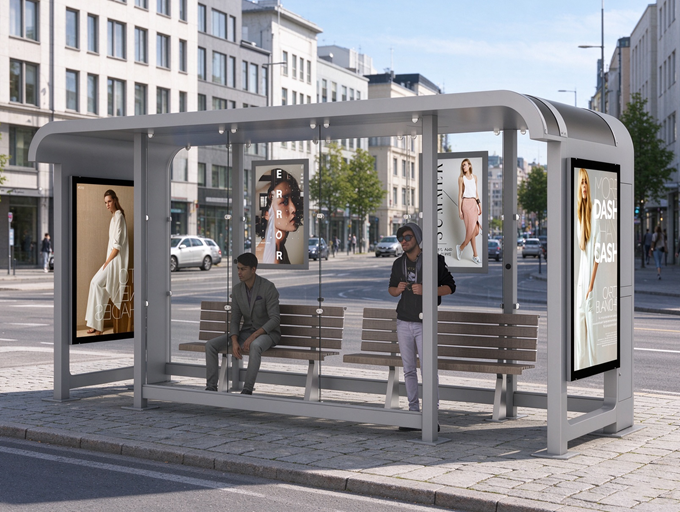
What must be fixed in the equipment schedule before you sign the supplier contract?
Five specification decisions determine playable hours, and each one belongs in the contract, not in a sales conversation. Write them as measurable acceptance criteria — if the shelter fails the test at commissioning, it is not accepted, and payment is withheld per contract.
Brightness and light sensor behaviour. Specify ≥ 2,500 nits (Tier 1: 4,000–5,000 nits) and an automatic ambient light sensor that dims to ≤ 300 nits at night to meet light-pollution and planning conditions. Require a luminance test report at 25% and 100% white as an acceptance document. A screen that cannot hold brightness at 40°C panel temperature will dim exactly when your audience is on the street — that is lost revenue, not a design detail.
Enclosure rating and thermal design. IP65 minimum on the screen enclosure; operating range documented for your climate (a Gulf network needs −10°C to +70°C; a Nordic one needs reliable cold-start at −30°C). Require the supplier's environmental test report per IEC 60068-2 series, not a datasheet claim.
Power and connectivity resilience. Mains power with surge protection; if the site is off-grid, solar sizing must be audited against the screen's daily Wh consumption, not guessed — the method in our solar sizing guidance applies directly to media faces. Connectivity: 4G/5G router with remote reboot and remote screen-on capability as a contractual requirement. Every truck roll for a manual reboot costs [YEROO DATA NEEDED: local service call-out rate] and takes the face dark for the duration.
CMS and ad-tech integration. The player must support VAST 4.x tags for programmatic, your SSP of choice, and proof-of-play logs exportable as an API. A CMS that cannot return third-party-auditable play logs will disqualify the screen from programmatic demand — cutting your fill rate by a third or more in most markets.
Spares and response SLA. Define mean time to repair contractually: specify the spare-part availability commitment (player, power supply, LED module, fan) and the response window. 【YEROO DATA NEEDED: YEROO's standard warranty duration and spare-parts dispatch policy per market】
If-then specification rules for operator tenders
Project condition | Then write this into the tender | Why it protects revenue |
Site faces east–west with direct sun on the screen | ≥ 4,000 nits + anti-reflective glass + sunshade canopy option | Midday washout kills premium daytime spots |
Ambient temperature regularly exceeds 40°C | Industrial-grade display with documented derating curve + forced-air cooling | Standard consumer panels throttle brightness above ~38°C |
No grid power within 150 m of the stop | Solar + LFP battery sized for 3 nights autonomy, or drop to static face | Under-sized solar = daily blackouts = forfeited contract penalties |
Planning authority restricts night luminance | Auto-dimming sensor mandated, ≤ 300 nits night cap, evidence required at acceptance | Avoids licence withdrawal after installation |
Programmatic is > 20% of expected revenue | VAST 4.x player + SSP integration + audited proof-of-play as acceptance test | Protects the demand side of your business model |
How should operators score shelter suppliers for media readiness?
Score suppliers the way you would score an ad-tech vendor, because that is what the shelter becomes: a media asset. Use the matrix below, weight evidence over claims, and require documentary proof for every scored line — a supplier who cannot produce the document scores zero on that line, however strong the brochure.
Supplier scoring matrix — media-readiness weighting
Criterion | Weight | Evidence required to score full marks | Fail signal |
Display performance documentation | 25% | Luminance report at rated nits, thermal derating curve, IP65 test report (IEC 60529) | Datasheet claims without test reports |
Ad-tech integration | 20% | Reference CMS with VAST 4.x, SSP integration in a live network, API proof-of-play spec | "Compatible with your CMS" without a named deployment |
Remote management | 15% | Demonstration of remote reboot, remote firmware, outage alerting | Site visits required for routine operations |
Project references in comparable markets | 15% | Named projects with operator contactable — e.g. YEROO digital shelter deployments in Spain (connected transit hub with digital advertising), Hungary (smart shelter with LED display) and Iceland (P4 LED advertising face) | Anonymous or unverifiable references |
Structural and finish quality | 10% | EN 1090 or equivalent structural calculation, coating spec ≥ 80 μm, corrosion class matched to site (ISO 9223) | Structure sound but media face is what earns — do not over-weight here |
Spares, warranty and service SLA | 15% | Written warranty schedule per component, spare-parts availability commitment, response-time table | Vague "comprehensive warranty" wording |
Pass threshold for shortlisting: 70/100 with zero fails on the evidence columns. This mirrors the verification method in our factory verification checklist — the difference is that a media operator should add the first two rows, which a city buyer would not weight as heavily.
What does the wrong specification actually cost?
Cost of mistakes is where the business case lives. Every row below is a documented failure pattern in shelter DOOH networks; the corrective cost is indicative and should be sanity-checked against your own rate card.
Cost-of-mistake table for shelter screen procurement
Mistake | Revenue impact | Corrective cost |
Consumer-grade panel (≈1,000 nits) on a sun-exposed site | Screen unreadable 10:00–16:00; premium dayparts unsellable | Full face replacement — the largest single line in this table |
No remote reboot; manual restarts only | 5–15% playable-hour loss network-wide | Retrofit routers + CMS licence per unit, plus ongoing truck-roll costs |
CMS without auditable proof-of-play | Excluded from programmatic demand; fill rate drops by a third or more | Player replacement or middleware integration across the fleet |
Solar system sized for lighting only, screen added later | Daily shutdowns; concession penalties; advertiser churn | Re-engineer array + batteries (often 2–3× the original solar capex) |
Night luminance exceeds planning permission | Licence revoked; face forced dark or removed | Legal cost + replacement static face + reputational damage with the authority |
No spares SLA in contract | Weeks of dark faces waiting on parts from overseas | Contract renegotiation from a weak position |
The pattern is consistent: hardware errors are visible on day one; integration and service errors surface in month three to six, after the final payment milestone. That is precisely why the acceptance criteria in the equipment schedule must include CMS integration and proof-of-play testing — not just luminance and IP rating.
What should acceptance and the operating contract include?
Acceptance is a revenue test, not a delivery inspection. Your acceptance protocol should require, per unit: luminance measured in situ at day and night settings; a live end-to-end playback test through your SSP or CMS; a simulated outage with remote recovery demonstrated; and delivery of the document pack (test reports, wiring diagrams, warranty schedule, spare-parts list). Withhold the final payment milestone until all four pass.
Then, for the operating years, your supplier contract should carry over four commitments: firmware and security update policy, spare-parts availability for the warranty period, a defined fault-response window, and annual preventive-maintenance visits including screen cleaning and cooling-system service — a dirty 75″ face in a dusty market can lose 20–30% of effective luminance within a year. Put the maintenance schedule and its evidence (dated service reports) into the contract as an operator right, not a supplier courtesy.
For a worked example of these principles deployed, see the YEROO Mauritius project, where shelter faces were specified as a high-impact advertising hub for urban commuters, and the YEROO Guam wind-resistant shelter combining storm-resilient structure with revenue-generating advertising — two cases where the media function drove the structural and electrical specification, not the other way round.
FAQ
How many nits does a bus shelter screen need?Plan on ≥ 2,500 nits for shaded or north-facing sites and 4,000–5,000 nits for direct-sun locations, verified by a luminance test report at acceptance. Consumer-grade 700–1,000 nits panels are unsellable in outdoor dayparts and should not be quoted for shelter media faces.
Can I add a digital screen to an existing static shelter network?Yes, structurally, in most cases, but the binding constraint is power and data: grid connection within 150 m or a properly sized solar system, plus 4G/5G coverage above −110 dBm RSRP. Where either is missing, convert the site to a shared digital face or keep it static.
What share of shelter DOOH revenue comes from programmatic?It varies by market; in mature markets programmatic typically represents 20–40% of OOH digital revenue and is growing. The practical takeaway is contractual: without VAST 4.x support and auditable proof-of-play, you cannot access that demand at all.
What is a realistic revenue split between operator and city in a concession?Concession structures range from fixed annual fees to revenue shares of roughly 20–50% for the authority. 【YEROO DATA NEEDED: YEROO does not set concession terms; confirm structure per market】 Model your bid on playable hours after the deductions in the cost-of-mistake table, not on gross theoretical spots.
How often do shelter screens need maintenance?Schedule preventive maintenance at least twice yearly — screen cleaning, filter and fan service, battery health check (solar sites), firmware updates — plus remote monitoring continuously. In high-dust or coastal environments, quarterly cleaning protects brightness and resale value of the asset.
Should I buy screens and shelters from the same supplier?For new networks, yes: single-source integration puts structural, electrical, thermal and CMS interface responsibility on one party, which is the simplest contract to enforce. If forced to mix, demand a signed interface responsibility matrix before fabrication starts.
Conclusion: buy playable hours, not screens
Media operators who treat the shelter as a structural purchase and the screen as an accessory consistently under-earn their forecasts. Reverse the order: start from the revenue model, tier the sites, specify the media face and its service envelope as the primary asset, and make the structure serve it. Every line in the equipment schedule should have a test, a document and a payment consequence attached.
YEROO manufactures smart shelters with integrated LED advertising faces — P4 full-colour displays, remote management, and structures engineered for your climate class — and has delivered digital shelter projects across Spain, Hungary, Iceland, Mexico and Mauritius. For an itemised quotation with the luminance, IP-rating and CMS integration evidence set out in this article attached, or a specification pack formatted for your board approval, contact the YEROO project team.
Further reading on this site:










 Address:North Tower 904,New World Times Center,Guangyuan Dong Road ,Guangzhou,China
 Phone: +86 13826225776
 Email:yeroo10@3dyeroo.com


