Solar bus shelters cost roughly 30–40% more upfront than grid-powered models, but they eliminate electricity bills and typically pay back the difference within 5–8 years in regions with strong sunlight. Choose solar for sunny, remote, or newly developed sites; choose grid power where a utility connection already exists and power demand is high.1. What is the difference between a solar and a grid-powered bus shelter?
A solar bus shelter generates its own power. Rooftop photovoltaic (PV) panels charge a battery bank during the day, and that stored energy powers LED lighting, USB charging ports, information displays, and sensors at night. A grid-powered shelter simply draws electricity from the municipal network through a meter, just like a streetlight.
The practical difference is location freedom: solar shelters can be installed anywhere with adequate sunlight, with no trenching, cabling, or utility permits. Grid shelters must be within reach of the power network, which often dictates where a bus stop can be placed.
2. How much does a solar bus shelter cost compared to a grid-powered one?
Expect to pay 30–40% more for solar upfront. On a typical shelter, that premium comes almost entirely from three components: a 300–500W PV panel array, a 100–200Ah lithium battery, and a charge controller with weatherproof housing.
For a standard 1-bay shelter, a grid-powered unit might cost X; the solar version typically costs X + 30–40%. That difference is the "investment" that the system later earns back through zero electricity costs.
Note: figures are typical market ranges (2026); confirm exact pricing with the manufacturer based on your specification.
3. Which type saves more money in the long run?
Solar wins on operating cost; grid wins on the first invoice. A grid-powered shelter carries a permanent electricity bill — roughly 200–800 kWh per year depending on lighting load and display size, plus municipal connection fees where applicable. A solar shelter has near-zero energy cost for 20+ years, with the only major future expense being battery replacement.
The break-even point for the solar premium is typically 5–8 years in regions with 1,500+ annual sunshine hours. After that, the solar shelter is effectively free to run. Cities that plan transit assets for 15–25 years almost always come out ahead with solar, purely on energy economics.
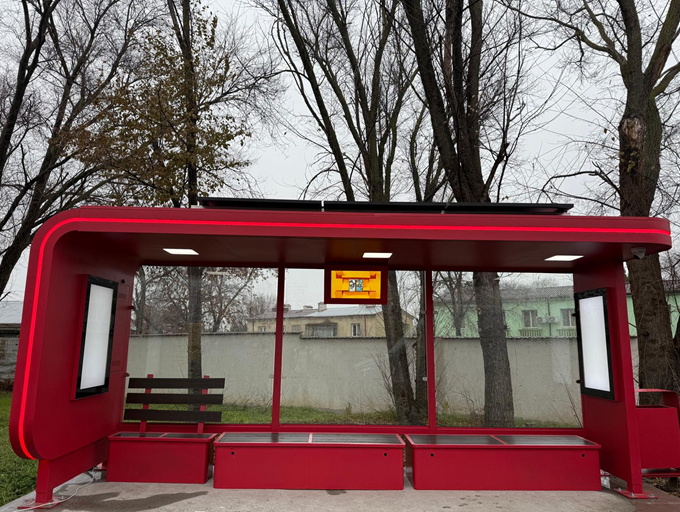
4. How much sunlight does a solar bus shelter need?
Solar shelters work well anywhere with roughly 1,500 sunshine hours per year or more. That covers most of the Middle East, Africa, South Asia, Southeast Asia, Latin America, southern Europe, and the southern United States.
PV panels still generate in overcast or indirect light, but output drops to 20–50% of rated capacity. In lower-sunlight climates, the answer is not to abandon solar but to spec larger panels and a bigger battery — which is why a professional supplier should size the system to your latitude, not sell you a one-size-fits-all kit.
5. What happens on cloudy days or at night?
Nothing stops working — that is what the battery is for. A properly sized solar shelter carries 3–5 days of autonomous reserve: the lights stay on all night and through consecutive overcast days. When the battery drops below a safety threshold, the system switches to low-power mode (dimmed lighting, essential functions only) rather than failing completely.
This is a common buyer worry, and it is also the single most important spec to verify: ask the supplier for the shelter's autonomy rating in days, not just the panel wattage.
6. Which type costs less to maintain?
Grid shelters are simpler to maintain; solar shelters have one bigger periodic cost. Solar systems require: battery replacement every 5–8 years (the main cost item), occasional PV panel cleaning, and controller checks. Grid shelters have no battery, but they depend on a utility connection that can suffer outages, and the shelter is unusable when the grid is down.
For remote or disaster-prone areas, solar's independence from the grid is itself a maintenance and resilience advantage: a solar stop keeps working when the power network fails.
7. Solar vs grid: decision table
| Factor | Solar-powered | Grid-powered |
|---|
| Upfront cost | 30–40% higher | Lower |
| Running cost | Near-zero electricity bills | Ongoing electricity + connection fees |
| Installation | No trenching, no cabling, no utility permit | Requires grid access; location limited by the network |
| Reliability | Depends on sunlight + battery; 3–5 days autonomy typical | Stable while grid is up; fails during outages |
| Maintenance | Battery replacement every 5–8 years; panel cleaning | No battery; grid-dependent |
| Payback | 5–8 years in sunny regions, then free to run | No payback concept; perpetual cost |
| Best for | Sunny, remote, new developments, resilience-focused projects | Dense downtown areas with existing grid and high power loads |
8. When should a city choose solar (and when not)?
Choose solar when: the site has no convenient grid connection (this is common — trenching can cost more than the premium itself); the region is sunny; the project budget allows a longer payback; or grid resilience is a priority. Choose grid when: a connection already exists at the site, power demand is high (large digital advertising screens), or the municipality wants the lowest possible first cost on a short-term project.
Many cities do a hybrid: solar-powered standard stops, grid-powered flagship stops with large media screens. This balances budget, reliability, and public perception.
9. FAQ
Can a solar bus shelter work at night?Yes. The battery stores daytime energy and powers lighting and displays through the night. Verify the autonomy rating (typically 3–5 days) before buying.
How long do solar shelter batteries last?Lithium batteries in transit applications typically last 5–8 years before replacement. Ask the supplier for the battery brand, cycle life, and replacement cost in the quote.
What happens during a long rainy season?A correctly sized system handles it: panels still produce in low light, and the battery reserve covers consecutive overcast days. If your site has an extreme season, the system is simply sized larger.
Is the 30–40% premium worth it?For assets kept 15+ years in sunny regions, yes — the payback is 5–8 years, after which the shelter is free to run. For short-term or low-sunlight projects, grid power is more economical.
Can solar power LED advertising screens?Yes, with limits. Small digital displays are feasible with larger panels and batteries. Large media screens consume far more power and usually need grid supply — which is why hybrid designs exist.
Do solar shelters work in cold climates?Yes. PV output depends on light, not heat, and modern batteries include cold-weather management. Solar is viable in northern climates, but payback lengthens with fewer sunshine hours.
10. How to get a reliable quote
Ask any manufacturer these five questions before comparing prices:
(1) What is the autonomy rating in days?
(2) What battery brand, capacity, and cycle life?
(3) What happens below the safety threshold — dimming or shutdown?
(4) Is the sizing customized to my latitude and load, or a fixed kit?
(5) What is the warranty and battery replacement cost?
A supplier that answers all five with numbers — not adjectives — is the one worth paying the premium to.
YEROO — Bus Shelter Manufacturer Since 2000
26 years of transit manufacturing · 31,000㎡ factory · exported to 111 countries · OEM/ODM · ISO 9001 certified
We size solar systems to your city's sunlight, load, and budget — not from a fixed kit. Get a data-based quotation at www.yeroo.com










 Address:North Tower 904,New World Times Center,Guangyuan Dong Road ,Guangzhou,China
 Phone: +86 13826225776
 Email:yeroo10@3dyeroo.com


