Why buy from China — and where it goes wrong
China supplies the majority of the world's bus shelters, shipping to transit agencies, city governments, and advertising operators across more than 100 countries. The cost advantage is real: comparable shelters typically cost 30–50% less than European or US manufacturing. But the failures are also real — unverified "factories" that ship undersized aluminum, shelters that fail in high wind, and contracts with no defined lead time.
The difference between a good experience and a bad one is not luck. It is verification. Everything in this guide is a check you can run before you pay a deposit.
What certifications should an export bus shelter manufacturer hold?
At minimum: ISO 9001 (quality management) and, for European buyers, CE marking where applicable. Treat any certificate you cannot verify online as nonexistent.
ISO 9001:2015 — quality management system. Verify the certificate number with the issuing body (SGS, TÜV, BSI, etc.) and confirm the scope covers "design and manufacture of bus shelters" — some certificates exist but cover unrelated products.
CE marking — required for certain structural and electrical aspects when selling into the EU. Ask which directives apply to your product (e.g., Machinery Directive, Low Voltage Directive for LED systems).
Wind-load / structural test reports — ask for the actual engineering calculation, not a brochure claim.
How to verify: ask for the certificate PDF, note the number and issuer, then check the issuer's online registry. A legitimate factory hands this over in one email. A factory that stalls is stalling for a reason.
What does a real factory audit look like?
The minimum acceptable proof is a live video call inside the production hall, plus current photos — not the gallery on their website. For larger orders, budget for an in-person or third-party inspection.
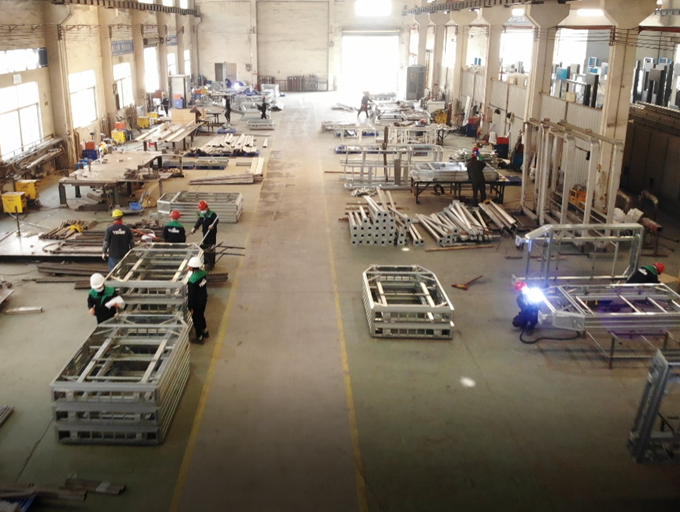
Factory scale and layout — floor area, number of production lines, and whether cutting, welding, painting, and assembly happen in one plant.
Equipment — CNC cutting, bending machines, welding robots, spray-painting booths. Ask the age and brand of key machines.
Real stock and work-in-progress — are there actual shelters being fabricated, or is this a trading office with rented photos?
Quality control station — is there a QC inspection point on the line? Who does incoming material inspection?
Export records — ask for sample Bills of Lading or customs declarations (names redacted if needed) to confirm they truly export.
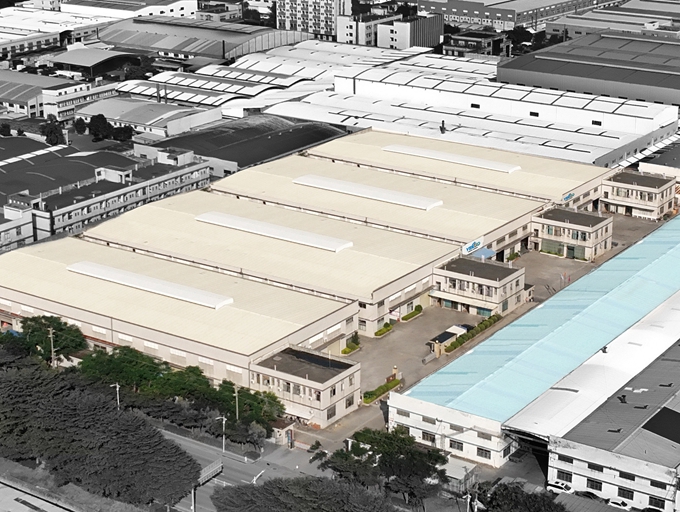
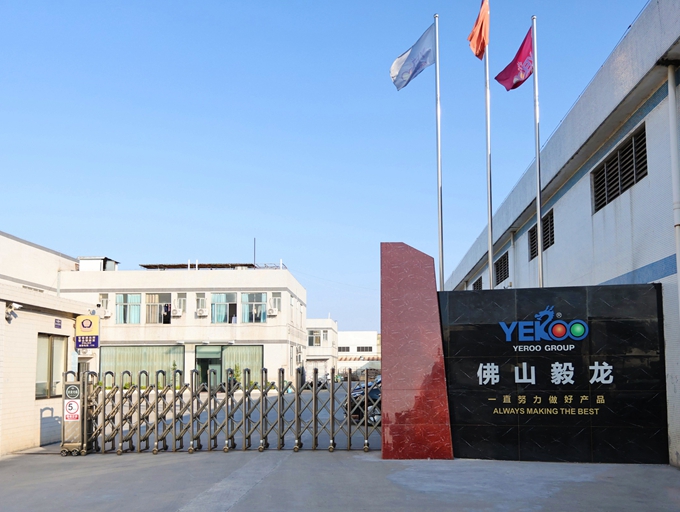
A verifiable reference point: YEROO operates a 31,000㎡ single-site plant with fabrication through painting done in-house, and has shipped to 111 countries since 2000. Whatever number a supplier quotes, ask to see the plant — not the website.
How do you verify wind-load safety?
Wind-load is the number-one engineering risk in bus shelters. The two standards buyers most often cite are EN 1991-1-4 (Europe) and ASCE 7 (US). Your supplier should produce a structural calculation for your site's wind zone — not a generic "we meet international standards" sentence.
What wind speed, or wind zone, is this shelter designed for?
Can you share the structural calculation or a third-party test report?
What glass and aluminum thicknesses are used, and what are the glazing fixings rated for?
What is the maximum column span without additional support?
Ask for the design to be adjusted to your local wind zone before production. This is routine for OEM suppliers; a capable factory treats it as standard engineering, not a special request.
How to compare quotes: use one table
The most reliable way to compare suppliers is a single table with the same five columns, filled from audit answers — not from the sales pitch.
| Check item | Question to ask | Pass threshold | Danger sign |
|---|
| Certification | "Please share the certificate number and issuer" | Verifiable online; scope covers bus shelters | "We have all certs" — but no number |
| Factory | "Show me a live video of your production line today" | Willing to do a live walk-through | Trading company; stock photos only |
| Wind load | "What wind zone is your standard design rated for?" | Calculation or test report provided | "We meet international standards" only |
| Lead time | "What is the confirmed lead time for my quantity?" | Written, with penalty clause | "Depends" — verbal only |
| References | "Which countries have you shipped to this year?" | B/L or customs evidence | No recent export proof |
A useful benchmark: a manufacturer with 20+ years of continuous operation has survived multiple market cycles — an indicator of production consistency that no marketing page can fake.
Solar or grid-powered: which should you choose?
If your site has reliable mains power and low electricity cost, a standard grid-powered shelter with LED lighting is the simplest and cheapest to maintain. Choose solar when the site has no nearby power connection, connection fees are high, or your city has a green-transport mandate.
Ask for a solar sizing calculation — panel wattage, battery capacity, and autonomy days for your region's worst month — not a "solar-ready" label. And confirm whether the shelter supports add-on smart features (real-time arrival displays, USB charging, advertising screens) before finalizing the design. Retrofitting after delivery is far more expensive.
What is a realistic lead time and shipping plan?
For a standard shelter, production typically runs 25–45 days after design approval; for custom designs with new tooling, allow 45–70 days. Sea freight adds 20–40 days depending on route. Get three numbers in writing: production lead time, port of loading, and Incoterms (FOB / CIF / EXW).
Also confirm in the contract:
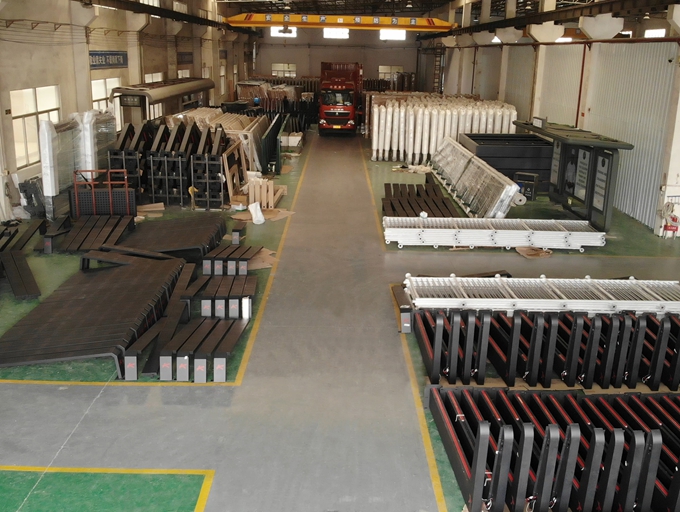
Packing standard — shelters usually ship in steel-framed or wooden crates; ask for the packing method and photo evidence.
Spare parts — how many fasteners, gaskets, and spare LED modules are included.
Payment terms — common export terms are 30% deposit + 70% before shipment, or L/C. Beware of anyone demanding 100% in advance.
Installation support — foundation drawings, installation drawings, and video guidance should be included.
Frequently asked questions
What is the minimum order quantity (MOQ) for custom bus shelters?
For standard models, MOQ is often 1–5 units. For fully custom designs with new molds or tooling, MOQ typically rises to 20–50 units, and tooling costs are sometimes amortized into the unit price. Ask for the MOQ by model, not a blanket number.
Can you manufacture to our own design (OEM) or develop products with us (ODM)?
Reputable factories do both. YEROO, for instance, supports OEM (build to your drawings) and ODM (we design based on your requirements) for bus shelters, smart bus stops, and LCD/LED display units. Confirm who owns the tooling and drawings in the contract.
How are bus shelters packed for export?
Standard practice is steel-frame or wooden crates with waterproof wrapping; glass panels are packed separately with edge protection. Ask for packing photos and a packing list before shipment, and confirm the crates suit your unloading equipment.
Do you provide installation guidance and foundation drawings?
Yes — exporters normally provide foundation and installation drawings plus video or on-site guidance for larger orders. Make it a written deliverable, not a verbal promise.
What payment terms are common for first-time importers?
Typical terms are 30% T/T deposit with 70% against the copy of the Bill of Lading, or a confirmed L/C at sight. For first orders, some buyers use a third-party inspection before releasing the balance. Avoid suppliers demanding 100% upfront.
How long does shipping from China take?
To Europe, 25–35 days by sea; to the Middle East, 15–25 days; to the US West Coast, 15–25 days; to Southeast Asia, 5–10 days. Add customs clearance time on your side. Air freight is possible for small quantities at significantly higher cost.
Buying from China is a good decision when the supplier is verified. Run the four checks — certifications, factory audit, wind-load engineering, confirmed lead time — compare suppliers in one table, and put everything in writing.










 Address:North Tower 904,New World Times Center,Guangyuan Dong Road ,Guangzhou,China
 Phone: +86 13826225776
 Email:yeroo10@3dyeroo.com


