A bus shelter specification document can run to thirty pages, yet still miss the details that determine whether a unit survives five winters or fifteen. Procurement officers, city planners and transit authorities routinely evaluate multiple bus shelter manufacturers against tight budgets, accessibility rules and long service-life targets. Without a standardised checklist, comparison shopping becomes an exercise in translating jargon rather than judging value.
This guide gives you a practical bus shelter specifications checklist built on 25 years of OEM/ODM manufacturing experience at YEROO. You will learn which structural, material, safety, environmental and smart-system details belong in every tender, how to spot under-specified quotes, and how to align your purchase with international standards. Whether you are refreshing a municipal fleet or specifying shelters for a new BRT corridor, the framework below will help you procure transit infrastructure that performs for decades.
Structural Load and Wind Rating: The Foundation of Shelter Safety
Every bus shelter specification must start with structural performance. A shelter that looks elegant in a showroom can fail in the field if its frame has not been engineered for local wind loads, snow accumulation and accidental impact. Procurement officers should request certified calculations for the specific installation region rather than accepting a generic "wind resistant" claim.
Key structural parameters include:
At YEROO, each shelter design is reviewed against the destination country's wind and load codes before production. Our engineering team supplies stamped structural drawings and welding procedure specifications for projects in Europe, Australia, Southeast Asia and the Middle East. Procurement teams can compare these documents directly against the checklist to ensure no critical load case has been overlooked.
Materials and Finishes: Specifying Durability by Environment
The second section of your bus shelter specifications should define materials by exposure class. A coastal city in Queensland faces salt spray, ultraviolet radiation and cyclone debris; an inland Nordic city battles freeze-thaw cycles and road salt. The same shelter design may not suit both without material adjustments.
Frame materials:
Aluminium: Lighter weight and naturally corrosion resistant, making it attractive for transportable or coastal installations. Check that alloy grade and wall thickness are stated (e.g., 6063-T5 extrusion, ≥2.5 mm wall).
Roof and cladding finishes:
YEROO's 31,000 sqm factory runs in-house cutting, bending, welding, galvanising partnerships, powder coating and assembly lines. This vertical integration lets us trace every steel batch to its mill certificate and adjust coating specifications to the destination climate.
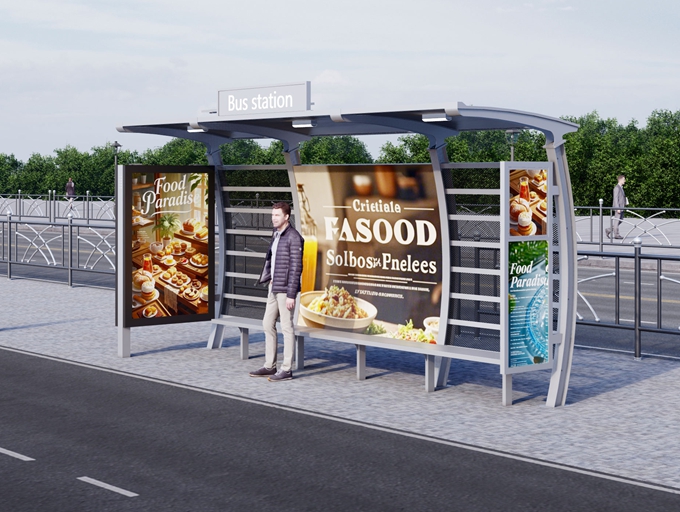
Glazing, Lighting and Accessibility: Public Safety and Inclusivity
Modern bus shelter specifications must treat glazing not merely as a weather shield but as a safety-critical component. The wrong glass can turn a minor vandalism incident into a public liability. Equally, lighting and access design determine whether elderly passengers, wheelchair users and parents with prams can use the shelter safely after dark.
Glazing requirements:
Lighting:
Accessibility:
Specifying these details up front prevents costly retrofits and demonstrates that your procurement process places passenger welfare first. YEROO's design team reviews accessibility requirements during the concept stage and produces 3D visualisations for client approval before manufacturing begins.
Smart Systems and DOOH Integration: Future-Proofing Your Shelter
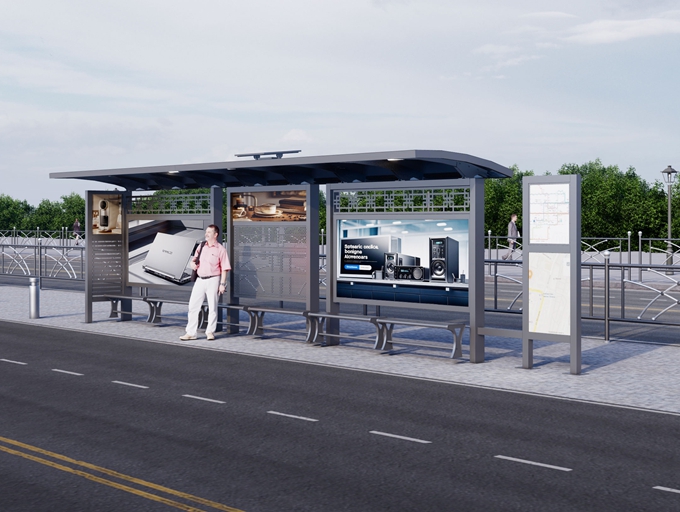
A bus shelter is no longer just a roof and a bench. Smart city programmes increasingly require real-time passenger information, environmental sensors, Wi-Fi, CCTV and digital advertising screens. Your bus shelter specifications should separate essential connectivity from optional media features so budgets can be scaled by phase.
System | Typical Specification | Procurement Note |
Real-time transit display | High-brightness LCD or e-paper, ≥700 cd/m², IP65, 4G/LTE modem | Specify API compatibility with local GTFS-RT or SIRI feeds |
Passenger Wi-Fi | Dual-band 802.11ac, WPA3, remote management | Clarify data cap and backhaul responsibility |
USB charging | 5 V/2.1 A outlets, surge protection | Useful for high-footfall urban stops |
Environmental sensors | PM2.5, NO₂, temperature, humidity | Align with open-data protocols where required |
CCTV | IP dome camera, IR night vision, 30-day edge storage | Address GDPR or local privacy compliance |
DOOH screen | 55–75 inch high-brightness display, brightness sensor | Confirm CMS platform and remote update capability |
When procuring smart transit infrastructure, always ask the manufacturer about power redundancy, remote diagnostics and Mean Time Between Failures (MTBF) data. YEROO supplies smart bus shelters with integrated electrical distribution boards, surge protection and cable management designed for 10-year service intervals. We also offer solar-powered bus shelter options that reduce grid connection costs in remote or green-field locations.
Warranty, Maintenance and Total Cost of Ownership
The final section of your bus shelter specifications should convert purchase price into lifecycle cost. A 10 per cent cheaper shelter that needs repainting every three years and glass replacement every two years will cost more over fifteen years than a higher-specification unit.
Request the following commercial details in writing:
Spare parts availability: Commitment to stock critical components (glass panels, light fittings, locks, door closers) for a defined period, usually 10 years.
A transparent maintenance plan also simplifies budget forecasting for transit authorities managing hundreds of units. YEROO's project engineers provide installation manuals, commissioning checklists and after-sales support for deployments across 110 countries. For larger programmes, we recommend reviewing our bus shelter cost breakdown to align capex and opex assumptions.
Frequently Asked Questions
What should a bus shelter specifications document include?
A complete bus shelter specifications document covers structural loads and wind ratings, frame and finish materials, glazing and lighting standards, accessibility compliance, smart-system interfaces, warranty terms and maintenance schedules. It should reference the applicable national codes for each installation region.
How do I compare quotes from different bus shelter manufacturers?
Convert every quote to the same specification baseline. Check wind-load calculations, material grades, coating standards, glass certifications and warranty periods. Avoid selecting purely on unit price; instead, calculate a 15-year total cost of ownership including maintenance and replacement parts.
Which wind standard applies to bus shelters?
The correct standard depends on the project location. European tenders typically use EN 1991-1-4, Australian projects use AS/NZS 1170.2, and North American projects reference ASCE 7 or local municipal amendments. Always request site-specific calculations rather than generic ratings.
Is powder coating or PVDF better for bus shelters?
Powder coating is cost-effective and suitable for most urban environments. PVDF offers superior UV and chalking resistance for tropical, desert or high-altitude locations. Coastal or industrial sites may benefit from duplex systems combining hot-dip galvanising with a high-performance organic coating.
What accessibility features must a bus shelter have?
Essential accessibility features include wheelchair turning space, tactile guidance strips, contrast seating, appropriate bench height and clear sightlines to approaching vehicles. Requirements vary by country; common references are ADA, BS 8300 and AS 1428.
Can smart bus shelters be retrofitted with advertising screens later?
Yes, if the initial electrical and structural specification includes spare capacity. Specify additional conduit paths, mounting points and load allowances during procurement. Retrofitting without prior provision is usually far more expensive than designing it in from the start.
Ready to Specify Your Next Bus Shelter Project?
Procuring bus shelter infrastructure is easier when your specification checklist covers structure, materials, safety, accessibility, smart technology and lifecycle cost from day one. The details above give procurement officers and transit planners a defensible framework for evaluating any bus shelter manufacturer.
YEROO has spent 25 years manufacturing OEM and ODM transit shelters for cities, contractors and media operators in more than 110 countries. Our 31,000 sqm facility in Foshan produces everything from classic steel shelters to fully integrated smart bus shelters with real-time displays and DOOH advertising screens. If you need project-specific specifications, 3D designs or a detailed quotation, contact our team or explore our bus shelter product range today.










 Address:North Tower 904,New World Times Center,Guangyuan Dong Road ,Guangzhou,China
 Phone: +86 13826225776
 Email:yeroo10@3dyeroo.com


