For media owners and transit authorities, a static bus shelter is a sunk cost — built once and then forgotten by everyone except the maintenance crew. A digital bus shelter is the opposite: every minute the screen is lit it is generating impressions, audience data, and, with the right commercial structure, advertising income. Global Digital Out-of-Home (DOOH) spend reached USD 14.9 billion in 2024 and is forecast to grow at roughly 9 % per year through 2030, with transit real estate consistently cited as the fastest-growing inventory category alongside airports and roadside digital billboards.
This guide is written for two audiences that increasingly sit on the same side of the procurement table: transit authorities and city planners evaluating the public-service upside of digital shelters, and outdoor media operators sizing the investment case. Drawing on YEROO's 25 years of OEM/ODM shelter manufacturing and deployments in 110+ countries, it walks through the hardware, the revenue mechanics, the realistic payback range, and the operational pitfalls that decide whether a digital network becomes a long-term revenue line or an expensive lesson.
Why Digital Bus Shelter Screens Are the Fastest-Growing DOOH Format
Three structural shifts have pushed digital bus shelters to the top of the DOOH priority list.
Catchment you cannot buy elsewhere. A roadside billboard competes with thousands of others; a bus shelter holds the only seated audience on a kerb for 200–500 metres. Average daily dwell time at a busy urban stop is 6–11 minutes — long enough for a 15-second spot to register and a 30-second spot to land. According to the Out of Home Advertising Association of America (OAAA), DOOH delivers a 62 % recall rate versus 45 % for online display in transit-adjacent contexts.
Programmatic trading has lifted CPMs. Before 2020, most transit DOOH was sold as static 14-day packages. Today, programmatic DOOH (pDOOH) lets media owners push day-parted, weather-triggered, or audience-segmented creatives at premium CPMs. The IAB Europe's 2024 DOOH Outlook reports that programmatic now accounts for over 40 % of DOOH revenue in Western Europe, and shelter networks are the inventory category most rapidly onboarded onto exchanges such as VIOOH, Place Exchange and Hivestack.
Hardware economics have crossed the line. A 10-year-old LCD shelter cost USD 18,000–25,000 in installed hardware. A modern high-bright LCD or fine-pitch LED shelter from a Chinese supplier such as YEROO lands at USD 7,500–13,000 FOB with brightness ratings of 2,500–3,500 nits, IP65 enclosures, and 5-year panel warranties. The break-even revenue threshold for a single screen has dropped by roughly half since 2018.
For procurement officers, the implication is straightforward: the question is no longer whether to digitise, but which stops, what spec, and under what commercial model.
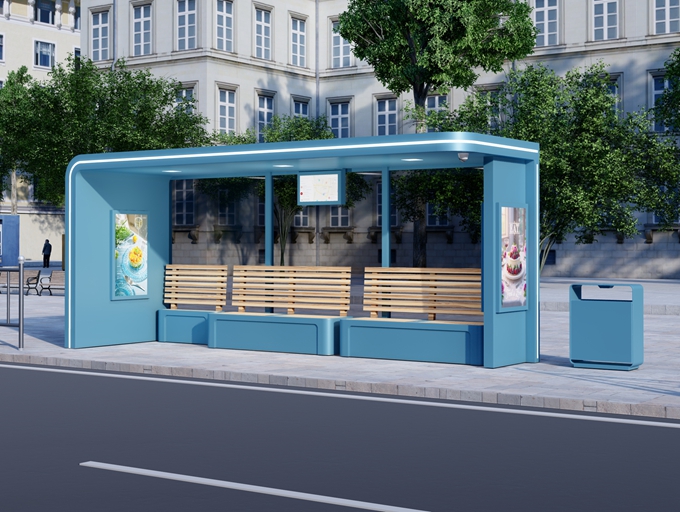
Anaomy of a Revenue-Generating Digital Bus Shelter
A digital screen bolted to a steel shelter is not a revenue asset on its own. The revenue-generating unit is a stack of six engineering decisions.
Display technology. Three options dominate: high-bright LCD (cheapest, good for shaded stops, 2,500–3,000 nits), fine-pitch LED (best sunlight readability, lowest maintenance, premium price), and e-paper (ultra-low power, monochrome, suited to timetable-only pilots). YEROO's smart bus shelter range ships in all three variants; spec selection is driven by solar exposure and ambient brightness, not aesthetics alone.
Brightness and ambient light control. A screen rated below 2,000 nits becomes unreadable in direct sun and loses its commercial value between 10:00 and 16:00 in summer — exactly the window advertisers pay premium rates for. Specify 2,500+ nits for partial shade and 3,500+ nits for fully exposed orientations, plus an ambient light sensor that automatically dims the panel at night to comply with dark-sky ordinances.
Connectivity. 4G LTE is the minimum; 5G is increasingly standard in greenfield networks. The screen needs always-on uplink for content management, audience measurement, and remote diagnostics. Hard-wired fibre is preferable in BRT corridors but rarely available at ordinary kerbside stops.
Media player and CMS. The screen is only as valuable as the content management system behind it. Look for an open-API CMS that integrates with major DSPs (VIOOH, Place Exchange, Hivestack, Vistar) and supports day-parting, weather triggers, and proof-of-play logging. Closed proprietary CMSes lock operators into single sales pipelines and depress CPMs.
Power architecture. Grid-tied shelters are cheaper to build but expose the network to power outages and rising tariffs. Solar-hybrid shelters — a 200–400 W PV array with a 1–2 kWh lithium battery — keep the screen live during grid outages and cut lifetime electricity costs by 60–80 % in high-insolation markets such as the Middle East, Australia, and Southern Europe. YEROO's solar bus shelter line pairs both product families for hybrid deployments.
Structural and vandal resistance. A digital shelter that is offline for 30 days while a screen is replaced loses USD 1,500–4,000 in spot revenue. Specify IK10-rated glazing, anti-graffiti film, secure rear-access panels, and a screen module that can be swapped by a two-person crew in under 90 minutes.
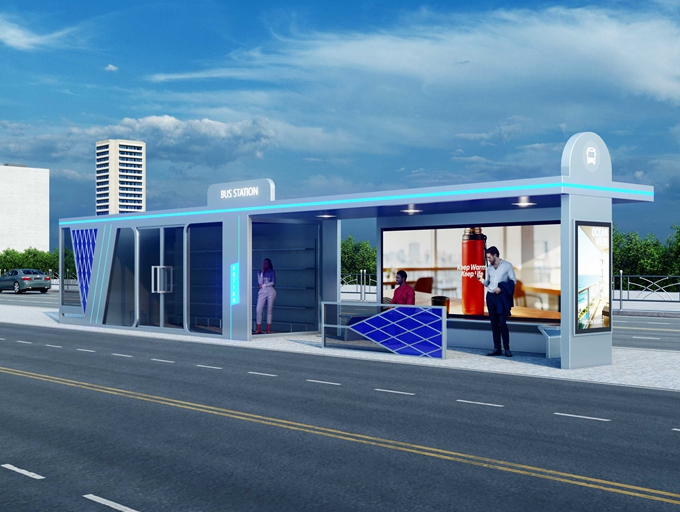
Revenue Models: How Operators Monetise Screens
There is no single right answer. The table below maps the four commercial models most commonly deployed against the operator type, the revenue risk profile, and the typical CPM range.
Revenue model | Best fit for | Capital structure | Typical CPM (USD) | Revenue risk |
Direct sales (long-term contracts) | City-owned operators, municipal media arms | Operator owns hardware; sells 12–36 month packages | USD 12–28 per 1,000 impressions | Low (contracted); high (renewal cliff) |
Programmatic (pDOOH) | Private operators with 50+ screens in one market | Operator owns hardware; uses DSP integration | USD 4–14 per 1,000 impressions | Medium (volatile; weather/day-part dependent) |
Concession / revenue share | Transit authorities that own the kerbside rights | Third party finances hardware; shares ad revenue with authority | USD 0.50–2.00 per spot, 30–60 % revenue share to authority | Low to authority (no capex); medium to operator |
Hybrid (anchor + programmatic) | Mature networks (100+ screens) | Operator owns hardware; mixes direct + programmatic | USD 8–22 blended per 1,000 impressions | Lowest (diversified buyer base) |
A useful rule of thumb from operators running 100+ screen networks: each fully-utilised digital screen generates USD 1,800–4,500 net ad revenue per year, depending on market, occupancy, and sales mix. The wide range reflects how much daylight there is between a 60 %-sold and a 95 %-sold network.
For a more granular view of how smart-shelter features — RTPI displays, USB charging, environmental sensors — stack against route profile and footfall, our smart bus shelter buyer's guide provides the matrix procurement teams use during spec workshops.
Cost, ROI and the Operator's Business Case
The investment case for a 50-screen urban network in a Tier-1 European or Australian market typically works as follows, assuming a mix of grid-tied and solar-hybrid shelters and a blended direct-plus-programmatic sales model.
Line item | Typical range (USD per screen, installed) |
Hardware (LCD or fine-pitch LED, IP65) | 7,500–13,000 |
CMS + connectivity hardware | 1,200–2,800 |
Civil works (foundation, power, comms) | 3,000–6,500 |
CMS licence (year 1) | 600–1,400 |
Installation and commissioning | 1,500–3,000 |
Total capex per screen | 13,800–26,700 |
Annual opex (power, connectivity, maintenance, CMS) | 900–2,000 |
Annual gross ad revenue (year 3, 90 % sell-through) | 5,400–13,500 |
Net annual ad revenue (year 3, after 30 % sales/ops cost) | 3,800–9,500 |
At these assumptions, payback on capex lands between 2.5 and 5 years on a like-for-like basis, before factoring carbon credits, government smart-city grants, or the public-service value of real-time transit information. YEROO's 25-year manufacturing footprint allows operators to compress hardware cost by 15–25 % versus Western OEM list prices, which shortens payback by 6–12 months on a 50-screen build.
To see how these shelters perform on real corridors, the project portfolio catalogues deployments from BRT corridors in Southeast Asia to advertising-funded networks in Eastern Europe.
Siting, Permits and Operational Best Practice
Hardware is the visible cost; the invisible cost is siting and permitting. Five operational points consistently determine whether a digital shelter network scales or stalls.
1. Kerbside rights and revenue share. In most markets, the kerbside belongs to the local authority. Negotiate a 10–15 year concession with a clear revenue-share formula (typically 30–60 % to the authority) and a contractual path to expand the network.
2. Planning consent for brightness. Many European municipalities cap night-time brightness at 80–100 cd/m² near residential buildings, and several Australian councils enforce curfew hours (commonly 23:00–05:00). Build the dimming schedule into the CMS before deployment, not after.
3. Content and ad standards. Most regulators require a minimum 20 % public-service content share (RTPI, weather, emergency alerts). Reserve a portion of the loop for safety messaging; it also tends to increase audience dwell time and ad effectiveness.
4. Maintenance response time. Negotiate a 48-hour on-site repair commitment with your manufacturer and stock two spare screen modules per 25 deployed units. The cost of a single screen offline for a month exceeds the cost of carrying spares for the entire network.
5. Measurement and proof of play. Buyers increasingly require independent audience measurement (e.g. Geopath in the US, Route in the UK). Build the analytics integration into the CMS from day one; retrofitting later costs more and weakens the data story.
YEROO's OEM/ODM service covers the full chain — structural engineering, display integration, CMS selection support, and post-installation spares — with manufacturing capacity at our 31,000 sqm ISO-certified facility in Foshan and an installed base spanning more than 110 countries.
Conclusion
A digital bus shelter is the rare transit asset that earns money while it serves the public. For media operators, the commercial case is increasingly favourable: hardware costs have halved, programmatic channels have opened, and DOOH spend continues to outpace most other media categories. For transit authorities, the same asset unlocks real-time passenger information and smart-city data capture at zero — or even negative — net cost, when structured as a revenue-share concession.
If you are scoping a tender, evaluating a vendor shortlist, or pricing a concession response, request a YEROO specifications pack covering LCD, LED, and e-paper screen variants, hybrid solar power options, and CMS integration reference designs. For municipal and BRT use cases that combine revenue generation with passenger information, our smart transit shelter solution consolidates the engineering, commercial, and deployment guidance into a single procurement package.
Frequently Asked Questions
How much revenue does a single digital bus shelter screen generate per year?A fully-utilised screen in a Tier-1 market typically generates USD 1,800–4,500 in net ad revenue annually, depending on occupancy rate, sales mix (direct versus programmatic), and audience measurement standards. Mature networks of 100+ screens reach the upper end of this range through blended sales models.
What is the typical payback period for a digital bus shelter network?On a 50-screen urban network with a blended sales model, payback on capex lands between 2.5 and 5 years before grants or carbon credits. Solar-hybrid power architecture and OEM-direct hardware sourcing can compress payback by 6–12 months.
LCD or LED — which is better for a digital bus shelter?LCD is cheaper and adequate for shaded stops at 2,500–3,000 nits. Fine-pitch LED is preferable in fully sun-exposed locations and has lower long-term maintenance because there is no backlight to replace. E-paper suits timetable-only pilots and is the only realistic option where grid power is unavailable.
Do digital bus shelters need planning permission for brightness?Yes, in most jurisdictions. Many European councils cap night-time brightness at 80–100 cd/m² near residential areas, and several enforce curfew hours. Australian and Canadian municipalities apply similar rules. Specify an ambient-light sensor and CMS-driven dimming schedule to stay compliant from day one.
Can digital bus shelters run fully off-grid?Yes, with a 200–400 W PV array and a 1–2 kWh lithium battery. Solar-hybrid shelters are standard in high-insolation markets such as the Middle East, Australia, and Southern Europe, and cut lifetime electricity costs by 60–80 % versus pure grid-tied installations.
What CMS should a digital bus shelter use?An open-API CMS that integrates with major DSPs (VIOOH, Place Exchange, Hivestack, Vistar) and supports day-parting, weather triggers, and proof-of-play logging. Closed proprietary systems restrict the buyer base and depress CPMs.










 Address:North Tower 904,New World Times Center,Guangyuan Dong Road ,Guangzhou,China
 Phone: +86 13826225776
 Email:yeroo10@3dyeroo.com


