Modern transit networks are no longer judged simply on whether a bus arrives on time — they are judged on the entire passenger experience, from the moment a traveller steps onto the platform to the moment they board. The bus stop has become the first and last touchpoint of that journey, and the smart bus shelter features integrated into it directly influence passenger satisfaction, route efficiency, and even municipal operating costs.
City planners, transit authorities, and outdoor media operators are increasingly specifying intelligent shelters as standard infrastructure rather than optional upgrades. The challenge is knowing which features genuinely move the needle and which ones are expensive extras that rarely justify their capital cost. This guide breaks down the smart bus shelter features that have measurable ROI, the engineering trade-offs behind each one, and how to assemble a specification that matches the climate, ridership, and budget of your route.
Real-Time Passenger Information Displays
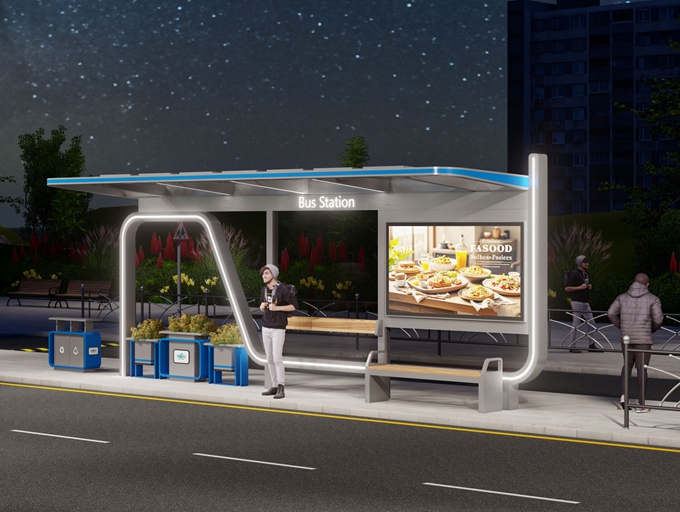
Real-time passenger information (RTPI) is the most frequently requested smart bus shelter feature, and for good reason — it directly improves the metric transit authorities care about most: perceived wait time. Even when actual service frequency is unchanged, showing passengers the next arrival in minutes reduces subjective wait time by an average of 20–30%, according to research published by Transport for London and replicated in studies from Brisbane's TransLink and Auckland Transport.
Display Technology Options
There are three dominant display technologies deployed in modern shelters, each with distinct cost, readability, and energy profiles. The right choice depends on route passenger volumes, ambient light conditions, and the available power budget.
Display Type | Brightness | Operating Temp | Typical Lifespan | Best Use Case |
LED Dot-Matrix (single colour) | High, sunlight-readable | -40°C to +75°C | 100,000+ hours | High-glare environments, budget routes |
LCD/TFT (32"–43") | Medium, requires shade housing | -20°C to +60°C | 50,000–70,000 hours | Medium-ridership urban corridors |
E-Paper (bi-stable) | Soft ambient light only | -10°C to +50°C | 5+ years static image | Solar-powered off-grid shelters |
For temperate climates with mixed lighting, YEROO's most common specification pairs a 32" high-brightness TFT panel (1,500-nit) with an automatic ambient light sensor that dims the display at night to reduce power draw from 60W to 18W. In equatorial deployment zones, full-sun-readable LED matrix panels remain the workhorse — their ability to remain legible at midday in direct sunlight makes them the only viable choice for unsheltered side panels.
Data Integration Layer
The display itself is only the visible layer. Behind every smart shelter sits a data integration stack pulling arrival predictions from the transit authority's AVL (Automatic Vehicle Location) feed — typically via GTFS-realtime or SIRI protocols. YEROO shelters are shipped with multi-protocol controllers that ingest GTFS-RT, SIRI, and proprietary operator APIs without requiring additional middleware. For agencies that do not yet operate a real-time feed, the shelter can run on a fixed-schedule fallback for the first 12 months, then upgrade to live data once the backend is ready.
USB Charging and Power Delivery Ports
USB charging is the second-most-requested passenger amenity, and the data supports the demand: a 2024 survey by the UK Department for Transport found that 64% of public transport passengers had experienced "range anxiety" about their phone battery during a journey. The willingness among operators to address this anxiety is high, but the specification must be careful — poorly specified USB ports become a maintenance liability within a year.
What to Specify
Type-C PD (Power Delivery) ports: At minimum, dual 18W Type-C PD ports per shelter, capable of charging modern smartphones from 0–50% in roughly 30 minutes. Anything below 15W is now considered obsolete.
YEROO's standard design includes four Type-C PD ports mounted in a brushed stainless-steel column rated to IP65, with replaceable cartridge modules that can be swapped in under five minutes using standard tools.
Public Wi-Fi Hotspot Connectivity
Free public Wi-Fi at bus stops is no longer a luxury amenity — it is increasingly treated as basic infrastructure, particularly in markets where mobile data costs remain high or where social inclusion policies mandate digital access. The UK government has committed to providing free Wi-Fi at all major transport hubs by 2030, and similar schemes are advancing in Australia, Singapore, and parts of the Middle East.
Connectivity Architecture
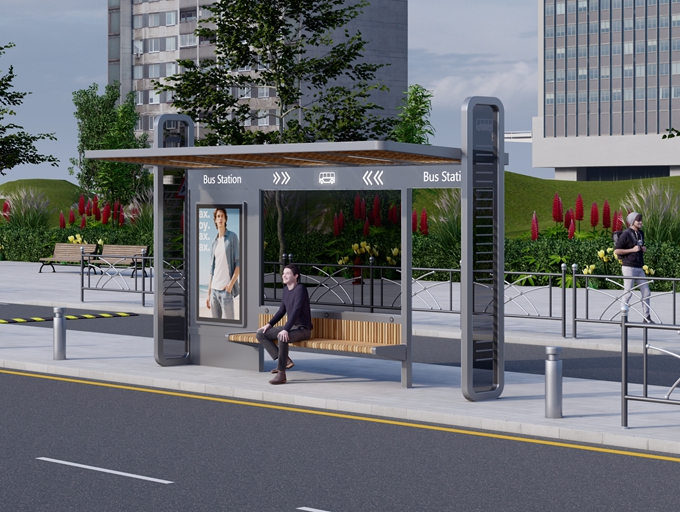
A typical shelter Wi-Fi deployment uses a 4G/5G cellular backhaul with a Wi-Fi 6 access point, supplying up to 200m² of coverage and supporting 50–80 simultaneous users before congestion. YEROO shelters integrate a hardened outdoor-rated 5G modem that accepts nano-SIM or eSIM provisioning, with antenna diversity on the roof structure to maintain signal even under heavy tree canopy.
Three policy decisions need to be confirmed at specification stage:
Bandwidth cap per user: For most municipal deployments, a 5 Mbps per-user cap prevents heavy streaming and ensures equitable distribution. Some media operators prefer uncapped Wi-Fi to maximise dwell time and ad-supported revenue.
Captive portal content: Most operators route the Wi-Fi login screen through a portal that displays route maps, local advertising, or city announcements — a captive audience that transit authorities are increasingly monetising.
Data retention and GDPR compliance: European deployments must include full logging for lawful access requests under the UK's Investigatory Powers Act or the EU's ePrivacy Directive. YEROO's controller firmware supports configurable retention windows from 7 days to 12 months.
Environmental Sensors and IoT Integration
Beyond passenger-facing features, the most underappreciated category of smart bus shelter feature is the environmental sensor pack. These sensors turn the shelter into a node in the city's broader IoT network, generating data that benefits transit operations, public health, and urban planning.
Common Sensor Modules
Sensor | Data Captured | Operational Benefit |
PM2.5/PM10 air quality | Particulate matter (µg/m³) | Open-data compliance for EU Air Quality Directive |
Temperature & humidity | Climate data | Adjust HVAC in adjacent buildings; track heat-island effects |
Noise level (dB) | Ambient sound pressure | Noise complaint evidence; supports night-delivery curfews |
Passenger counting (stereo vision) | Boarding/alighting counts | Validate route demand without expensive APC surveys |
Shelter occupancy | Real-time people count | Bus bunching response; dynamic dispatch decisions |
YEROO's IoT controller exposes all sensor data via MQTT and REST APIs, allowing integration with city open-data platforms such as FIWARE, Sidewalk Labs' Coord, or operator-specific dashboards. For deployment projects where the municipal IoT backhaul already exists, edge computing modules can pre-process data locally and transmit only summary statistics — a critical feature when cellular data costs exceed $0.50/GB.
Selecting the Right Feature Mix for Your Route
There is no universal specification that fits every corridor. A high-density inner-city stop with 15,000 daily boardings needs a different feature stack than a suburban last-mile stop serving 200 passengers a day. The procurement question is fundamentally about matching features to ridership, climate, and operating model.
A Practical Selection Matrix
Route Profile | Recommended Core Features | Estimated CapEx Premium vs Classic Shelter |
Rural/low-ridership (<500/day) | Solar power, LED lighting, basic RTPI | +35% |
Suburban (500–3,000/day) | RTPI, USB charging, sensor pack | +60% |
Urban high-density (3,000+/day) | Full RTPI, USB, Wi-Fi, ePaper/touchscreen, sensors | +95% |
Interchange / BRT terminus | High-brightness TFT + intermodal arrival display + wayfinding | +140% |
The above figures are based on YEROO deployment data across 110+ countries. The premium percentages include all electronic components, integration labour, and 5 years of cellular data — not just hardware. Volume procurement (corridors of 50+ shelters) typically reduces these premiums by 12–18%.
Frequently Asked Questions
What is the typical lifespan of a smart bus shelter?
A well-engineered smart shelter has a 15–20 year structural lifespan for the steel and aluminium frame, while the electronic subsystems (displays, controllers, sensors) typically need refurbishment every 7–10 years. YEROO designs its shelters with field-replaceable electronic cartridges so the full system can be modernised without rebuilding the structure.
How much cellular data does a smart shelter use per month?
A single shelter with RTPI, sensors, and 200 daily Wi-Fi users consumes between 25 GB and 60 GB per month, depending on user behaviour and content filtering. For large fleets, YEROO recommends negotiating pooled data plans with regional operators — typically 30% cheaper than per-shelter SIMs.
Can smart shelters operate entirely off-grid?
Yes. YEROO's solar-powered variants include 900W–1,200W PV arrays with battery storage sized for 3 days of autonomy. They can run RTPI, USB charging, and Wi-Fi simultaneously without grid connection, making them viable for remote corridors or pilot deployments where trenching costs would exceed the shelter budget.
What cybersecurity standards apply to connected shelters?
Connected shelters should comply with IEC 62443 for industrial control system security, including signed firmware updates, encrypted MQTT channels, and role-based access control for maintenance staff. YEROO controllers ship with hardware secure modules (HSMs) and support OTA firmware rollouts with cryptographic verification.
Do smart shelters require ADA or accessibility compliance?
Yes — and the requirement is most often missed on the digital components. Audio announcements for RTPI displays, tactile button legends on USB charging columns, and 1.4m minimum clearance for forward wheelchair approach are common compliance items. YEROO's design team provides region-specific compliance checklists for EU, UK, AU, US, and GCC markets.
How are smart shelters maintained?
Preventive maintenance typically follows a 6-month cycle: cleaning display filters, testing sensor calibration, and verifying cellular signal strength. YEROO offers remote monitoring dashboards that flag anomalies before passengers notice them, reducing truck rolls by up to 40% compared to scheduled-only maintenance models.
Moving from Specification to Deployment
Specifying smart bus shelter features is the easy part — delivering them reliably over a 15-year service life is the engineering challenge that separates credible manufacturers from catalogue assemblers. YEROO's vertically integrated production at our 31,000 sqm Foshan facility means every electronic module, structural column, and glazing panel passes through a single quality system before export, with ISO 9001 and CE certification as standard.
For agencies that already operate a fleet, our smart bus shelter product range can be configured to match existing RTPI backends, civil infrastructure standards, and city brand guidelines. For corridors still in planning, the YEROO engineering team prepares site-specific feasibility assessments covering solar yield, cellular signal, and structural anchoring — typically within 5 working days of receiving site coordinates.
Explore recent deployments in our European smart shelter project portfolio to see how the feature mix above translates into completed routes, or contact our solutions team for a tailored specification for your next corridor.










 Address:North Tower 904,New World Times Center,Guangyuan Dong Road ,Guangzhou,China
 Phone: +86 13826225776
 Email:yeroo10@3dyeroo.com


